Showing posts with label magic literature. Show all posts

Sunday, October 31, 2010

The Persian Mystics Jami

The Persian Mystics Jami Cover

Book: The Persian Mystics Jami by Frederick Hadland Davis

Jami (1414-1492), a scholar and mystic, is considered by many to be one of the greatest Persian poets of the 15th century. This volume, edited by F. Hadland Davis and first published in 1908, contains selections from some of Jami's best-known works. "Salaman and Absal" examines the earthly love ("the love that binds and fetters and is corruptible") of the eponymous star-crossed lovers and contrasts it with "incorruptible" celestial love. The "Lawa'ih" is a treatise on Sufism. "Yusuf and Zulaikha" tells of Zulaikha's unrequited love for Yusuf, and the "Baharistan" is a book of verse and prose written as a series of eight "gardens." A brief biography of Jami and some additional Information on each of the selections are included in this timeless work.

This is a basic Introduction to Jami the Persian Sufi poet. The first part of the book covers his life, a brief biography of Jami. The next chapters cover some of his most famous works the story of Salman and Absal, the Lawa'ih, the story of Yusuf and Zulakha and the Baharistan. The final part of the book are selections from the above 4 books translated.

While this is a nice Little Book it is very brief and covers only the most basic of the life and works of Jami. The author however, has remained faithful to the teachings of Jami and has done a fairly good job in explaining the teachings of Jami to the reader and providing him/her with a fair introduction to further reading.

Download Frederick Hadland Davis's eBook: The Persian Mystics Jami

Downloadable books (free):

Max Heindel - The Rosicrucian Mysteries
Frederick Hadland Davis - The Persian Mystics Jalaluddin Rumi
Frederick Hadland Davis - The Persian Mystics Jami

Monday, October 11, 2010

Crystal Vision Through Crystal Gazing

Crystal Vision Through Crystal Gazing Cover

Book: Crystal Vision Through Crystal Gazing by Frater Achad

1923. Or the Crystal as a Stepping Stone to Clear Vision. A Practical Treatise on the Real Value of Crystal Gazing. Contents: The lesser crystal sphere; The greater crystal sphere; Universal crystalline sphere; A consideration of the ancient methods; Further considerations the methods of Dr. Dee and Sir Edward Kelly; Attainment of Crystal Vision; The ultimate crystal.

Achad writes for two audiences, the exoteric occult dabbler that wants to scry and the esoteric mystic who is gazing more deeply than into an orb of stone. It is a treatise on spiritual growth and finding out who you really are - whether you do it in Meditation With your legs crossed or by staring at a crystal, the results are the same for the student of truth. Fascinating!

I found this book to be more than a guide to crystal gazing. It was a warning for those who do not take things of a spiritual nature seriously. And a guide and tease in that it made you want to go deeper into your own spiritualness, but explained that you would have to search farther as well as develop or evolve into a higher place to receive the answers. This will be required text for my children.

Download Frater Achad's eBook: Crystal Vision Through Crystal Gazing

Downloadable books (free):

Saint Synaptics - Metaclysmia Discordia Or The Chaonomicon
Benjamin Rowe - A Ritual Of The Heptagram
Tom Peete Cross - Witchcraft In North Carolina
Frater Ahyhhgyg - Manipulation Through Astral Correspondences
Frater Achad - Crystal Vision Through Crystal Gazing

Sunday, October 3, 2010

The Book Of Raziel The Angel Or Sefer Raziel Hamalakh

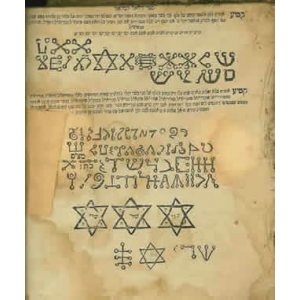
The Book Of Raziel The Angel Or Sefer Raziel Hamalakh Cover

Book: The Book Of Raziel The Angel Or Sefer Raziel Hamalakh by Medieval Grimoires

The Book of Raziel the Angel is a medieval Hebrew Grimoire originally written in Hebrew and Aramaic. We understand that ther is a Latin translation titled Liber Razielis Archangeli, produced under Alfonso X in the 13th century. Like many other mystical manuscripts the Book of Raziel has suffered many from the production of many versions.

The Grimoire contains five Books which cover such secrets as, the mysteries of creation, the production of magical talismans, the angels, the Zodiac, Gematria and the names of God. It draws heavily on the Sepher Yetzirah and Sepher Ha-Razim.

The Book was reputed to have been given to Adam by the Angel Raziel in order to teach Adam the spiritual laws of nature, knowledge of the planets, stars and the spiritual laws of creation. Raziel also taught Adam the knowledge of the power of speech, thought, the Hebrew alphabet and how to co-exist harmously with the physical and spiritual worlds.

The Book is still available today, and a Hebrew version may be obtained from any good Jewish bookshop for it is still believed that the book has power. However, it is forbidden to open the book or read it because of its inherent power. Therefore many keep their copies sealed. Finally, by tradition no charge may be taken for the book!

Download Medieval Grimoires's eBook: The Book Of Raziel The Angel Or Sefer Raziel Hamalakh

Free eBooks (Can Be Downloaded):

Benjamin Rowe - The Book Of The Seniors
Michal Jerabek - The Book Of Enoch Vol V The Epistle Of Enoch
Medieval Grimoires - The Book Of Raziel The Angel Or Sefer Raziel Hamalakh

The Garnerian Book Of Shadows

The Garnerian Book Of Shadows Cover

Book: The Garnerian Book Of Shadows by Gerald Gardner

This is the text of the Gardnerian Book of Shadows. In one sense, this is the central sacred text of the Wicca religion. However, it is important to point out that there is no 'official' Book of Shadows. Typically each coven has a hand-written copy of a Book of Shadows, sometimes in cypher or code, which reflects its own practices and knowledge. This particular text is derived from a file posted on the Internet in the early 90s, and quotes previously published material which was known to be in use by Gardner and his group.

The book of shadows was attributed by Gardner to an ancient, clandestine witch cult, which he claimed to have been initiated into. However, modern researchers have concluded that it was composed by Gardner. The text shows influences from English and Celtic Folk-lore, the Enochian system of John Dee, Thelema, the Golden Dawn, Stregaria, Tantric Yoga, the KJV Bible and even Kipling. This version organizes the material in chronological order and has estimated dates for each section, ranging from 1949 to 1961.

The copyright status of this text can best be described as 'orphaned.' This version was compiled by Aidan A. Kelly. It was originally posted on the Internet in the mid-90s as part of the Internet book of shadows material. Text in square brackets is Kelly's commentary.

Download Gerald Gardner's eBook: The Garnerian Book Of Shadows

Free eBooks (Can Be Downloaded):

Franz Bardon - The Golden Book Of Wisdom
Sasha Fierce - The Book Of Shadows
Sekhet Sophia - The Alexandrian Book Of Shadows
Gerald Gardner - The Garnerian Book Of Shadows

Saturday, October 2, 2010

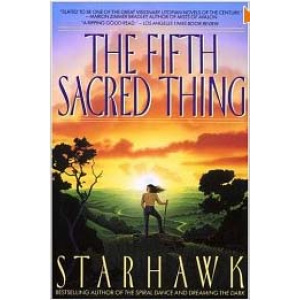
The Fifth Sacred Thing

The Fifth Sacred Thing Cover

Book: The Fifth Sacred Thing by Starhawk

I love this book. I didn't like it at first, but I decided to give it an hour before I made up my mind. Now I am really glad I stuck with it, because it is one of the richest, most thought-provoking books I have ever read.

I had this book on my shelf for several years before I actually read it. Although it obviously sounded good enough at the time I bought it, I feared that it would be preachy and overbearing. It was nothing of the sort. The characters are complex; flawed at times, saintly at others. The story is compelling, combining plots about the personal growth of the various characters, adventure stories as Bird escapes from prison and Madrone ventures into the southern wilds to help the freedom fighters, and the ultimate show down between the San Franciscans and the Stewards. It is a bit simplistic, perhaps, but that didn't stop me from wishing things in reality were more like they are in Maya and Madrone's world. The attempts to portray this world as one free of any racial or sexual bigotry do get a bit heavy handed at times, but never so much that it interfered with my enjoyment of the story. I would recommend this book to anyone, and in fact immediately after I finished Ran out and bought a copy to give as a gift this Christmas.

One of the greatest questions is - how do people resist the violent advances of others without becoming violent themselves? We can look to others for inspiration - HH the Dalai Lama, Gandhi, MLK - there have been a few who have managed to hold on to their ideals despite the crimes inflicted upon them. But how do we do this ourselves? How do we maintain peace within ourselves?

This book discusses these issues on a societal level, but the wisdom you will gain can be applied on a personal level. You will likely find yourself rethinking how you view numerous things - from illness to monogamy.

And the story is interesting and creative, with characters you will come to care about. This is a fantastic book. Go ahead and give it some time - you will probably love it, too!

Buy Starhawk's book: The Fifth Sacred Thing

Free eBooks (Can Be Downloaded):

Friedrich Max Muller - The Sacred Books Of The East
Solomonic Grimoires - The Book Of Secrets
Aleister Crowley - His Secret Sin

Thursday, September 30, 2010

The Sacred Magic Of Abramelin The Mage Book 3

The Sacred Magic Of Abramelin The Mage Book 3 Cover

Book: The Sacred Magic Of Abramelin The Mage Book 3 by Abramelin The Mage

Volume III of The Book of the Sacred Magic of Abramelin the Mage.

The Book of Abramelin tells the story of an Egyptian mage named Abramelin, or Abra-Melin, who taught a system of magic to Abraham of Worms, a German Jew presumed to have lived from c.1362 - c.1458. The system of magic from this book regained popularity in the 19th and 20th centuries due to the efforts of Mathers' translation, The Book of the Sacred Magic of Abramelin the Mage, its import within the Hermetic Order of the Golden Dawn, and later within the mystical system of Thelema (created in 1904 by Aleister Crowley).

Unfortunately, Mathers used the least-reliable manuscript copy as the basis for his translation, and it contains many errors and omissions. The later English translation by Georg Dehn and Steven Guth, based on the earliest and most complete sources, is more scholarly and comprehensive. Dehn attributed authorship of The Book of Abramelin to Rabbi Yaakov Moelin (Hebrew ca. 1365–1427), a German Jewish Talmudist.

Structure of the book

The grimoire is framed as a sort of epistolary novel or autobiography in which Abraham of Worms describes his journey from Germany to Egypt and reveals Abramelin's magical and Kabbalistic secrets to his son Lamech. Internally the text dates itself to the year 1458.

The story involves Abraham of Worms passing his magical and Kabbalistic secrets on to his son, and tells how he acquired his knowledge. Abraham recounts how he found Abramelin The Mage living in the desert outside an Egyptian town, Arachi or Araki, which borders the Nile. Abramelin's home sat atop a small hill surrounded by trees. He was an Egyptian mage and taught a powerful form of Kabbalistic magic to Abraham. He was a "venerable aged man", and very courteous and kind. He discussed nothing but "the Fear of God", leading a well-regulated life, and the evils of the "acquisition of riches and goods."

Abramelin extracted a promise from Abraham that he would give up his "false dogmas" and live "in the Way and Law of the Lord." He then gave Abraham two manuscript books to copy for himself, asking for ten gold florins, which he took with the intention of distributing to seventy-two poor persons in Arachi. Upon his return fifteen days later, after having disposed of the payment money, Abramelin extracted an oath from Abraham to "serve and fear" the Lord, and to "live and die in His most Holy Law." After this, Abramelin gave Abraham the "Divine Science" and "True Magic" embedded within the two manuscripts, which he was to follow and give to only those whom he knew well.

Origin of the manuscript

The book exists in the form of six manuscripts and an early printed edition. The provenance of the text has not been definitively identified. The earliest manuscripts are two versions that date from about 1608, are written in German and are now found in Wolfenbuttel Another two manuscripts are in Dresden, and date from about 1700 and 1750 respectively.

The first printed version, also in German, dates to 1725 and was printed in Cologne by Peter Hammer. A partial copy in Hebrew is found in the Bodleian Library in Oxford, and dates from around 1740. A manuscript copy existed in French in the Bibliotheque de l'Arsenal in Paris, an institution founded in 1797. The French copy has since disappeared, but is available on microfilm.

All German copies of the text consist of four books: an autobiographical account of the travels of Abraham of Worms to Egypt, a book of assorted materials from the corpus of the practical Kabbalah (including some which is duplicated in the German-Jewish grimoire called "The Sixth and 7th Books of Moses") and the two books of magic given by Abramelin to Abraham. The well-known English translation by S.L. MacGregor Mathers from the French Manuscript in Paris contains only three of the four books. The Hebrew version in Oxford is limited to Book One, without reference to the further books.

Of all the extant sources, the German manuscripts in Wolfenbuttel and Dresden are taken by scholars to be the authoritative texts. According to respected Kabbalah scholar Gershom Scholem, the Hebrew version in Oxford was translated into Hebrew from German. An analysis of the spelling and language usage in the French manuscript indicates that it dates to the 18th century, and that it was also likely copied from a German original. Although the author quotes from the Jewish Book of Psalms, the version given is not from the Hebrew; rather, it is from the Latin Vulgate, a translation of the Bible employed by Roman Catholics at that time.

The German esoteric scholar Georg Dehn has argued that the author of The Book of Abramelin was Rabbi Yaakov Moelin (Hebrew 1365–1427), a German Jewish Talmudist and posek (authority on Jewish law). (ref Georg Dehn, The Book of Abramelin: A New Translation, transl. by Steven Guth, Ibis Publishing, 2006)

Magic word squares

The practical magic of Abramelin (found in both Book III of the French text, and Book IV of the German original) centers around a set of talismans composed of magic word squares. These are similar to traditional magic squares, though the latter are usually composed of numbers, while Abramelin's squares contain letters. Commonly word squares are used as puzzles or as teaching aids for students. In the context of Abramelin, the focus becomes mystical—so that each square should contain words or names that relate to the magical goal of the square. A parallel is found in the famous Sator Arepo Tenet Opera Rotas word square, an altered version of which is also found among Abramelin's squares.

For example, a square entitled "To walk under water for as long as you want" contains the word MAIAM, the Hebrew and Arabic word for "water". A square for recovering treasures of jewelry begins with the word TIPHARAH (a variant of Tiferet), which can mean "golden ring" in Hebrew and is also the name of the sphere of "Beauty" on the Kabbalistic Tree of Life.

Download Abramelin The Mage's eBook: The Sacred Magic Of Abramelin The Mage Book 3

Free eBooks (Can Be Downloaded):

Aleister Crowley - The Sixth Chakra Of The Human Body
Manly Palmer Hall - The Secret Teachings Of All Ages
Solomonic Grimoires - The Magic Of Armadel
Abramelin The Mage - The Sacred Magic Of Abramelin The Mage Book 2
Abramelin The Mage - The Sacred Magic Of Abramelin The Mage Book 3

Wednesday, September 29, 2010

The Golden Verses Of Pythagoras

The Golden Verses Of Pythagoras Cover

Book: The Golden Verses Of Pythagoras by Antoine Fabre Dolivet

This is english translation of The Golden Verses of Pythagoras by Antoine Fabre d'Olivet (December 8, 1767-March 25, 1825) a French author poet, and composer whose biblical and philosophical hermeneutics infuenced many occultists, such as Eliphas Lvi and Gerard Encausse (Papus), and Ren Gunon.

The Golden Verses of Pythagoras are a collection of moral exhortations. They comprise 71 lines written in hexameter verse and are traditionally attributed to Pythagoras.

The exact origins of the golden verses are unknown and there are varying opinions regarding their dating. It appears that the verses may have been known as early as the third century BC but their existence as we know them cannot be confirmed prior to the fifth century AD.

The golden verses enjoyed great popularity and were widely distributed in late antiquity being often quoted. Their renown persisted during the medieval ages and into the renaissance.
The Neoplatonists used the golden verses as part of their preparatory program of moral instruction and a number of neoplatonic commentaries on the verses are extant.


Download Antoine Fabre Dolivet's eBook: The Golden Verses Of Pythagoras

Free eBooks (Can Be Downloaded):

Anonymous - The Gospel Of Thomas
Anton Josef Kirchweger - The Golden Chain Of Homer
Samuel Croxall - The Secret History Of Pythagoras
Antoine Fabre Dolivet - The Golden Verses Of Pythagoras

The Magic Of Armadel

The Magic Of Armadel Cover

Book: The Magic Of Armadel by Solomonic Grimoires

The grimoire of Armadel translated from the original French and Latin of a manuscript in the Biblotheque l'Arsenal in Paris. This is classed as a Christian Grimoire and contains many important seals and sigils of the various demons and planetary spirits. First translated by S.L. McGregor Mathers in the late 1890’s. The Grimoire of Armadel remained unpublished until 1980.

What follows is an unabridged introduction taken directly from the version of the Grimoire by Frator Alastor:

“…….When Mathers made his translation he notice that the title page was the last page of the Grimoire, so he moved to the front but keep the rest of the chapters in the same order. He also notice that this Grimoire began speaking about the magick circle like if it where something that the reader should already know. Now it is my believe that the whole Grimoire was written backward, this is to say that you should read the last page first (the title page) then the last chapter and so on. If you read it this way you will see that make a lot of sense. In Mathers version the first chapter is a reference to the magick circle and the License to depart, it make no sense to begin a Grimoire that way since the license to depart is the last think that a magician read. Also if you fallow the Latin titles in Mathers version the text begin with the Sanhedrin, Jesus and go on to the creation of Adam and the demons and the angels etc. This order is completely the opposite of that one on the bible this is god first, then the angels, the demons, Adam, Jesus, the Crucifixion and the Sanhedrin. So neither to say I had inverted the orders of the chapters in Mathers version under the believing that this is the way that the magic was intended to be read.”

Download Solomonic Grimoires's eBook: The Magic Of Armadel

Free eBooks (Can Be Downloaded):

William Blake - The Marriage Of Heaven And Hell
John Musick - The Witch Of Salem
Reynold Nicholson - The Mystics Of Islam
Aubrey Bell - The Magic Of Spain
Solomonic Grimoires - The Magic Of Armadel

Tuesday, September 28, 2010

The Pungo Witch

The Pungo Witch Cover The Pungo Witch, as she has come to be called, or in real life, Grace Sherwood, was accused of bewitching a neighbor's crop in 1698. Allegations of other 'witchy' things escalated over time in the Princess Anne County government. Her accusers decided to test her by 'ducking,' or, trial by water, her innocence or guilt determined by whether she floated or drowned. Drowning, by the way, was the GOOD outcome.

On July 10th, 1706 at ten o'clock, Grace Sherwood was tied by her thumbs, cross-bound and dropped into the western branch of the Lynnhaven River near what is now known as Witchduck Point in Virginia. Unfortunately for Sherwood, she floated. Guilty of being a duck? No, guilty of being a witch. She was imprisoned, and eventually released, but Sherwood lived the rest of her life quietly unvindicated, and died in 1740.

I guess they taught her a lesson, huh? Grace Sherwood was a midwife who would often wear men's clothing while working her own homestead. She went to court a dozen times to either defend herself or sue her neighbors for slander, yet never turned her back on a woman in need of her skills. She never married. Thus one can assume that then, as now, a woman who takes care of herself, a confident, competent woman, is suspect at best, ducked at worst, but always, apparently, in need of being taught to mind her place.

In 2006, she was pardoned by the Governor of Virginia, Timothy M Kaine--300 years after her ordeal. The wheels of justice sure do run slow, sometimes, but at least they turn.

Free eBooks (Can Be Downloaded):

Anonymous - The Laws For Witches
Margaret Alice Murray - The God Of The Witches
Alfred Elton Van Vogt - The Witch

Monday, September 27, 2010

Arnold Crowther Biography

Arnold Crowther Biography Cover Arnold Crowther was a skilled stage magician and ventriloquist with interests in paganism and witchcraft. He co-authored two books and a radio series on witchcraft, with his wife Patricia Crowther, and wrote numerous articles for a variety of magazines. His greatest claim to fame though comes as the connecting influence between Gerald B Gardner, and Aleister Crowley.

Born in Chatham, Kent, on the 6th October 1909, Crowther was one side of twin brothers. His mother was Scottish and his father, an optician came from Yorkshire. Crowther from an early age was fascinated with sleight-of-hand magic, ventriloquism, and puppeteering. From the age of eight he began practicing tricks and perfecting his technique in the secrecy of his bedroom. By the time he was twenty he was a professional magic act, working in cabaret, touring around the country and overseas.

His career peaked in 1938-39 when he was invited to entertain Princesses Elizabeth and Margaret at Buckingham Palace. This led him to numerous like engagements entertaining the landed gentry of England, and also into contact with many of the days leading occultists and magicians. At this time Crowther was a Freemason with interests in Buddhism, he didn’t enter the craft until very much later in 1960.

Crowther was a founder member and President of the Puppet Guild, and as a master puppeteer he made over 500 puppets during his career, mainly for use in his ventriloquism act. He also collected unusual puppets and oddities, regularly giving lectures at his Masons Hall, and to other interested societies, on curios from around the world.

Before the start of World War II, Crowther met Gerald Gardner and his wife Donna after they had been to view one of his lectures on curios. He and Gardner became good friends, sharing many similar interests. Crowther soon became a frequent visitor at the Gardner’s London flat, and from there they would venture out together and browse the many antique stalls at the nearby Caledonian Market. Rubbing shoulders with Gardner, Crowther soon became interested in the craft, however Gardner’s coven was still wary of adverse publicity. They felt that Crowther might use craft information in his act, and refused to accept him. Gardner predicted that “a very special person with fair hair” would initiate him when the time was right.

During the war years Crowther joined the Forces Entertainment’s Corps, and entertained troops all over Europe with his show “Black Magic”, the show also included an African Basuto choir. Crowther would perform where and whenever he was required, like on the 10th November 1943 while en-route from Tripoli to Malta, he performed aboard a DC 3 airplane flying at 4,000 feet.

For a time during the war Crowther was stationed in Paris, and there he first learned of his past life as a Tibetan beggar monk. He and an officer went to visit palmist, “Madame Brux”, who invited them to a seance. After introductions the medium went into a trance and began to communicate with a masculine spirit. The spirit claimed to have been Crowthers teacher in a previous life, and was his guide in this present one. The spirit reported that Crowther had been a student in a Tibetan lamasery, he mentioned the name “Younghusband” and that he had been killed in a battle. “Your possessions will be returned to you,” said the medium, and an object fell onto the seance table. It was a Tibetan prayer wheel inscribed with “OM MA NI PAD ME HUNG” (Translation)

After the war had ended other Tibetan objects came into his possession, they included: a butter lamp, a trumpet made from a human thighbone, a drum made of a human skull, and a small rattle hand-drum. An expert explained to Crowther that the “Zi-jed-pa” (The Mild Doer), a homeless medicant class of Yogi regarded as saints, used such items. They believed they would attain Nirvana after death and not have to be reborn again.

That being so, why then had he been reincarnated as Crowther he reasoned? The expert explained that if he, as the monk, had killed someone, then he would have to be reincarnated to balance the karma. Later at an exhibition of Tibetan curios in London, Crowther discovered that a Colonel “Younghusband” had led a military attack against Tibet in 1904. During the attack “Younghusband” had killed another soldier, before he himself was killed.

Crowther returned to the public stage after the war, and continued to tour about the country. During his travels he met and made the acquaintance of Aleister Crowley. It wasn’t long before he introduced his friend Gardner to Crowley on the 1st May 1947. An entry in Crowther’s dairy for that date reads: “Dr. G.B.Gardner Ph.D. Singapore and aleister crowley Prof, a magician, came to tea…”

In 1958 while travelling to perform on the Isle of White, Crowther met a lady “with fair hair”, Patricia Dawson. She was performing in the same show as he, and they soon discovered a mutual interest in witchcraft. Crowther offered to introduce her to his friend Gardner. Over the following two years and after regularly meeting with him, Gardner initiated Patricia on the 6th June 1960 at his home in Castletown, Isle of Man. Patricia in turn initiated Crowther, and the prediction Gardner had made to Crowther many years earlier, came true.

Later that same year on the 8th November 1960, Arnold Crowther and Patricia Dawson where married in a private handfasting ceremony, officiated by Gerald Gardner. The following day on the 9th November they married again in a civil ceremony, this attracted the attention of the media and was heavily publicized. The Crowthers settled in Sheffield and used the media publicity to spread the word about witchcraft, and started many new covens throughout the country.

Crowther passed into the next world on the 1st May 1974. “Or did he”? If from his past life as “Colonel Younghusband”, he revisited as “Arnold Crowther”, has not his karma been corrected? One wonders if he has finally achieved Nirvana?

In addition to his collaborated works with his wife Patricia, Crowther’s other published credits include: “Let’s Put On A Show” (1964), a book of “how-to-do” magic, illustrated by himself. “Linda and the Lollipop Man” (1973), a road safety book for children, and “Hex Certificate” (Late 1970’s), a collection of cartoons he drew on witchcraft themes. His autobiography “Hand in Glove”, has not been published, but was serialized on BBC Radio in Bristol, Sheffield, Medway and Leeds between 1975 and 1977.

Free eBooks (Can Be Downloaded):

Reformed Druids - Anthology 06 The Green Books
Aleister Crowley - Ahab And Other Poems
Anthony Arndt - Asatru The Northern Way

The Book Of Forbidden Knowledge

The Book Of Forbidden Knowledge Cover

Book: The Book Of Forbidden Knowledge by Basil Crouch

This is the most dangerous book you will ever hold in you hands. It is books of secret rituals. The ceremonies are powerful beyond belief. They can be dangerous if treared lightly, but if directions are faithfully followed then no barm should befall you. After reading this books you life will never be same, its magic will change you life merely by reading it.

Whoosover steps one foot on this pathway stays forever. It is beyond life, beyond death, beyond eternity, beyond heaven, it it taught in the beginning so shall it remain until the stars fall from sky, and all life on Earth is destroyed.

This books deals with life and death, it deals with health and sickness, it deals with wealth, it can make you rich beyond you wildest dreams; it can also destriy you, body and mind, so be warned. Treat it with care and understanding, use it to better you life, use it for become rich, better station in life, and if necessary use it to destroy your enemies.

Buy Basil Crouch's book: The Book Of Forbidden Knowledge

Free eBooks (Can Be Downloaded):

Sasha Fierce - The Book Of Shadows
Idres Shah - The Book Of Power
Anonymous - Black Book Of Forbidden Knowledge Lucid Dreaming
Basil Crouch - The Book Of Forbidden Knowledge

Sunday, September 26, 2010

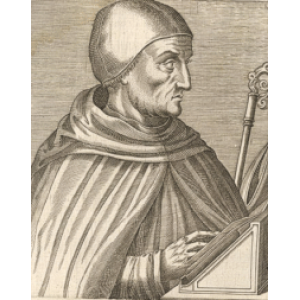
Albertus Magnus Biography

Albertus Magnus Biography Cover Albertus Magnus (1193-1206? - 1280) also known as “Albert the Great” was a German scholar of theology, philosophy, natural science, medicine, alchemy, astrology, chemistry and physics. He was also an alleged magician who believed in the benefits of botany, claiming that various plants, rocks and amethysts improved clairvoyance. He was known as “Doctor Universalis” (“Universal Doctor”) because of the breadth of his knowledge, and was especially noted for introducing Greek and Arabic science and philosophy to the medieval world. He was the most prolific writer of his century and was the only scholar of his time to be called “the Great”, a title that was used even before his death.

Albertus Magnus was born Albert de Groot, in Lauingen, Bavaria, the eldest son of the Count of Bollstadt, a military lord in the service of Emperor Frederick II. Later contemporaries such as Roger Bacon (1214-1294) applied the latinised name of “Albertus Magnus” out of respect for his immense reputation as a scholar and philosopher. Nothing about his primary or preparatory education is known but it is thought he was privately tutored at home before being sent to Bologna University in Italy for his formal education. He then moved to Padua University where he studied the liberal arts and teachings of the Greek philosopher Aristotle.

While there in 1223, he was recruited by the Blessed Jordan of Saxony, the second Master General of the recently formed Dominican Order of Friar Preachers (founded by St Dominic in 1214), who was doing the rounds of major universities in Europe recruiting the best young scholars into the Dominican Order. The Order at that time was less than ten years old, and had only been granted ecclesiastical approval in 1216. Magnus was ordained in a Dominican convent house in Cologne, Germany, from where he quickly advanced through the ranks of the Order.

After leaving Padua, Magnus taught theology at several convent houses throughout Germany including: Regensburg, Freiburg, Strasbourg, Hildesheim and lastly at the convent house in Cologne, were he reinterpreted Peter Lombard’s “Book of the Sentences” (Magister Sententiarum), the theological textbook used in most of the medieval universities. He then moved on to the University of Paris were he became Master of Theology in 1245.

His most famous pupil at the University of Paris was Thomas Aquinas, who later in 1248 joined him at the new Studium Generale in Cologne, in which Magnus was appointed Regent and were Aquinas became his second professor and Magister Studentium (Master of Students). Magnus went on to become an influential Church administrator, teacher and preacher, and travelled throughout Western Europe on behalf of the Dominican Order.

In 1254 Magnus was made provincial of the Dominican Order in Germany, and in 1256 journeyed to Rome to defend the Mendicant Orders against an attack by William of St. Amour, who sought to have the Dominican’s right to alms removed. Magnus succeeded in having his book treatise “De novissimis temporum periculis” condemned by Pope Alexander IV on the 05th October 1256. During his short stay in Rome, he also filled the position of Master of the Sacred Palace, from were he preached on the Gospel of St. John and the Canonical Epistles.

A year later in 1257, Magnus resigned the office of Provincial in Germany to devote himself to his studies and teaching, although he remained a leading force in the Order. At a General meeting of the Dominicans held in Valenciennes, France in 1258, with Thomas Aquinas and Peter of Tarentasia (later Pope Innocent V), he drew up rules for the direction of studies and determined the future system of graduation to be used throughout the Order.

In 1260 Magnus was called by the Pope Alexander IV to serve as the Bishop of Regensburg, a position he resigned from in 1262, in order return to his convent in Cologne, there once again to concentrate on his scholarly interests. However from 1263 to 1264 he was made a legate of Pope Urban IV, and sent to preach the crusades throughout Germany and Bohemia, where subsequently he lectured at Wurzburg and at Strasbourg.

On his journeys around Europe, Magnus showed an intense interest in natural phenomena, and was consumed by the scientific writings of Aristotle. He examined his works, commented on them, and occasionally contradicted them based on the evidence of his own observations. In his laboratory in Cologne he carried out his own experiments in chemistry, mineralogy and physics, and built up a collection of plants, insects and chemical compounds. Of his experiments he is said to have discovered the metallic element of arsenic, caustic potash, and was the first person to determine the chemical composition of cinnabar, minium and white lead.

As a theologian and philosopher, Magnus was outstanding among his contemporaries but not as innovative as his star pupil Thomas Aquinas. Magnus attempted to bring Aristotelian doctrines together with Christian teachings, and in his Summa Theologiae (1270) he maintained that human reason could not contradict revelation, but defended the philosopher’s right to investigate divine mysteries.

In 1274 Magnus was called by Pope Gregory X to attend the ecumenical Council of Lyon, where he had to defend the orthodoxy of his former pupil Thomas Aquinas and the Aristotelian doctrines that both he and Aquinas held to be true. While there he received the sad news that Aquinas had died on his way to the same Council. The news was a heavy blow to Magnus who declared, “that a shining light of the Church had been extinguished”. In 1277 when it was announced that critics wished to condemn and writings of Aquinas, believing that his teachings were too favourable to unbelieving philosophers, Magnus again travelled to Paris to defend his good name.

Magnus suffered serious health problems in 1278 and later died in Cologne on the 15th of November 1280. He was buried in a crypt tomb at the Dominican Church of St. Andreas in Cologne, while his relics were held at Cologne Cathedral. Much later in 1622 he was beatified, and later still declared a Saint by Pope Pius XI in 1931, at which time he was also acclaimed an official Doctor of the Church. In 1941 Pope Pius XII made him the Patron Saint of Natural Sciences.

In the centuries after his death, many myths and stories were told about Magnus the alchemist and magician. On the subject of alchemy and chemistry, he had written mant treaties, including: Alchemy; Metals and Materials; the Secrets of Chemistry; the Origin of Metals; the Origins of Compounds, and Concordance, which is a collection of Observations on the philospher's stone. Other alchemical and chemistry topics were collected under the name of Theatrum Chemicum.

Magnus believed that stones had occult properties, as he related in his work De mineralibus. However there is little actual evidence that he personally performed alchemical experiments. Most of the modern myths are the result of later works, such as the alchemical work known as the Secreta Alberti or the Experimenta Alberti, which were falsely attributed to Magnus by their authors in order to increase their prestige through association. According to one myth, Magnus is said to have discovered the Philosopher’s Stone and passed it on to his pupil Thomas Aquinas. While Magnus made observations about the stone in his writings, he does not mention ever discovering or owning it, although he did record that he witnessed the creation of gold by “transmutation”.

Magnus was also deeply interested in astrology, as were most academics in his day. In the high Middle Ages and well into the early modern period, few intellectuals questioned the basic theories of astrology i.e. that humans lived within a web of celestial influences that affect their bodies, and motivates them to behave in certain ways. They believed that astrology could be used to predict the probable future of a human being. Magnus made this a central component of his philosophical system, arguing that an understanding of celestial influences could help us to live our lives more in accord with Christian precepts. His astrological beliefs can be found in a work he authored around 1260, now known as the Speculum astronomiae. However, details of these beliefs can be found in almost everything he wrote, from his early Summa de bono to his last work the Summa theologiae.

The works of Albertus Magnus represents the entire body of European knowledge, as was extent during his time, not only in theology but also in philosophy and the natural sciences. His importance to the history of medieval academia consists in his bringing Aristotelian doctrines to the fore against the reactionary tendencies of his contemporaries. But it was by his writings on the natural sciences that he exercised his greatest influence. Albertus Magnus must be regarded as unique in his time for having made accessible and available the Aristotelian knowledge of nature and for having enriched it by his own observations. A pre-eminent place in the history of science was accorded to him when because of his achievements, he was canonised and made the Patron Saint of Natural Sciences.

Free eBooks (Can Be Downloaded):

Aleister Crowley - Liber 132 Liber Apotheosis
Anonymous - The Lawes Against Witches
Aleister Crowley - Liber 011 Nu With Commentary
Aleister Crowley - Eight Lectures On Yoga
Aleister Crowley - Liber 666 The Master Therion A Biographical Note

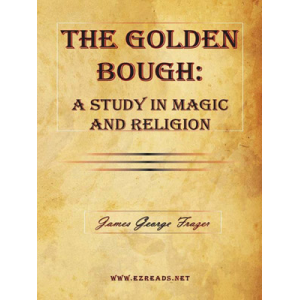
The Golden Bough A Study Of Magic And Religion

The Golden Bough A Study Of Magic And Religion Cover

Book: The Golden Bough A Study Of Magic And Religion by Sir James George Frazer

The Golden Bough: A Study in Magic and Religion is a wide-ranging, comparative study of mythology and religion, written by Scottish anthropologist Sir James George Frazer (1854–1941). It first was published in two volumes in 1890; the third edition, published 1906–15, comprised twelve volumes. It was aimed at a broad literate audience raised on tales as told in such publications as Thomas Bulfinch's The Age of Fable, or Stories of Gods and Heroes (1855). It offered a modernist approach to discussing religion, treating it dispassionately as a cultural phenomenon rather than from a theological perspective. The impact of The Golden Bough on contemporary European literature was substantial.

The book scandalized the British public upon its first publication, because it included the Christian story of Jesus in its comparative study, thus inviting an agnostic reading of the Lamb of God as a relic of a pagan religion. Frazer removed his analysis of the Crucifixion to a speculative appendix for the third edition, and it was entirely missing from the single-volume abridged edition.

Its influence on the emerging discipline of anthropology was pervasive and undeniable. For example, Bronislaw Malinowski, stricken with tuberculosis shortly after receiving his doctorate in physics and mathematics, read Frazer's work in the original English to distract himself from his illness. "No sooner had I read this great work than I became immersed in it and enslaved by it. I realized then that anthropology, as presented by Sir James Frazer, is a great science, worthy of as much devotion as any of her elder and more exact studies and I became bound to the service of Frazerian anthropology."

Despite whatever controversy the work may have generated, and its critical reception amongst other scholars, The Golden Bough had a tremendous effect on the literature of the period. Robert Graves adapted Frazer's concept of the dying king who is sacrificed for the good of the kingdom to the romantic idea of the poet's necessary suffering for the sake of his Muse-Goddess in his Frazer-esque book on poetry, rituals, and myths, The White Goddess, which was published in 1948. William Butler Yeats makes reference to it in his poem, "Sailing to Byzantium." H. P. Lovecraft mentions the book in his short story "The Call of Cthulhu." T. S. Eliot acknowledged indebtedness to Frazer in his first note to his poem The Waste Land. William Carlos Williams references it as well in Book Two, part two, of his extended poem in five books, Paterson. James Joyce, Ernest Hemingway, D. H. Lawrence, Aleister Crowley, Ezra Pound, Mary Renault, Joseph Campbell, Naomi Mitchison (in her The Corn King and the Spring Queen), and Camille Paglia are but a few authors deeply influenced by The Golden Bough. Its literary impact has given it continued life, even as its direct influence in anthropology has waned.

Download Sir James George Frazer's eBook: The Golden Bough A Study Of Magic And Religion

Free eBooks (Can Be Downloaded):

Lynn Thorndike - A History Of Magic And Experimental Science
Robert Ellwood - The Encyclopedia Of World Religions
Susan Greenwood - The Nature Of Magic An Anthropology Of Consciousness
Don Karr - The Study Of Solomonic Magic In English
Sir James George Frazer - The Golden Bough A Study Of Magic And Religion

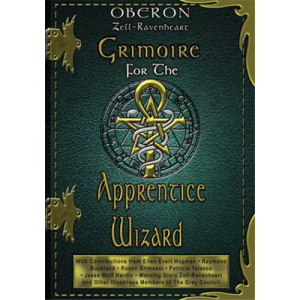
Grimoire For The Apprentice Wizard

Grimoire For The Apprentice Wizard Cover

Book: Grimoire For The Apprentice Wizard by Oberon Zell Ravenheart

Magick, through all its varied forms and traditions, always has at least one component that it shares. Freedom. Freedom from old ideas. Freedom from old religions. A pathway leading the practioner to new depths of themselves, and through that, the world.

It is not, and should not, be used as a tool for the crushing of imagination, but its expansion. It is a very delicate line, to separate one's own prejudices and mythology from the craft itself, creating a clear platform that allows, or even more, encourages the reader to find their own truth. To question authority, even the authority of the writer.

Oberon Zell's grimoire For the Apprentice Wizard does just that. Though there are many books on magick, too often they emphasize the writer's particular viewpoint on the craft, providing a kind of blueprint for development in a particular tradition at the expense of the infinite multiverse of alternate perspectives that could, and should exist.

In his Grimoire, it is apparent that Oberon's intention is to create a platform that is, as well as he is able, clear. Beginning with a brief history of magick in its various incarnations in the Western world; as well as a fundamental glossary of magickal terms as used by all, he moves into beautifully illustrated and well-intentioned explanation of the various types of magick and process.

He includes chapters on healing, herbology, astronomy, mathematics, animal communion (a personal favourite), divination, and many more. Each section illustrates the fundamental principles common to all traditions, allowing the student the space to find their own ideas. Supposedly geared to the adolescent reader, each chapter contains instructions on how to create and manage spells; focusing not only on the process of starting a magick, but the responsible cleanup so often neglected afterwards in making your spells efficient and successful.

I was particularly impressed with the various sources and quotations used in the book. Many authors fail to see (or perhaps, respect) the ways in which spiritual, magickal truths have expressed themselves in today's world. In drawing on gems of wisdom hidden in popular culture; from Aristotle to Discworld, Pythagoreas to Spiderman; Oberon's viewpoint shows an open-mind free of the prejudice of the past that sees the Goddesses, and Gods, still alive inside the imagination of the modern world.

More than just a set of instructions, the Grimoire provides a set of tools designed to allow young minds the opportunity to find their own way through the labyrinth of their imagination. I highly ... highly recommend this book to both new and old readers alike. It is refreshing to see an author who not only claims the intention to provide an open philosophy that still honours its history and practice, but who succeeds in doing so.

Download Oberon Zell Ravenheart's eBook: Grimoire For The Apprentice Wizard

Free eBooks (Can Be Downloaded):

Aleister Crowley - Mortadello Or The Angel Of Venice
Parker Torrence - Grimoire Of Eclectic Magick Part 3 Of 3
Moses Maimonides - The Guide For The Perplexed
Oberon Zell Ravenheart - Grimoire For The Apprentice Wizard.pdf

Monday, August 2, 2010

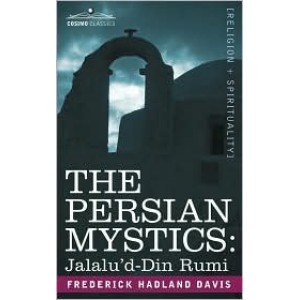
The Persian Mystics Jalaluddin Rumi

The Persian Mystics Jalaluddin Rumi Cover

Book: The Persian Mystics Jalaluddin Rumi by Frederick Hadland Davis

Rumi (1207-1273) was a Persian jurist and theologian best known for being perhaps the finest of all Sufi poets. His writings have been widely translated and remain especially popular in Iran, Afghanistan, and Tajikistan. Though written from a Sufi perspective, Rumi's poems on spiritual growth-here collected and edited by F. Hadland Davis and first published in 1907-cross all cultural and Religious bounds, and can still be heard today in many secular and religious settings.

The Persian Mystics: Jalalu'd-din Rumi includes selections from some of Rumi's most famous works, the "Divani Shamsi Tabriz" and the "Masnavi," as well as passages on his life and work, and the origin and nature of Sufism.

Download Frederick Hadland Davis's eBook: The Persian Mystics Jalaluddin Rumi

Free eBooks (Can Be Downloaded):

Reynold Nicholson - The Mystics Of Islam
Frederick Hadland Davis - The Persian Mystics Jami
Frederick Hadland Davis - The Persian Mystics Jalaluddin Rumi

Monday, July 26, 2010

Witch Hunts Today

Witch Hunts Today Cover Few people are aware that witch-hunts still claim thousands of lives every year, especially in the countries of sub-Saharan Africa, and above all in South Africa.

Witch-hunts in South Africa have become "a national scourge," according to Phumele Ntombele-Nzimande of the country's Commission on Gender Equality. (Quoted in Gilbert Lewthwaite, "South Africans go on witch hunts," Baltimore Sun, September 27, 1998.) The phenomenon is centered in the country's poverty-stricken Northern Province, where "legislators counted 204 witchcraft-related killings [from 1985-95] ... Police counted 312 for the same period. Everybody agreed both numbers were gross underestimates." (Neely Tucker, "Season of the Witch Haunts Africa," The Toronto Star, August 1, 1999.) In 1996 The Observer (UK) reported that "the precise statistics are not known, but the deaths from witch-burning episodes number in the hundreds each year and the trend appears to be on the rise." (David Beresford, "Ancient superstitions, fear of witches cast spell on new nation," reprinted in The Ottawa Citizen, June 18, 1996.)

As with its European predecessor, witch-hunting in South Africa is closely tied not only to prevailing superstitions, but to socio-economic pressures, natural disasters, and personal jealousies. In the Northern Province, "among the poorly educated rural residents, traditional healers and clairvoyants claiming supernatural powers hold broad sway. And hunger, poverty, and unemployment can create jealousies that can quickly turn to anger and vengeance." (Lewthwaite, "South Africans go on witch hunts.") Likewise, Peter Alexander reports that "In a region of intense poverty and little education, villagers are quick to blame any adverse act of fate on black magic." These traditional tendencies have been exacerbated by a recent hysteria (extending to Kenya and Zimbabwe) over the very real phenomenon of "ritual killings related to witchcraft," which "include the removal of organs and limbs from the victims -- the genitals, hands or the head, all of which are believed to bring good luck." (Alexander, "'Witches' get protection from superstitious mobs," The Daily Telegraph, May 26, 1997.) Such ritual murders often bring "retribution" against innocents accused of witchcraft.

The intensity of the persecution and vigilantism in South Africa has reached such levels that no fewer than ten villages have been established in the Northern Province, populated exclusively by accused "witches" whose lives are at risk in their home communities. One such settlement, Helena, counted among its residents 62-year-old Esther Rasesemola, who "was accused in 1990 of being a witch after lightning struck her village":

A group of people visited the Inkanga [village witch-doctor] to see who was responsible. When they returned, it was my brother-in-law who told the rest of the village that I was responsible. He owed me money and I think he did it to get rid of me because he did not want to pay the money back. People in the village became convinced I was a witch. They came to my house at night and burnt it down and took all my belongings. Then they put me in a truck and drove me to a deserted place and dropped me off with my husband and my three children. They told me never to come back to the village or they would kill me. My husband died two years after we were expelled. My children have gone away and now I have nothing. I don't believe in witchcraft. It is just superstitious belief. (Quoted in Alexander, "'Witches' get protection.")

Gilbert Lewthwaite of the Baltimore Sun described the case of Violet Dangale, a 42-year-old woman who "was driven from her home 30 months ago by relatives and neighbours who accused her of being a witch growing rich from the work of zombies, as the 'living dead' are known." Now she was "penniless and in fear for her life," living in Tshilamba, another of the refuges for accused witches. Her "main accuser was her uncle. He first accused her father of using zombies to enrich himself. Then he turned on her, suggesting that she enjoyed her share of the family's wealth through witchcraft. ... As the accusations and threats grew stronger, the Dangale family fled their homes in Dzimauli." "They said I was a witch," Dangale told Lewthwaite. "I don't know anything about witchcraft. I don't believe in zombies. Since I was born, I never saw a zombie." (Lewthwaite, "South Africans go on witch hunts.")

Both of these women were luckier than 65-year-old Linah Seabi, "a sorghum beer brewer ... [who] was charged with killing an elderly woman with a poisonous potion. More than 200 villagers stormed Seabi's house in late May [1991], beat her and burned her to death with straw thatch from the roof of her house." (Nina Shapiro, "Wave of witch hunts sweeps South African countryside," The Toronto Star, September 19, 1991.) In December 1998, "Francina Sebatsana, 75, and Desia Mamafa, 55 ... were burned to death on pyres of wood in the village of Wydhoek," in the Northern Province, for alleged witchcraft. "Eleven men, ages 21 to 50" were charged with her murder. (Lewthwaite, "South Africans go on witch hunts.")

The gendering of the European witch-hunts appears to be closely duplicated in the South African case. As the above accounts suggest, "traditionally, it is women who are accused of witchcraft" (Alexander, "'Witches' get police protection"). Especially vulnerable are "defenceless elderly women, against whom the actions are taken without resistance," according to Northern Province Premier Ngoako Ramatlhodi. "That women most often are the victims of witch hunts stems from attitudes toward gender," writes Nina Shapiro of The Toronto Star:

"In our culture, men go out in the afternoon, women remain in the home," said Russell Molefe, a local journalist. People believe women sit at home concocting potions, he said. Older women are suspected, according to Lebowa police lieutenant Mohlabi Tlomatsana, simply because they are alive. "People will think 'Why has she not died? Probably because she is a witch.'" (Shapiro, "Wave of witch hunts.")

However, as in the European case-study, "these days almost a third of victims of men" (Alexander, "'Witches' get police protection.") Nonetheless, approximately 30 percent of accused witches are male -- reflecting men's prominence as nangas, or traditional healers. Anton La Guardia describes the case of "Credo Mutwa, southern Africa's best-known practising healer ... [who] said he had been accosted by a mob and stabbed several times. He lay bleeding on the ground and waited helplessly to die as his assailants poured petrol and prepared to set it alight. Mr. Mutwa ... said he was saved by the same superstition which was about to claim his life. 'A young man shouted, "His ghost will haunt you." They vanished, leaving me like a fish on dry land.'" (La Guardia, "South Africa's non-political witch-hunts," The Daily Telegraph, September 9, 1998.)

As in all these campaigns, it is difficult to assign particular responsibility for fuelling the anti-witch hysteria. Although they may themselves be accused of witchcraft, it is also generally the nangas who are called upon to point out "suspicious" persons who can be accused as witches: according to one South African police sergeant, "Generally, if people believe there is a witch in their village, they will consult the [witch-doctor]. He or she will then 'sniff out' the witch. The person who is accused will then be killed or ordered to leave the village." (Alexander, "'Witches' get police protection.") Village males usually carry out the murders and other acts of terrorism. But as in the European case-study, patterns of gossip and rumour are central to the process -- and to shielding the perpetrators from justice. South African police inspector Matome Mamabolo reports: "If someone is accused of murdering a witch, the community tends to support them by supplying money for an advocate when the case comes to court. There is a solidarity there -- after all, that person is accused of ridding the village of a witch." (Quoted in Alexander, "'Witches' get police protection.")

Much the same pattern is evident in Tanzania, Zimbabwe, and Kenya, although the gender of the victims may be more even. In August 1999, Paul Harris of the Sunday Telegraph reported that

Lynch mobs have killed hundreds of Tanzanians whom they accuse of witchcraft as black magic hysteria sweeps East Africa. Most of the usually elderly victims have been beaten or burnt to death by gangs of youths. Some old women have been singled out simply because they have red eyes -- regarded as a sign of sorcery by their assailants. The condition is actually caused by years of toiling in smoky kitchens cooking family meals. ... Police say 357 suspected witches have been killed in the past 18 months, but the Ministry of Home Affairs believes that the true figure is much higher. A departmental survey said as many as 5,000 people were lynched between 1994 and 1998. (Paul Harris, "Hundreds burnt to death in Tanzanian witch-hunt," Sunday Telegraph, August 22, 1999.)

In Zimbabwe, as in neighbouring South Africa, the witch-hunts also seem closely related to "the black market demand for human body parts, which are used in making evil potions." The upsurge in such practices, the ritual murders they require, and the vengefulness that results against accused "witches," are all linked to the country's precipitous economic decline. "It's obvious the cause is economic," says Gordon Chavanduka, head of the Zimbabwe National Traditional Healers Association (which counts 50,000 members). "The worse the economy gets, the more political tension there is in society, the more frustrated and frightened people get. They turn to witchcraft to gain riches or to hurt their enemies." (Neely Tucker, "Season of the witch haunts Africa," The Toronto Star, August 1, 1999.)

In the Kenyan case, as was also true in a handful of European countries, the witch-hunts appear predominantly to target males. A British sociologist, J.F.M. Middleton, records the conviction of the Lugbara tribe of Kenya that

a witch is a man [emphasis added] who perverts a mystical power of kinship for his own selfish ends and is therefore an evil person. Witches in general are given both physical and moral attributes: a witch has greyish skin, red eyes, a physical deformity; he may travel about upside down; he is bad tempered, secretive, petty and jealous; he is thought to practice incest and cannibalism. The distinction between witchcraft, a mystical activity, and sorcery, the use of material objects, was widespread in eastern Africa, Dr. Middleton said. When, as in Lugbara, the basic principles of organization were unilineal descent and seniority by generation it would be expected that men were believed to practise witchcraft, whereas women should have the less important role of sorcerer. ("How to recognize witches," The Times [UK], September 5, 1997.)

In Kenya in 1993, killings among the Gusii tribe were occurring at the rate of one a week. "In most cases ... village mobs several hundred strong locked the victims inside thatch-roof houses and set them on fire. ... According to tribal elders, the Gusii have always executed people found to be witches. Sanslaus Anunda, a 99-year-old tribal elder, said that during his youth, villagers had a foolproof method for determining guilt. The most respected men in the community would call a meeting. Next, they would smear local herbs on the hands of the suspect and that of a second, innocent man [emphasis added]. Both men would be ordered to dip their hands into a pot of boiling water, then return in five days. If the suspect was a witch, burns would appear on his hands. However, Anunda insists, the innocent man's hands would remain unscarred." (Tammerlin Drummong, "Kenya: Dozens die in witch hunts," The Ottawa Citizen, August 28, 1993.)

A trend of predominantly male victimization may also be evident in West Africa, where a bizarre wave of accusations of "penis-snatching" has come to light. The Reuters news agency reported in 1996 that "eight men in Accra, Ghana, were accused of using witchcraft to snatch penises. Their motivation was allegedly to return the sexual organs in return for cash. Mobs attacked them ... two died and six were seriously injured. The police examined all the alleged victims and found their genitals intact. ... [But] the 'victims' believed that sorcerers only had to touch them to make the genitals shrink or disappear completely." ("'Witches' steal penises in Ghana," Reuters dispatch, January 17, 1996.) D. Trull reported in 1997 that "the killings of alleged 'penis snatchers'" had been reported "along the west coast from Cameroon to Nigeria." (See Trull, "Witches Protection Program".)

Books You Might Enjoy:

Phil Hine - Aspects Of Evocation
Aleister Crowley - The Sixth Chakra Of The Human Body
Richard Johnson - The Zodiac Stellar Stories
Gerald Gardner - Witchcraft Today
Friday, July 23, 2010

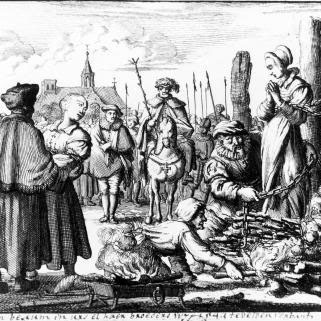
Who Burned The Witches

Who Burned The Witches Cover The 30,000 to 50,000 casualties of the European witch-hunts were not distributed uniformally through time or space, even within particular jurisdictions. Three-quarters of Europe saw not a single trial. witch persecution spread outward from its first center in alpine Italy in the early 15th century, guttering out in Poland, where witchcraft laws were finally repealed in 1788. The center had generally stopped trying witches before the peripheries even started.

The Spanish Road stretching from Italy to the Netherlands was also a "witch-road." The Catholic-ruled Spanish Netherlands (today's Belgium) saw far worse persecutions than the Protestant-ruled United Provinces of the Netherlands, which had stopped burning convicted witches by 1600. There were early panics in the German cities of Brandenburg and Mecklenburg, as well as in Lorraine, France, and parts of Switzerland and Scotland. The Rhineland and Southwest Germany suffered severe outbreaks, with German ecclesiastical territories hit hardest. Three-quarters of all witchcraft trials took place in the Catholic-ruled territories of the Holy Roman Empire. But Catholic Portugal, Castile and Spanish-ruled Italy, and the Orthodox lands of Eastern Europe saw virtually none. The panic in Salem, Massachusetts, was as bad as anything in England, but there seem to have been no executions in the Latin colonies of the New World.

The regional tolls demonstrated the patchwork pattern of witch-hunting. The town of Baden, Germany, for example, burned 200 witches from 1627 to 1630, more than all the convicted witches who perished in Sweden. The tiny town of Ellwangen, Germany, burned 393 witches from 1611 to 1618, more than Spain and Portugal combined ever executed. The Catholic prince-bishop of Wurzburg, Germany, burned 600 witches from 1628 to 1631, more witches than ever died in Protestant Sweden, Norway, Finland, and Iceland combined. The Swiss canton of Vaud executed about 1,800 witches from 1611 to 1660, compared with Scotland's toll of between 1,300 and 1,500 and England's toll of 500. The claim of some Catholic apologists that Elizabeth I executed 800 witches a year is gross slander. In Southwest Germany alone, 3,229 people were executed for witchcraft between 1562 and 1684 -- more than were executed for any reason by the Spanish, Portuguese, and Roman Inquisitions between 1500 and 1800. (All three of these Inquisitions burned fewer than a dozen witches in total.)

The most-dreaded lay witch-hunter was Nicholas Remy, attorney general of Lorraine, who boasted of sending 900 persons to the stake in a single decade (1581-1591). But the all-time grand champion exterminator of witches was Ferdinand von Wittelsbach, Catholic prince-archbishop of Cologne, Germany, who burned 2,000 members of his flock during the 1630s.

Let no one argue that witch-hunting was a predominantly Protestant activity. Both Catholic and Protestant lands saw light and heavy hunts. Demonologists and critics alike came from both religious camps.


Books You Might Enjoy:

Ralph Blum - The New Book Of Runes
Marian Green - A Witch Alone
Tarostar - The Witchs Spellcraft Revised
Margaret Alice Murray - God Of The Whitches

Thursday, July 22, 2010

What Is A Kitchen Witch

What Is A Kitchen Witch Cover What is Kitchen Witchery?:

There's a growing movement within modern paganism known as kitchen witchery. The kitchen is, after all, the heart and hearth of many modern households. When you have a gathering in your home, where do most of your guests hang out? Why, the kitchen, of course! Also, thanks to a declining economy, many more people are making meals from scratch and the kitchen has once again become a place where people spend hours, rather than minutes. So it's no surprise that kitchen witchery has seen a rise in popularity.
Meal Prep as Magic:

When you take the time to put meals together from the basic ingredients, you have a magical opportunity at hand. You can infuse every dish with intent and will. A meal can stop being something you dump out of a can, and start being a ritual in and of itself. When you take time to prepare something with your own hands, that lends it sacredness, and will make you want to spend time savoring it with your family, rather than just snarfing it down on your way out the door to soccer practice. By changing the way you view food, its preparation and its consumption, you can craft some practical magic at its simplest level.

Books You Might Enjoy:

Tarostar - The Witchs Spellcraft Revised
Aj Drew - A Wiccan Bible
Michael Harrison - The Roots Of Witchcraft

Wednesday, July 21, 2010

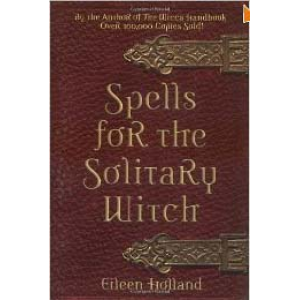
Spells For The Solitary Witch

Spells For The Solitary Witch Cover

Book: Spells For The Solitary Witch by Eileen Holland

This book "Spells for the Solitary Witch" focuses on spells and spell work specifically for the Solitary Practitioner. Clear and easy to follow, Spells for the Solitary Witch explains how to prepare and cast spells 87 spells in all together with the materials needed for each spell and the incantations to say that will ensure the best results. Tailored to the needs of solitary witches, Holland suggests alternatives to hard-to-find ingredients, as well as directions about where to find specific ingredients crucial to a spells success.

Written by a solitary witch and Wiccan priestess herself, Spells For The Solitary Witch is a simple walkthrough of ways to release hidden power for health, wellness, emotional enrichiment, and environmental harmony. Chapters discuss magick and its applications in love, life enhancement, and problem solving, as well as magickal candle gardens, tea potions, and more. Detailed instructions, specific incantations, detailed how-to's down to where one can easily obtain sesame oil or Tiger Balm, and much more make Spells For The Solitary Witch ideal for novice and experienced spellcasters alike.

Again we are presented with Ms. Holland's easy to read and follow style of writing. She lays her book out according to the kind of spells you may want to do, and lists her spells according to what you want to accomplish when working your spells.

I have to say her opening section, entitled :Before you Begin" is exceptional in explaining basic spellwork, what it is, what is magic, ethics when working magic, personal responsibility and terminology. This is an excellent reference on it's own and should be suggested to all beginning spellworkers as a point of essential reference. I wish Ms. Holland would have expanded this section, as she did it so well, but it does stand on it's own as a very good overview.

The sections on actual spellworking are divided into seven chapters, covering "Inner Work, "Goals, Hopes, Wishes", "Love", "Life Enhancement", "Problem Solving", "Magickal Candle Gardens", and "Tea Potions".

Each section has a selection of spells for various situations. Under "Inner Work" we find spells for acceptance, getting over it, even personal power talisman, a tool for building self-confidence. Each spell has complete instructions and directions on how to use the spells for each intent. A list of needs is followed by preparation and the actual spell working, which may include an incantation, ritual, and sometimes an "afterward" or review of what should be the focus and how you should react to the spellworking. With the Talisman, she discusses creating these talisman, the proper signs for you, day workings and Correspondences, and all you would need to know to create and use a personal talisman.

Going forward into the various chapters, each chapter contains spells referencing the chapter title. In "Goals, Hopes, Wishes" we have spells for goals you wish to reach, spells for special wishes, interview charms; all with discussions on your intents to what you want to achieve and how to work the spell.

The "Love" section has workings for personal enhancement, to bring love into your life. The "Life Enhancement" chapter has spells for home blessings, abundance, fertility, joy, and protection to name a few. "Problem Solving" covers dealing with major mistakes, fearsome problems, problematic persons and hard times.

What I note in her spells is that when a spell calls for a "potion" as in her Tragedy Potion (for someone who has just encountered a tragedy in their life and you offer them this potion to help calm nerves and help them center and balance) the ingredients are noted and the appropriate cautions are given. In this case, she gives a recipe for a hot cup of cocoa, with some oil of peppermint. She notes "Note: this potion isn't for you if you are lactose-intolerant, allergic to chocolate or peppermint or have any medical reason that precludes its use." Wise words from a wise witch.

The book contains many notes of wisdom. "Magickal Candle Gardens" focuses on candle magic to assist persons in need. The garden is built indoors, containing candles arranged for your specific purpose and using candles of specific shapes and size depending on the needs. After going over the plans and the layout, it looks to be something even I would consider as a special magical working, being attractive, practical and very especially magical.

The last chapter is about "Tea Potions" specifically, and again, contains potions to work on yourself for specific situations you may encounter, such as personal health, luck, creativity and success to name a few. She works some of the potions with runes, others with chant. The only note I have here is that she did not repeat her good advice about being allergic to certain herbs, as most of these teas are herbal in their base. Please use your own digression when preparing these teas and if allergic, then look for a substitute.

Eileen Holland is a solitary eclectic witch, a Wiccan priestess who calls her path Goddess Wicca. She is the author of several books about magick and witchcraft, including Spells for the Solitary Witch and the best-selling The Wicca Handbook. Eileen is the webmaster of www.open-sesame.com, a popular long-running Wiccan web-site. She lives in upstate New York.

Buy Eileen Holland's book: Spells For The Solitary Witch

Downloadable books (free):

Anonymous - Welcome To The Secrets Of The Root Witch
Scott Cunningham - Wicca A Guide For The Solitary Practitioner
Shanddaramon - Self Initiation For The Solitary Witch

Saturday, July 10, 2010

Are Witches Really Condemned To Hell

Are Witches Really Condemned To Hell Cover If you walk a pagan path, sooner or later you'll be told by a Christian friend or family member that practicing witchcraft or magic will "condemn you to Hell." Christians feel this way because they THINK it's what their Bible teaches. Most will quote the following infamous scripture that appears to support this belief: "Thou shalt not suffer a witch to live" (Exodus 22:18).

Obviously, in the original Hebrew language this word did not mean 'witch'. It actually referred to someone who used poisonous herbs to harm others. In Greek, this same word is translated as 'pharmacopeia'- someone who cast curses, and provided people with poisonous herbs to harm others. Today, we might call that person a drug dealer, and a more accurate modern translation might read 'Thou shalt not suffer a drug dealer to live'. The passage was NOT intended to condemn people who used herbs and magic to help others. So, unless you are dealing in poisonous herbs or drugs with the intent to cause harm, this scripture really does not apply to YOU!

Other passages that appear to condemn Witchcraft are also just victim of poor translation or interpretation. ALL of them refer to specific actions that cause harm in some way. For example, in the scriptures people were told to avoid fortunetellers. This was because most of them were fakes who gave false prophecy for money. THAT action was being condemned. The advice was never ment to denounce prophecy, but rather to encourage people to live in the NOW and place their focus on their current situation rather than worry about future and/or past events. Throughout the scriptures it is very clear that prophecy is considered a Divine gift. If you have this gift, you are blessed, not cursed.

Finally, as most already know, the title Magi or Magician originally meant 'wise-one' and was actually a position that commanded great respect. If you are helping others and making the world around you a better place, you deserve that same respect. Don't let anyone convince you your actions are condemned by the Divine.

Books You Might Enjoy:

John Dee - Testament Of John Dee To John Gwynn
Jaroslav Nemec - Witchcraft And Medicine
Douglas Ezzy - Practising The Witchs Craft Real Magic Under A Southern Sky
Marian Green - A Witch Alone
Kathryn Paulsen - Witches Potions And Spells

Popular Posts