Showing posts with label ancient book. Show all posts

Saturday, October 2, 2010

Fairy Gold

Fairy Gold Cover

Book: Fairy Gold by Basil Crouch

Basil Crouch A.K.A. Basil LaCroix is one of those old-time great Magicians who learned by the pragmatics of worldly travels in lieu of the theoretics found in most books. Basil spent his youth in a circus amongst the main artistes who were pure Romany, all members of the Manouche Tribe who revere Sara the Black Virgin & Jacques deMolay (GrandMaster of the Templars). The leading Witchdoctor taught him many trix of Magick. He also learned many strange Spells from an Australian Aborigine Witchdoctor. In the late 1960's he masterminded 'coven-style' Occult groups consisting of 6 or 7 women, reaching very advanced stages of development, like producing actual Apports using thoughtform entities, just mindblowing stuff. His teachings excited alot of jealousy within Occult Societies who wanted this kind of thing kept secret. (from reader)

Download Basil Crouch's eBook: Fairy Gold

Free eBooks (Can Be Downloaded):

Aleister Crowley - Liber 831 Iod
Franceska De Grandis - Be A Goddess
Aleister Crowley - Gargoyles
Basil Crouch - Fairy Gold

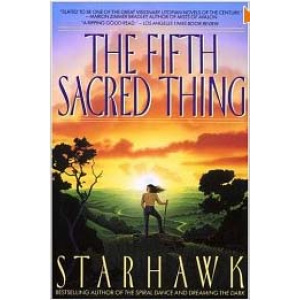
The Fifth Sacred Thing

The Fifth Sacred Thing Cover

Book: The Fifth Sacred Thing by Starhawk

I love this book. I didn't like it at first, but I decided to give it an hour before I made up my mind. Now I am really glad I stuck with it, because it is one of the richest, most thought-provoking books I have ever read.

I had this book on my shelf for several years before I actually read it. Although it obviously sounded good enough at the time I bought it, I feared that it would be preachy and overbearing. It was nothing of the sort. The characters are complex; flawed at times, saintly at others. The story is compelling, combining plots about the personal growth of the various characters, adventure stories as Bird escapes from prison and Madrone ventures into the southern wilds to help the freedom fighters, and the ultimate show down between the San Franciscans and the Stewards. It is a bit simplistic, perhaps, but that didn't stop me from wishing things in reality were more like they are in Maya and Madrone's world. The attempts to portray this world as one free of any racial or sexual bigotry do get a bit heavy handed at times, but never so much that it interfered with my enjoyment of the story. I would recommend this book to anyone, and in fact immediately after I finished Ran out and bought a copy to give as a gift this Christmas.

One of the greatest questions is - how do people resist the violent advances of others without becoming violent themselves? We can look to others for inspiration - HH the Dalai Lama, Gandhi, MLK - there have been a few who have managed to hold on to their ideals despite the crimes inflicted upon them. But how do we do this ourselves? How do we maintain peace within ourselves?

This book discusses these issues on a societal level, but the wisdom you will gain can be applied on a personal level. You will likely find yourself rethinking how you view numerous things - from illness to monogamy.

And the story is interesting and creative, with characters you will come to care about. This is a fantastic book. Go ahead and give it some time - you will probably love it, too!

Buy Starhawk's book: The Fifth Sacred Thing

Free eBooks (Can Be Downloaded):

Friedrich Max Muller - The Sacred Books Of The East
Solomonic Grimoires - The Book Of Secrets
Aleister Crowley - His Secret Sin

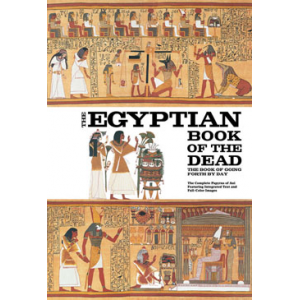
The Egyptian Book Of The Dead

The Egyptian Book Of The Dead Cover

Book: The Egyptian Book Of The Dead by Ea Wallis Budge

"The Egyptian Book of Dead"—the ancient Egyptian title is ‘rw nw prt m hrw’ , roughly translated as “Spells of Going Forth by Day” — was written by the ancient Egyptians as a sort of guide to help newly deceased souls as they crossed over into the afterlife. It was usually written on a papyrus scroll which was sent with the prepared body in its coffin or burial chamber.

German Egyptologist Karl Richard Lepsius first used the title, “Book of the Dead” in a selection of Texts he published in 1842. Since then, the word “Egyptian” has been added and it has become the generally accepted title of the book. E. A. Wallis Budge published this translation in 1901 and, as an important version, it is still in print to this day.

The Book of the Dead was the product of a long process of evolution from the Pyramid Texts of the Old Kingdom (writings on the crypt walls intending to help the dead person) to the Coffin Texts of the Middle Kingdom (similar writings, placed on the outside of a coffin). Eventually, many of these texts were written on papyrus and placed in the burial chamber, or inside the coffin with the mummy.

About one-third of the chapters in The Book of the Dead are derived from the earlier Coffin Texts. The Book of the Dead itself was adapted to The Book of Breathings in the Late Period, but remained popular in its own right until the Roman period.


Download Ea Wallis Budge's eBook: The Egyptian Book Of The Dead

Free eBooks (Can Be Downloaded):

Gerald Gardner - The Garnerian Book Of Shadows
Friedrich Max Muller - The Sacred Books Of The East
Lady Galadriel - The New Book Of The Law
Ea Wallis Budge - The Egyptian Book Of The Dead

Thursday, September 30, 2010

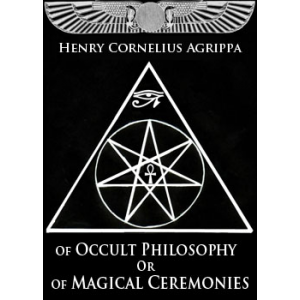
Of Occult Philosophy Or Of Magical Ceremonies The Book Iv

Of Occult Philosophy Or Of Magical Ceremonies The Book Iv Cover

Book: Of Occult Philosophy Or Of Magical Ceremonies The Book Iv by Henry Cornelius Agrippa

Of Occult philosophy Or Of Magical Ceremonies The Book IV of The Three Book of Occult Philosphy by Henry Cornelius Agrippa

The Three Book of Occult Philosphy purports to be the work of Henry Agrippa, the 16th century author of "Three Books of Occult Philosophy". But the 4th Book was obviously not written by Agrippa and bears no resemblance to his style of writing. Although it can be traced back to the 16th century as it is mentioned by Agrippa's student, Johann Weyer in his "De Praestigiis Daemonum", the work remains of uncertain provencance.

In part a partial summary of some of Agrippa's writings, this facsimile of the English translation by the 17th century Cambridge scholar Robert Turner, comprises spurious essays on Geomancy and Magick under the name of Agrippa, The Heptameron of Peter of Abano, and books on Astrology and Demonolgy, concluding with the Arbatel, a largely Judeo-Christian outlook on the dangers of magic.

It is a very quick and easy read, despite the portions dealing with Geomancy and Astrology that even those serious about such subjects would find largely frustrating and incomprehensible.

The work largely remains of pure historical interest with not much of serious substance to an undertanding of Magic and Occult Philiosphy.

This volume is a facsimile of Robert Turner's English translation (1654); the original volume first appeared (in Latin) in Marburg around 1554. The original volume included a large number of short texts of varying interest, but Robert Turner's (1654) (for unclear reasons) decided only to translate a few of them. This edition includes 6 short texts: Of Geomancy (H.C. Agrippa); Of Occult philosophy the Three Book (pseudo-Agrippa); Heptameron or Magical Elements (pseudo-Peter de Abano); Isagoge: An Introductory Discourse on the Nature of ... Spirits... (Georg Pictorius Villinganus); Of Astronomical Geomancy (Gerard of Cremona); and the Anonymous Arbatel of Magic. Only the Geomancy is actually by Agrippa, and it doesn't fit well with the other texts. The Three Book is, as another reviewer noted, certainly spurious; it purports to be Agrippa's "secret key" to the Occult Philosophy, of which he spoke in a letter to a friend. The Heptameron and the Arbatel are grimoires of some interest for those interested in black magic, as indeed is the Three Book itself; the Isagoge is a rather dull dialogue about spirits; and the Astronomical Geomancy is more or less impenetrable but perhaps interesting in a peculiar way. There have been a number of reprints of this volume, some now surprisingly valuable despite their modernity; all, however, have trimmed out one or more of the already few texts. As such, this is probably the best edition available. It is, like all Kessinger products, a cheaply-bound xerox facsimile of the original 17th-century text, but it's readable and includes everything. If you collect grimoires or magical texts, this is a very famous one, and you ought to have it; copies of the various Latin printings turn up with some regularity, and those with access to Latin would do better with those, although they are of course quite expensive. If you're looking for works by Agrippa, the Geomancy is all you'll find here, but it's interesting in a number of respects. If you want to know about Agrippa's ceremonial magic, however, you need to read book 3 of the Occult Philosophy, available in a nice Llewellyn edition.

Download Henry Cornelius Agrippa's eBook: Of Occult Philosophy Or Of Magical Ceremonies The Book Iv

Free eBooks (Can Be Downloaded):

Henry Cornelius Agrippa - Occult Philosophy And Magick Book Iii
Henry Cornelius Agrippa - Occult Philosophy And Magick Book Ii
Henry Cornelius Agrippa - Occult Philosophy And Magick Book I
Henry Cornelius Agrippa - Occult Philosophy And Magick Book Iv
Henry Cornelius Agrippa - Of Occult Philosophy Or Of Magical Ceremonies The Book Iv

The Sacred Magic Of Abramelin The Mage Book 3

The Sacred Magic Of Abramelin The Mage Book 3 Cover

Book: The Sacred Magic Of Abramelin The Mage Book 3 by Abramelin The Mage

Volume III of The Book of the Sacred Magic of Abramelin the Mage.

The Book of Abramelin tells the story of an Egyptian mage named Abramelin, or Abra-Melin, who taught a system of magic to Abraham of Worms, a German Jew presumed to have lived from c.1362 - c.1458. The system of magic from this book regained popularity in the 19th and 20th centuries due to the efforts of Mathers' translation, The Book of the Sacred Magic of Abramelin the Mage, its import within the Hermetic Order of the Golden Dawn, and later within the mystical system of Thelema (created in 1904 by Aleister Crowley).

Unfortunately, Mathers used the least-reliable manuscript copy as the basis for his translation, and it contains many errors and omissions. The later English translation by Georg Dehn and Steven Guth, based on the earliest and most complete sources, is more scholarly and comprehensive. Dehn attributed authorship of The Book of Abramelin to Rabbi Yaakov Moelin (Hebrew ca. 1365–1427), a German Jewish Talmudist.

Structure of the book

The grimoire is framed as a sort of epistolary novel or autobiography in which Abraham of Worms describes his journey from Germany to Egypt and reveals Abramelin's magical and Kabbalistic secrets to his son Lamech. Internally the text dates itself to the year 1458.

The story involves Abraham of Worms passing his magical and Kabbalistic secrets on to his son, and tells how he acquired his knowledge. Abraham recounts how he found Abramelin The Mage living in the desert outside an Egyptian town, Arachi or Araki, which borders the Nile. Abramelin's home sat atop a small hill surrounded by trees. He was an Egyptian mage and taught a powerful form of Kabbalistic magic to Abraham. He was a "venerable aged man", and very courteous and kind. He discussed nothing but "the Fear of God", leading a well-regulated life, and the evils of the "acquisition of riches and goods."

Abramelin extracted a promise from Abraham that he would give up his "false dogmas" and live "in the Way and Law of the Lord." He then gave Abraham two manuscript books to copy for himself, asking for ten gold florins, which he took with the intention of distributing to seventy-two poor persons in Arachi. Upon his return fifteen days later, after having disposed of the payment money, Abramelin extracted an oath from Abraham to "serve and fear" the Lord, and to "live and die in His most Holy Law." After this, Abramelin gave Abraham the "Divine Science" and "True Magic" embedded within the two manuscripts, which he was to follow and give to only those whom he knew well.

Origin of the manuscript

The book exists in the form of six manuscripts and an early printed edition. The provenance of the text has not been definitively identified. The earliest manuscripts are two versions that date from about 1608, are written in German and are now found in Wolfenbuttel Another two manuscripts are in Dresden, and date from about 1700 and 1750 respectively.

The first printed version, also in German, dates to 1725 and was printed in Cologne by Peter Hammer. A partial copy in Hebrew is found in the Bodleian Library in Oxford, and dates from around 1740. A manuscript copy existed in French in the Bibliotheque de l'Arsenal in Paris, an institution founded in 1797. The French copy has since disappeared, but is available on microfilm.

All German copies of the text consist of four books: an autobiographical account of the travels of Abraham of Worms to Egypt, a book of assorted materials from the corpus of the practical Kabbalah (including some which is duplicated in the German-Jewish grimoire called "The Sixth and 7th Books of Moses") and the two books of magic given by Abramelin to Abraham. The well-known English translation by S.L. MacGregor Mathers from the French Manuscript in Paris contains only three of the four books. The Hebrew version in Oxford is limited to Book One, without reference to the further books.

Of all the extant sources, the German manuscripts in Wolfenbuttel and Dresden are taken by scholars to be the authoritative texts. According to respected Kabbalah scholar Gershom Scholem, the Hebrew version in Oxford was translated into Hebrew from German. An analysis of the spelling and language usage in the French manuscript indicates that it dates to the 18th century, and that it was also likely copied from a German original. Although the author quotes from the Jewish Book of Psalms, the version given is not from the Hebrew; rather, it is from the Latin Vulgate, a translation of the Bible employed by Roman Catholics at that time.

The German esoteric scholar Georg Dehn has argued that the author of The Book of Abramelin was Rabbi Yaakov Moelin (Hebrew 1365–1427), a German Jewish Talmudist and posek (authority on Jewish law). (ref Georg Dehn, The Book of Abramelin: A New Translation, transl. by Steven Guth, Ibis Publishing, 2006)

Magic word squares

The practical magic of Abramelin (found in both Book III of the French text, and Book IV of the German original) centers around a set of talismans composed of magic word squares. These are similar to traditional magic squares, though the latter are usually composed of numbers, while Abramelin's squares contain letters. Commonly word squares are used as puzzles or as teaching aids for students. In the context of Abramelin, the focus becomes mystical—so that each square should contain words or names that relate to the magical goal of the square. A parallel is found in the famous Sator Arepo Tenet Opera Rotas word square, an altered version of which is also found among Abramelin's squares.

For example, a square entitled "To walk under water for as long as you want" contains the word MAIAM, the Hebrew and Arabic word for "water". A square for recovering treasures of jewelry begins with the word TIPHARAH (a variant of Tiferet), which can mean "golden ring" in Hebrew and is also the name of the sphere of "Beauty" on the Kabbalistic Tree of Life.

Download Abramelin The Mage's eBook: The Sacred Magic Of Abramelin The Mage Book 3

Free eBooks (Can Be Downloaded):

Aleister Crowley - The Sixth Chakra Of The Human Body
Manly Palmer Hall - The Secret Teachings Of All Ages
Solomonic Grimoires - The Magic Of Armadel
Abramelin The Mage - The Sacred Magic Of Abramelin The Mage Book 2
Abramelin The Mage - The Sacred Magic Of Abramelin The Mage Book 3

Wednesday, September 29, 2010

Historical Summary Of The European Witch Hunts

Historical  Summary Of The European Witch Hunts Cover The European witch Craze started roughly during conclusion of the 15th century and peaked during the first half of the seventeenth century. The belief that women were sinful and had the power of the devil within them developed out of the Middle Ages. The Reformation further promoted the idea of a satanic kingdom of evil on earth with which to justify persecutions. Theologians sought to prove that accused witches represented the devil.

The first and most significant written cumulative concept of witchcraft available to a large audience was the Malleus Maleficarum written by Sprenger and Kraemer. It was first published in 1486 and reprinted fourteen times before 1520. The document made an important contribution to the widespread witch hunt. Most people accused of witchcraft were rural, poor, and single women. The hunts are often seen as a massive effort to keep women in their place. Women were seen as evil, and unclean people whose weakness could summon the devil for sexual intercourse.

The Malleus Maleficarum document ignited a widespread hunt for the so-called witches described in it. During the hunt, witches were accused of "impractical" and "traceless" crimes such as intercourse with the devil, unregistered babies from hidden pregnancies who were supposedly eaten or sacrificed, and even natural disasters. However there is no record of any solid evidence for any of these accused crimes.

Often these hunts were instigated by hysterical children, or nuns who accused relatives, and neighbors of these outrageous crimes. Witnesses were often bribed or threatened in order to prosecute the accused. The accused would then be tortured until they confessed. The methods of torture were very cruel and painful, and almost all who were put through the various devices would confess. In some cases the accused would die of torture, and very few survived the ordeal without confessing. However, the accused was set free if they survived the torture without a confession. After the forced confession, the trial took place. These trials were run by genuine believers of witchcraft. The aim of the trial was to exterminate the witches as conspirators with the devil. When the accused was declared guilty, they were usually executed.

Although, there are many estimates as to how many actual people were killed during these hunts, most estimates show the number well below the one-million mark. The actual number of documented executions, is generally considered to be under one hundred thousand. Of all that were executed, only a minority were men, and of those men, many are those who tried to protect accused women from the hunters.

Free eBooks (Can Be Downloaded):

Sharynne Nicmacha - The Star Of Life A Historical And Spiritual History Of The Pentagram
Martin Van Buren Perley - A Short History Of The Salem Village Witchcraft Trials
Tuesday Lobsang Rampa - Wisdom Of The Ancients
Michael Bailey - Historical Dictionary Of Witchcraft
Charles Kirkpatrick Sharpe - A Historical Account Of The Belief In Witchcraft In Scotland

Tuesday, September 28, 2010

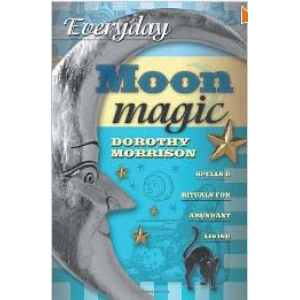
Everyday Moon Magic Spells And Rituals For Abundant Living

Everyday Moon Magic Spells And Rituals For Abundant Living Cover

Book: Everyday Moon Magic Spells And Rituals For Abundant Living by Dorothy Morrison

I've read a couple other Moon books, but this one is by far the best. Why? Because Ms. Morrison (much like another of my favorite authors, Patricia Telesco) has a certain and very special way of making things simple, accessable and right to the point without talking down to the reader, getting lost in Craft mumbo-jumbo or making things harder than they really need to be as I've seen so many times by other authors. There are no lectures, power trips or mind-numbing lists of hard-to-find ingredients here; no lofty words or flowery rituals. In fact, you probably already have many of the ingredients she mentions. This book is practical, useful, wonderfully organized and chock full of Moon facts, spells, rituals and other worthy and interesting tidbits that can indeed be used every day. I found it a fast read, which is good -this way I can get right into things :) If you've been disappointed, bored or overwhelmed by other Moon Magic books, give this one a try. Simply put, this book is a pleasure to read, use and own; it's one I'm sure I'll refer to often. I'm keeing this right next to my much-loved copy of Everyday Magic and will likely be following up with her companion book, Everyday Sun Magic.

That magical, mystical, glorious Moon-invite Her power into your life every day, from fixing your computer to blessing your pets. You'll learn how each Moon phase affects your spellwork, including the seldom-discussed energies of the true Blue Moon, the Black Moon, the void-of-course moon, and the lunar eclipse. Follow the Moon as She traverses each sign of the zodiac, and discover how each astrological phase affects magic, mundane events, and gardening-and how your personal Moon sign affects your magical work. Includes more than 140 modernized spells, chants, and rituals, along with Esbat celebrations for the Full Moon.

Dorothy Morrison has put together in this book a wonderful primer that is chock full of moon lore, moon mystery and moon magic. And because of all the bits of information collected here, even the experienced practitioner will read through this book and come away scratching their head saying "I didn't know that!"

Ms. Morrison includes in this book some of the history of moon lore and moon cycles. Included are bits of 'old sayings' and superstitions as well as names of the monthly moons and what they mean. She reviews the moon phases and effects. Ms. Morrison also discusses astrological terms referencing the moon and what they actually mean. For those who are not familiar or don't remember or are not sure, this section alone is worth the price of the book. Then she takes it a step further by explaining how these references apply in relationship to our magic and our lives. Times and cycles for ritual, magic and spells are also discussed and examined. Empowering moon rituals filled with positive affirmations for the building of personal self esteem, which Ms. Morrison is so good at writing, are here for you to incorporate into your own ritual material. And, of course, no book by Dorothy Morrison would be complete without a whole section of her wonderful spells.

As usual, Dorothy takes all this and puts it into a book that shows you, step by step, how to work this into your everyday life, making it a practical as well as informative book. There is so much more here that I've not included in this review because it would take pages to write about. Needless to say, Ms. Morrison has been thorough in her research. There is a table of contents to help you find what you are looking for as well as a bibliography. Add to that her easy to read format and no nonsense approach to teaching, and you have a winner here.


This is a book that should be considered when you are in the store looking for something practical, informative and just plain good to read and add to your library.

Originally from Texas, Dorothy Morrison now lives the magical life in Maine with her family. Dorothy is a member of the Pagan Poets Society and a charter member of M.A.G.I.C., a magical writers and artists organization. Dorothy is a Wiccan High Priestess of the Georgian Tradition, and has been an avid practitioner of the ancient arts for more than twenty years. She founded the Coven of the Crystal Garden in 1986, and spent many years teaching the Craft of Wicca to students both in the United States and in Australia. A former state championship archer and bow hunter, Dorothys current interests include Tarot work, magical herbalism, stonework, and computer networking.Dorothys work has been published in many journals and magazines, including Circle Network News, SageWoman, and Crone Chronicles. She is the author of the acclaimed Everyday Magic, Magical Needlework, In Praise of the Crone, Yule, Bud, Blossom & Leaf: The Magical Herb Gardeners Handbook, The Craft, and The Craft Companion, among other works..

Buy Dorothy Morrison's book: Everyday Moon Magic Spells And Rituals For Abundant Living

Free eBooks (Can Be Downloaded):

Lady Sabrina - Exploring Wicca The Beliefs Rites And Rituals Of The Wiccan Religion
Benjamin Rowe - A Modified Hexagram Ritual For Enochian Workings
Richard Alan Miller - The Magical And Ritual Use Of Herbs
Talismagick - Love Spells And Rituals For Love And Relationships

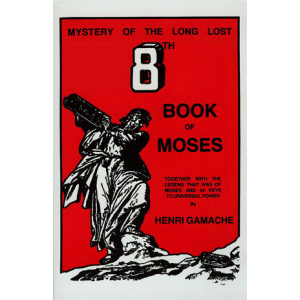
The 8th Book Of Moses

The 8th Book Of Moses Cover

Book: The 8th Book Of Moses by Ancient Grimoires

The Eighth Book of Moses, a magical treatise that otherwise has nothing to do with Moses and which is found in Greek Magical Papyrus (PGM) xiii in two versions. The end of this papyrus also mentions the "Hidden Book of Moses Concerning the Great Name," which may be another lost Moses work.

Download Ancient Grimoires's eBook: The 8th Book Of Moses

Free eBooks (Can Be Downloaded):

Solomonic Grimoires - The Book Of Secrets
Ancient Grimoires - The 6th And 7th Book Of Moses
Ancient Grimoires - The 8th Book Of Moses

Monday, September 27, 2010

The Book Of Forbidden Knowledge

The Book Of Forbidden Knowledge Cover

Book: The Book Of Forbidden Knowledge by Basil Crouch

This is the most dangerous book you will ever hold in you hands. It is books of secret rituals. The ceremonies are powerful beyond belief. They can be dangerous if treared lightly, but if directions are faithfully followed then no barm should befall you. After reading this books you life will never be same, its magic will change you life merely by reading it.

Whoosover steps one foot on this pathway stays forever. It is beyond life, beyond death, beyond eternity, beyond heaven, it it taught in the beginning so shall it remain until the stars fall from sky, and all life on Earth is destroyed.

This books deals with life and death, it deals with health and sickness, it deals with wealth, it can make you rich beyond you wildest dreams; it can also destriy you, body and mind, so be warned. Treat it with care and understanding, use it to better you life, use it for become rich, better station in life, and if necessary use it to destroy your enemies.

Buy Basil Crouch's book: The Book Of Forbidden Knowledge

Free eBooks (Can Be Downloaded):

Sasha Fierce - The Book Of Shadows
Idres Shah - The Book Of Power
Anonymous - Black Book Of Forbidden Knowledge Lucid Dreaming
Basil Crouch - The Book Of Forbidden Knowledge

Moon Eclipses

Moon Eclipses Cover A lunar eclipse occurs whenever the moon passes through some portion of the Earth’s shadow. This can only occur when the Sun, Earth and Moon are aligned exactly, or very closely, with the Earth in the middle. As such there is always a Full Moon on the night of a lunar eclipse. Every year there are at least two partial lunar eclipses, while total eclipses are much less common. The type and length of an eclipse depends upon the moon’s location relative to its orbit of the earth. As of writing this article the most recent total eclipse occurred on the 21st February 2008. The next eclipse, allbeit a partial one, will occur on the 16th August 2008. The next total eclipse is due on the 21st December 2010. Unlike a solar eclipse, which can only be seen from a number of small areas around the world, a lunar eclipse can be seen from anywhere on the night side of the Earth.

Free eBooks (Can Be Downloaded):

Charlotte Fell Smith - John Dee
Charles Baize - Pagan Scriptures
Nicolas Schreck - Demons Of The Flesh

Sunday, September 26, 2010

Alex Sanders Biography

Alex Sanders Biography Cover Alex Sanders – the “King of the Witches” as he became known - was responsible for founding the Alexandrian Tradition of Wicca, now one of the main traditions of the Wicca/Witchcraft movement. But his reign was fraught with criticism and controversy.

Alex Sanders was born Orrel Alexander Carter on the 06th June 1926 in a house on Moon St, Birkenhead. He was the eldest of six children to parents Hannah and Harold Carter. His father Harold Carter was a music hall entertainer who suffered from alcoholism, and soon after the birth of Alex, moved the family to Grape St in Manchester, there he unofficially changed the family name to Sanders. Alex was unaware of his official surname until he applied for a passport later in life, at which time he officailly changed his name to Sanders by deed poll.

As a young boy Sanders suffered with tuberculosis and would regularly visit with his grandmother in Wales, where he could benefit from the Welsh fresh air. At the age of seven, he is believed to have happened upon his grandmother “Mary Biddy” performing some sort of pagan ritual. Taken by surprise she immediately swore young Sanders to secrecy, and initiated him on the spot claiming, “Now, you are one of us”. Thus he became her student and started on the path of the Old Religion.

Sanders was a natural psychic who learned all he could from his grandmother. He claimed that she gave him her “Book of Shadows” to copy and taught him all the rites and magic of the witches including clairvoyance by scrying in inky water and using his grandmother's crystal. Sanders also claimed that following the Blitz during WWII and just a few months before her death at age 74, his grandmother conferred upon him the second and third grade initiations involving ritual sex. After her death he tried to contact other witches, and though failing continued with his studies while working for a time as a healer in Spiritualist Churches under the pseudonym of Paul Dallas.

In the early 60’s, Sanders is reported to have sought entrance to some Gardnerian covens (see Gerald Gardner), including that run by "Patricia and Arnold Crowther", who refused to accept him. Not to be put off so easily, he somehow managed to obtain a copy of the Gardnerian Book of Shadows. This he copied (badly from all accounts) and embellished it with a few of his own amendments. He then used this as the bases to found his own coven, claiming it to be a copy of his grandmother’s Book of Shadows.

Sanders was a born showman who avidly courted publicity. In September of 1962 he even succeeded in convincing the Manchester Evening News to run a front-page article about Wicca. As a result he soon attracted a large following. During this period Sanders and his coven worked from his home at 24 Egerton Road North, Chorlton-cum-Hardy, Manchester. One of his initiates was "Maxine Morris", a Roman Catholic 20 years his junior. After her initiation, they handfasted and she became his High Priestess. They were married in a civil ceremony in 1968 and moved into a basement flat near Nottinghill Gate, London. Later that same year, Maxine bore him a daughter they called "Maya".

From their new home the Sanders’ ran his London coven and taught training classes, he claimed to have initiated more than 1,623 witches working in 100 covens around the country, all-practicing what had become known as the Alexandrian Tradition. At one meeting, a gathering of sixteen of his covens, Sanders was bestowed with the title of “King of the Witches”. Sanders frequently appeared in ritual photos as robed or wearing only a loincloth while Witches surrounding him were naked. His explanation for this was that the old “Witch laws” required that the Elder of a coven should be easily identifiable from the other coven members.

In 1968-69, Sanders with Maxine appeared in and gave technical advice on a film called “Legend of the Witches”. During the press preview of the film, they met with and were introduced to "Stewart Farrar", then a reporter for the Reveille. Stewart would later be initiated by Maxine, and move on to become famous himself as a witch and author.

Without doubt Alex Sanders was a controversial and flamboyant man, who without scruples plagiarized the work of others to embellish he own. Whither he did so with malice, remains a question? Personally I don’t think so. More I assume through innocuous indifference, and mainly for the benefit of his students, even though it resulted in criticism from many in the craft. He was also without doubt a very skilled witch, and powerful magician, whose contribution to the newly evolving movement, brought witchcraft back into the public arena and changed the face of Wicca. He helped to influence many newcomers entering the craft and Alexandrian Wicca remains today one of the largest traditions of the craft.

Free eBooks (Can Be Downloaded):

Aleister Crowley - Alice An Adultery
Albert Pike - Morals And Dogma
Aleister Crowley - Alexandra

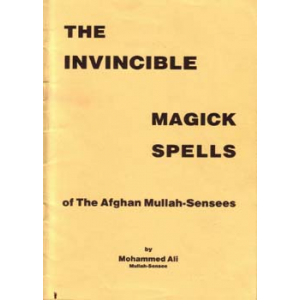
Invincible Magick Spells Of The Afghan Mullah Sensees

Invincible Magick Spells Of The Afghan Mullah Sensees Cover

Book: Invincible Magick Spells Of The Afghan Mullah Sensees by Muhammad Ibn Arabi

All the spells and signs are from the mountains of Afghanistan and the surrounding areas. All have been handed down from generation to generation, student to student. All are in their original form and have not been translated or altered so as to preserve the originality and power.

Download Muhammad Ibn Arabi's eBook: Invincible Magick Spells Of The Afghan Mullah Sensees

Free eBooks (Can Be Downloaded):

Peter Carroll - The Magical Pact Of The Illuminnates Of Thanateros
Medieval Grimoires - The Black Pullet Or The Hen With The Golden Eggs
Mcgiolla Cathain - Secret Magic Spells Of The Romany Gypsies
Muhammad Ibn Arabi - Invincible Magick Spells Of The Afghan Mullah Sensees

Monday, July 26, 2010

Witch Hunts Today

Witch Hunts Today Cover Few people are aware that witch-hunts still claim thousands of lives every year, especially in the countries of sub-Saharan Africa, and above all in South Africa.

Witch-hunts in South Africa have become "a national scourge," according to Phumele Ntombele-Nzimande of the country's Commission on Gender Equality. (Quoted in Gilbert Lewthwaite, "South Africans go on witch hunts," Baltimore Sun, September 27, 1998.) The phenomenon is centered in the country's poverty-stricken Northern Province, where "legislators counted 204 witchcraft-related killings [from 1985-95] ... Police counted 312 for the same period. Everybody agreed both numbers were gross underestimates." (Neely Tucker, "Season of the Witch Haunts Africa," The Toronto Star, August 1, 1999.) In 1996 The Observer (UK) reported that "the precise statistics are not known, but the deaths from witch-burning episodes number in the hundreds each year and the trend appears to be on the rise." (David Beresford, "Ancient superstitions, fear of witches cast spell on new nation," reprinted in The Ottawa Citizen, June 18, 1996.)

As with its European predecessor, witch-hunting in South Africa is closely tied not only to prevailing superstitions, but to socio-economic pressures, natural disasters, and personal jealousies. In the Northern Province, "among the poorly educated rural residents, traditional healers and clairvoyants claiming supernatural powers hold broad sway. And hunger, poverty, and unemployment can create jealousies that can quickly turn to anger and vengeance." (Lewthwaite, "South Africans go on witch hunts.") Likewise, Peter Alexander reports that "In a region of intense poverty and little education, villagers are quick to blame any adverse act of fate on black magic." These traditional tendencies have been exacerbated by a recent hysteria (extending to Kenya and Zimbabwe) over the very real phenomenon of "ritual killings related to witchcraft," which "include the removal of organs and limbs from the victims -- the genitals, hands or the head, all of which are believed to bring good luck." (Alexander, "'Witches' get protection from superstitious mobs," The Daily Telegraph, May 26, 1997.) Such ritual murders often bring "retribution" against innocents accused of witchcraft.

The intensity of the persecution and vigilantism in South Africa has reached such levels that no fewer than ten villages have been established in the Northern Province, populated exclusively by accused "witches" whose lives are at risk in their home communities. One such settlement, Helena, counted among its residents 62-year-old Esther Rasesemola, who "was accused in 1990 of being a witch after lightning struck her village":

A group of people visited the Inkanga [village witch-doctor] to see who was responsible. When they returned, it was my brother-in-law who told the rest of the village that I was responsible. He owed me money and I think he did it to get rid of me because he did not want to pay the money back. People in the village became convinced I was a witch. They came to my house at night and burnt it down and took all my belongings. Then they put me in a truck and drove me to a deserted place and dropped me off with my husband and my three children. They told me never to come back to the village or they would kill me. My husband died two years after we were expelled. My children have gone away and now I have nothing. I don't believe in witchcraft. It is just superstitious belief. (Quoted in Alexander, "'Witches' get protection.")

Gilbert Lewthwaite of the Baltimore Sun described the case of Violet Dangale, a 42-year-old woman who "was driven from her home 30 months ago by relatives and neighbours who accused her of being a witch growing rich from the work of zombies, as the 'living dead' are known." Now she was "penniless and in fear for her life," living in Tshilamba, another of the refuges for accused witches. Her "main accuser was her uncle. He first accused her father of using zombies to enrich himself. Then he turned on her, suggesting that she enjoyed her share of the family's wealth through witchcraft. ... As the accusations and threats grew stronger, the Dangale family fled their homes in Dzimauli." "They said I was a witch," Dangale told Lewthwaite. "I don't know anything about witchcraft. I don't believe in zombies. Since I was born, I never saw a zombie." (Lewthwaite, "South Africans go on witch hunts.")

Both of these women were luckier than 65-year-old Linah Seabi, "a sorghum beer brewer ... [who] was charged with killing an elderly woman with a poisonous potion. More than 200 villagers stormed Seabi's house in late May [1991], beat her and burned her to death with straw thatch from the roof of her house." (Nina Shapiro, "Wave of witch hunts sweeps South African countryside," The Toronto Star, September 19, 1991.) In December 1998, "Francina Sebatsana, 75, and Desia Mamafa, 55 ... were burned to death on pyres of wood in the village of Wydhoek," in the Northern Province, for alleged witchcraft. "Eleven men, ages 21 to 50" were charged with her murder. (Lewthwaite, "South Africans go on witch hunts.")

The gendering of the European witch-hunts appears to be closely duplicated in the South African case. As the above accounts suggest, "traditionally, it is women who are accused of witchcraft" (Alexander, "'Witches' get police protection"). Especially vulnerable are "defenceless elderly women, against whom the actions are taken without resistance," according to Northern Province Premier Ngoako Ramatlhodi. "That women most often are the victims of witch hunts stems from attitudes toward gender," writes Nina Shapiro of The Toronto Star:

"In our culture, men go out in the afternoon, women remain in the home," said Russell Molefe, a local journalist. People believe women sit at home concocting potions, he said. Older women are suspected, according to Lebowa police lieutenant Mohlabi Tlomatsana, simply because they are alive. "People will think 'Why has she not died? Probably because she is a witch.'" (Shapiro, "Wave of witch hunts.")

However, as in the European case-study, "these days almost a third of victims of men" (Alexander, "'Witches' get police protection.") Nonetheless, approximately 30 percent of accused witches are male -- reflecting men's prominence as nangas, or traditional healers. Anton La Guardia describes the case of "Credo Mutwa, southern Africa's best-known practising healer ... [who] said he had been accosted by a mob and stabbed several times. He lay bleeding on the ground and waited helplessly to die as his assailants poured petrol and prepared to set it alight. Mr. Mutwa ... said he was saved by the same superstition which was about to claim his life. 'A young man shouted, "His ghost will haunt you." They vanished, leaving me like a fish on dry land.'" (La Guardia, "South Africa's non-political witch-hunts," The Daily Telegraph, September 9, 1998.)

As in all these campaigns, it is difficult to assign particular responsibility for fuelling the anti-witch hysteria. Although they may themselves be accused of witchcraft, it is also generally the nangas who are called upon to point out "suspicious" persons who can be accused as witches: according to one South African police sergeant, "Generally, if people believe there is a witch in their village, they will consult the [witch-doctor]. He or she will then 'sniff out' the witch. The person who is accused will then be killed or ordered to leave the village." (Alexander, "'Witches' get police protection.") Village males usually carry out the murders and other acts of terrorism. But as in the European case-study, patterns of gossip and rumour are central to the process -- and to shielding the perpetrators from justice. South African police inspector Matome Mamabolo reports: "If someone is accused of murdering a witch, the community tends to support them by supplying money for an advocate when the case comes to court. There is a solidarity there -- after all, that person is accused of ridding the village of a witch." (Quoted in Alexander, "'Witches' get police protection.")

Much the same pattern is evident in Tanzania, Zimbabwe, and Kenya, although the gender of the victims may be more even. In August 1999, Paul Harris of the Sunday Telegraph reported that

Lynch mobs have killed hundreds of Tanzanians whom they accuse of witchcraft as black magic hysteria sweeps East Africa. Most of the usually elderly victims have been beaten or burnt to death by gangs of youths. Some old women have been singled out simply because they have red eyes -- regarded as a sign of sorcery by their assailants. The condition is actually caused by years of toiling in smoky kitchens cooking family meals. ... Police say 357 suspected witches have been killed in the past 18 months, but the Ministry of Home Affairs believes that the true figure is much higher. A departmental survey said as many as 5,000 people were lynched between 1994 and 1998. (Paul Harris, "Hundreds burnt to death in Tanzanian witch-hunt," Sunday Telegraph, August 22, 1999.)

In Zimbabwe, as in neighbouring South Africa, the witch-hunts also seem closely related to "the black market demand for human body parts, which are used in making evil potions." The upsurge in such practices, the ritual murders they require, and the vengefulness that results against accused "witches," are all linked to the country's precipitous economic decline. "It's obvious the cause is economic," says Gordon Chavanduka, head of the Zimbabwe National Traditional Healers Association (which counts 50,000 members). "The worse the economy gets, the more political tension there is in society, the more frustrated and frightened people get. They turn to witchcraft to gain riches or to hurt their enemies." (Neely Tucker, "Season of the witch haunts Africa," The Toronto Star, August 1, 1999.)

In the Kenyan case, as was also true in a handful of European countries, the witch-hunts appear predominantly to target males. A British sociologist, J.F.M. Middleton, records the conviction of the Lugbara tribe of Kenya that

a witch is a man [emphasis added] who perverts a mystical power of kinship for his own selfish ends and is therefore an evil person. Witches in general are given both physical and moral attributes: a witch has greyish skin, red eyes, a physical deformity; he may travel about upside down; he is bad tempered, secretive, petty and jealous; he is thought to practice incest and cannibalism. The distinction between witchcraft, a mystical activity, and sorcery, the use of material objects, was widespread in eastern Africa, Dr. Middleton said. When, as in Lugbara, the basic principles of organization were unilineal descent and seniority by generation it would be expected that men were believed to practise witchcraft, whereas women should have the less important role of sorcerer. ("How to recognize witches," The Times [UK], September 5, 1997.)

In Kenya in 1993, killings among the Gusii tribe were occurring at the rate of one a week. "In most cases ... village mobs several hundred strong locked the victims inside thatch-roof houses and set them on fire. ... According to tribal elders, the Gusii have always executed people found to be witches. Sanslaus Anunda, a 99-year-old tribal elder, said that during his youth, villagers had a foolproof method for determining guilt. The most respected men in the community would call a meeting. Next, they would smear local herbs on the hands of the suspect and that of a second, innocent man [emphasis added]. Both men would be ordered to dip their hands into a pot of boiling water, then return in five days. If the suspect was a witch, burns would appear on his hands. However, Anunda insists, the innocent man's hands would remain unscarred." (Tammerlin Drummong, "Kenya: Dozens die in witch hunts," The Ottawa Citizen, August 28, 1993.)

A trend of predominantly male victimization may also be evident in West Africa, where a bizarre wave of accusations of "penis-snatching" has come to light. The Reuters news agency reported in 1996 that "eight men in Accra, Ghana, were accused of using witchcraft to snatch penises. Their motivation was allegedly to return the sexual organs in return for cash. Mobs attacked them ... two died and six were seriously injured. The police examined all the alleged victims and found their genitals intact. ... [But] the 'victims' believed that sorcerers only had to touch them to make the genitals shrink or disappear completely." ("'Witches' steal penises in Ghana," Reuters dispatch, January 17, 1996.) D. Trull reported in 1997 that "the killings of alleged 'penis snatchers'" had been reported "along the west coast from Cameroon to Nigeria." (See Trull, "Witches Protection Program".)

Books You Might Enjoy:

Phil Hine - Aspects Of Evocation
Aleister Crowley - The Sixth Chakra Of The Human Body
Richard Johnson - The Zodiac Stellar Stories
Gerald Gardner - Witchcraft Today

Witch Hunting Panic And Torture

Witch Hunting Panic And Torture Cover Witch-hunting could be endemic or epidemic. Its dynamics varied. Small panics (fewer than 20 victims) tended to occur in villages worried about maleficium. Their victims were often poor, obnoxious persons whose removal the rest of the community applauded.

If small panics fed on long-smoldering fears about neighbors, large ones exploded without warning, killing people of all classes and conditions and rupturing social bonds. The worst examples of this were in Germany, where unlimited use of torture (in defiance of imperial law) produced an ever-expanding wave of denunciations. To object was to court death.

Large witch-panics started with the usual obscure suspects and worked up the social scale to prosperous citizens, reputable matrons, high-ranking clerics, town officials, and even judges. The longer a panic lasted, the higher was the proportion of male and wealthy victims.

According to the Dutch Jesuit Cornelius van Loos, confiscations from suspected witches in large panics could "coin gold and silver from human blood," Youngsters were legally old enough to burn as soon as they could distinguish "gold from an apple." Children as young as nine were burned in Wurzburg, including the bishop's nephew, and boys ages three and four were imprisoned as Satan's catamites.

Some of the German trials were marred by collusion, bribes, and rape. Unspeakable tortures were routine -- 17 different kinds were authorized by "the Saxon lawgiver," Benedikt Carpzov, during the 17th century. Confessing "without torture" in Germany meant without torture that drew blood. Nearly all who underwent this broke, even the blameless.

Yet witches sometimes did turn themselves in and confess spontaneously, the equivalent of today's "suicide by police." The same melancholy, frustration, and despair that they claimed had driven them into the devil's arms brought them willingly to the stake. They had apparently come to believe the wish-fulfillment fantasies of pleasure and revenge enacted in the theaters of their minds. Nevertheless, they still hoped to save their souls through pain.

A few brave men spoke up for justice. In 1563, Johann Weyer, a Protestant court physician, drew attention to the cruelty of the trials and the mental incompetence of many of the accused. English country gentleman Reginald Scot mocked witchcraft as popish nonsense in 1584. In 1631, the Jesuit Friedrich von Spec, confessor to witches burned at Mainz, proclaimed them innocent victims. Van Loos, witness to the horrors of witchcraft trials at Trier, had his manuscript confiscated in 1592 before it could be published and was himself imprisoned and banished.

Ironically, a Spanish inquisitor named Alonso Salazar y Frias mounted the most dramatic challenge to witch-hunting. In 1609, a panic among French Basques in the western Pyrenees on the Bay of Biscay spilled over into the Navarra region in Spain, where six accused witches went to the stake. But Salazar, who had been a judge in that trial, became skeptical as the panic widened to engulf 1,800 suspects, 1,500 of them children. Basque witches' confessions included such incredible details as familiars in the form of costumed toads that child-witches herded with little crooks during sabbats.

Salazar cross-checked testimony, had supposed magic substances tested, and applied logic to conclude that the alleged witches were simply an artifact of witch-hunting. "There were neither witches nor bewitched until they were talked and written about," he reported in 1610. With stubborn practice, Salazar wrested a decision from his superiors that freed the accused in 1614. The Spanish Inquisition never executed another witch; nor did it permit secular authorities to do so after an outbreak in Catalonia that saw more than 300 witches hanged between 1616 and 1619. What could have erupted into Europe's worst witch-panic was extinguished by one man.


Books You Might Enjoy:

Max Heindel - Teachings Of An Initiate
Richard Johnson - The Zodiac Stellar Stories
Stephen William Hawking - Space And Time Warps

Sunday, July 25, 2010

Witch Hunting Multitude Of Myths

Witch Hunting Multitude Of Myths Cover Historians have now realized that witch-hunting was not primarily a medieval phenomenon. It peaked in the 17th century, during the rationalist age of Descartes, Newton, and St. Vincent de Paul. Persecuting suspected witches was not an elite plot against the poor; not was practicing witchcraft a mode of peasant resistance. Catholics and Protestants hunted witches with comparable vigor. Church and state alike tried and executed them. It took more than pure Reason to end the witch craze.

Nor were witches secret pagans serving an ancient Triple Goddess and Horned God, as the neopagans claim. In fact, no witch was ever executed for worshipping a pagan deity. Matilda Gage's estimate of nine million women burned is more than 200 times the best current estimate of 30,000 to 50,000 killed during the 400 years from 1400 to 1800 -- a large number but no Holocaust. And it wasn't all a burning time. Witches were hanged, strangled, and beheaded as well. Witch-hunting was not woman-hunting: At least 20 percent of all suspected witches were male. Midwives were not especially targeted; nor were witches liquidated as obstacles to professionalized medicine and mechanistic science.

This revised set of facts should not entirely comfort Catholics, however. Catholics have been misled -- at times deliberately misled -- about the Church's role in the witch-hunts by apologists eager to present the Church as innocent of witches' blood so as to refute the Enlightenment theory that witch-burning was almost entirely a Catholic phenomenon. Catholics should know that the thinking that set the great witch-hunt in motion was developed by Catholic clerics before the Reformation.

But the great witch-hunt was nonetheless remarkably slow in coming. Many cultures around the world believed for millennia -- and still believe -- in witches. In typical folklore, past and present, witches are night-flying evildoers who inflict harm on others by supernatural means, such as curses, the evil eye, and magic substances. Witchcraft is usually thought of as an innate power, unlike sorcery, whose magical spells must be learned. What Christianity uniquely added to those traditional beliefs was Satan. God's enemies were said to join Satan's band of demons through a pact and worship him at monstrous bacchanals called "sabbats," where they parodied the liturgy.

The Church inherited Roman and Germanic laws regarding maleficent magic, laws that treated witchcraft as a crime. But to St. Augustine, concrete witchcraft consisted of idolatry and illusion rather than harm to others. Following Augustine, an Anonymous ninth-century text, Canon Episcopi, became part of the Church's canon law, declaring that belief in the reality of night-flying witches was heresy because there was no such thing as an actual witch. Although the idolatry and heresy associated with witchcraft resided only in the will, not in actual deeds, they were nevertheless sinful, Augustine wrote. Punishment was in order -- but not burning.

The High Middle Ages of the twelfth and 13th centuries saw the bloody suppression of heretics, notably the Cathars in Provence. Measures against Jews, magicians, and sexual deviants also grew harsher. These groups were associated with a stereotyped set of blasphemies, orgies, and outrages, including infanticide and cannibalism. Starting in 1232, the papal Inquisition dispatched roving specialists to detect and punish heretics outside existing legal systems.

Then, the idea that witchcraft was a reality rather than a heretical illusion suddenly made a comeback. The inquisitors who had cut their teeth on heretics were devouring accused witches as well by the end of the Middle Ages. This was not simply a matter of shifting scapegoats to suit market demand. In a society that feared supernatural menaces working through human conspiracies, the sinister folk figure of the esoterically schooled magician apparently fused with that of the petty village wise-woman or cunning man to create the new phenomenon of the diabolical witch.

After the first wisps of this change in the late 14th century, the flames burst forth around 1425 in the Savoy region, in what is now southeast France, and in the canton of Valais in Switzerland, near the borders of France and Italy. About 500 more witch trials followed before the Reformation began in 1517.

Books You Might Enjoy:

Richard Alan Miller - The Magical And Ritual Use Of Herbs
Edna Kenton - The Book Of Earths
Michael Johnstone - The Ultimate Encyclopedia Of Spells

Witch Hunts And Persecution In America

Witch Hunts And Persecution In America Cover As most Americans know, witch hunts also affected the American colonies. The Salem witch trials pursued the Massachusetts Puritans have entered American consciousness as being much more then just the killing of witches. They, like the trials of Europe, have become a symbol. In our case, the witch trials have become a symbol of what can go wrong when mobs of ignorant people go crazy, especially when egged on by just as ignorant and/or power hungry leaders.

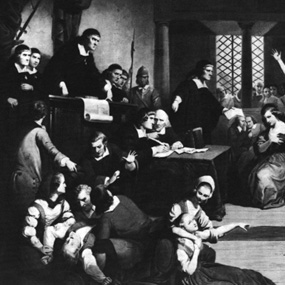
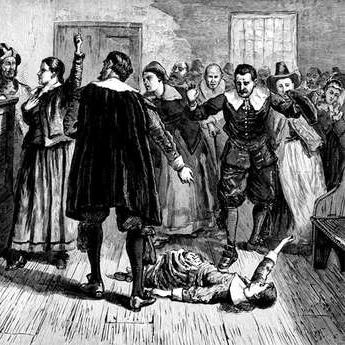
The Salem story began in 1692 when a few girls, who had become friendly with a slave woman named Tituba, began acting very strangely -- hysterical screaming, falling into convulsions, barking like dogs, etc. Soon other girls began acting in a similar manner and of course they all must have been possessed by demons. Three woman, including Tituba, were promptly accused of witchcraft. The result was much like the European experience, with a chain-reaction of confessions, denouncements, and more arrests.

In an effort to help combat the witch menace, courts relaxed traditional rules of evidence and procedure -- after all, witches are a terrible menace and must be stopped. In place of the normal rules and methods, the courts used what was common among Inquisitors in Europe -- scouring the womens' bodies for marks, numb spots, etc. Also accepted were "spectral sources" of evidence -- if someone had a vision of a woman being a witch, that was good enough for the judges.

The people who were mostly killed were not those who submitted quickly and obediently to authorities. Only those who were defiant or hostile were put to death. If you admitted being a witch and repented, you had a very good chance of living. If you denied being a witch and insisted that you had rights which must be acknowledged, you were on a quick path to execution. Your chances were also bad if you were a woman -- especially if you were an older, deviant, troublesome or somehow disorderly woman.

In the end, nineteen people were executed, two died in prison and one man was pressed to death under rocks. This is a better record than what we see in Europe, but that isn't saying very much. The religious and political authorities clearly used the witch trials to impose their own ideas of order and righteousness upon the local populace. As in Europe, violence was a tool used by religion and religious people to enforce uniformity and conformity in the face of dissent and social disorder.

Books You Might Enjoy:

Mira Ray - Minerals And Gems In Indian Alchemy
Anonymous - Protection Of Space
Gabor Klaniczay - Witchcraft Mythologies And Persecutions

Saturday, July 24, 2010

Who Is A Witch

Who Is A Witch Cover The origin of the word witch predates the Anglo-Saxon period. Etymologically, the word has been derived from an Old English masculine noun wicca, the feminine being wicce. The word ‘wicker’ in old German also stood for a soothsayer. A soothsayer is a fortune-teller or psychic.

In routine usage, a witch is a feminine noun for wizard or sorcerer, but the former has different functional connotations from its masculine counterpart. While a wizard or a sorcerer may have some element of manipulativeness in their craft, a witch, though a practitioner of witchcraft, is far from being a crafty person. A witch is essentially a very noble and deeply religious person whose purity of heart combined with spiritual and meditation practices bestow her with a deeply religious and mysterious aura. A witch does not act with any ulterior motives, not to mention any machinations in her pursuits. A witch is a very compassionate person, gifted with supernatural powers and works for the alleviation of pain and suffering of her fellow human beings and brings them the much needed solace and succor.

A highly misunderstood, deeply suspected, much maligned and doggedly hounded person especially during the middle ages, a witch has regained lost ground and has acquired a respectable position in the society. Colloquially, the term witch, applied most often to a female, also includes male practitioners of witchcraft, especially Wicca. Witches believe in certain ethical codes and strictly adhere to them.

A witch engaged in her witchcraft practices spells developed by worshiping many deities primarily the supreme Goddess and sometimes her consort the God. The craft or workings of a witch are used for healing the acute health problems. For curing these problems, she uses the personal powers in combination with energies within candles, stones, herbs and other natural items. Witch practices witchcraft to help better the world and mankind. A witch certainly is not ugly, nefarious, dreadful hag who worships the devil or hurts the people as the stereotype image presents her to be.

A witch derives her strength from Paganism, which is influenced by ancient, primarily pre-Christian and sometimes pre-Judaic religion. A witch has deep faith in the elements of Nature such as earth, fire, nature, air, and water. Fire cleanses and has an aura that transports her into the astral world and enables her to view this world with psychic clarity. Water purifies.connects with the Goddess herself. The air is an all-enveloping blanket of gods. It wraps around the witch and lifts her to the divine immenseness and freedom of the skies. The spirit of the witch gets united with the air and floats freely in the sky. The witch achieves this uplifted state through meditation, perseverance and sometimes she is blissfully born with these talents.

A witch is just as ordinary looking person as any one in your neighborhood. She can be a housewife with kids doing her daily domestic chores. She too has her share of emotions, but they function more at a macro level than at personal. So if she is feeling sad, the sadness is not just due to some personal vested interest, but it is born out of the suffering of the world around her. Another difference between a witch and an ordinary woman is that a witch can commune with her goddess. The commune is just meant to bare her soul reaching a complete state of oneness. A witch may even cry before the alter of her goddess whenever she feels a spiritual vacuum and wants to replenish it with godliness.

A witch performs her craft using many rituals such as worshiping alone or in covens in the alter room. She lights candles, incense, chants incantations and worships her deities or goddesses. She meditates while staring into the candle flames and in the course of meditation, she feels her spirit leaving her body and enters into trance. A witch gets lost in the awesome power of the Fire with her mind dancing with the flames of the candles. Insightful images deluge her head and become a permanent part of her psyche.

Witches also practice necromancy and summon spirits of the dead to gain knowledge of the future events from them. These spirits are called Operative Spirits or the Spirits of divination.

Books You Might Enjoy:

Michael Bailey - Historical Dictionary Of Witchcraft
Howard Phillips Lovecraft - Cults Of Cthulhu
Mike Nichols - Eight Sabbats Of Witchcraft
Louise Huebner - Witchcraft For All
Paul Huson - Mastering Witchcraft

Friday, July 23, 2010

Hubble Bubble Pardoned From Trouble

Hubble Bubble Pardoned From Trouble Cover It's Halloween and, consequently, one of my favorite days of the year. There are some things that have become inexorably linked to this holiday: candy, costumes, watching It's the Great Pumpkin Charlie Brown and, of course, witches.

Modern culture has really taken the witch in interesting places. From the evil Wicked Witch of the West in the original Wizard of Oz to the Not-Really-Wicked-But-Misunderstood Witch of the West Elphaba in the book and play Wicked, it is clear that witches can take on any number of personas. Today, witches can be good, bad, cutesy, goofy, and cunning. But not so long ago, the term "witch" was not taken so lightly.

Here at the Museum of Jewish Heritage, we often talk about scapegoating. If one looks at the history of the witch, this term comes to the fore pretty quickly. In Europe, between approximately 1480 and 1700, between 40,000 and 100,000 women and men were put to death on the charge of witchcraft. Accusations often arose as a result of an unexplained natural phenomenon--such as a failed crop or sick livestock-- or simply out of the malicious desire to seek revenge on another person.

Today, campaigners will petition Justice Secretary Jack Straw to posthumously pardon the 2,400 women and men wrongfully put to death for witchcraft in England and Scotland before the Witchcraft Act put an end to the practice in 1735. (Read full article here.) These campaigners follow the example of Swiss groups who successfully urged the government to pardon Anna Goeldi, the last woman in Europe on record to be put to death for witchcraft in 1782. While such pardons are, of course, entirely symbolic, I think this gesture is an important one. Not only does it officially clear the names of innocent victims, but makes a stand against scapegoating and lets everyone know that this injustice has no place in today's society.

Books You Might Enjoy:

John White - Toward Homo Noeticus
Ea Wallis Budge - Egyptian Ideas Of The Future Life
Aleister Crowley - Songs For Italy

Thursday, July 22, 2010

The Witch Hunts Of Early Modern Europe

The Witch Hunts Of Early Modern Europe Cover For three centuries of early modern European history, diverse societies were consumed by a panic over alleged witches in their midst. Witch-hunts, especially in Central Europe, resulted in the trial, torture, and execution of tens of thousands of victims, about three-quarters of whom were women. Arguably, neither before nor since have adult European women been selectively targeted for such largescale atrocities.

The witch-hunts of early modern Europe took place against a backdrop of rapid social, economic, and religious transformation. As we will see in the modern-day case-studies below, such generalized stress -- including the prevalence of epidemics and natural disasters -- is nearly always central to outbreaks of mass hysteria of this type. Jenny Gibbons' analysis ties the witch-hunts to other "panics" in early modern Europe:

Traditional [tolerant] attitudes towards witchcraft began to change in the 14th century, at the very end of the Middle Ages. ... Early 14th century central Europe was seized by a series of rumor-panics. Some malign conspiracy (Jews and lepers, Moslems, or Jews and witches) was attempting to destroy the Christian kingdoms through magick and poison. After the terrible devastation caused by the Black Death [bubonic plague] (1347-1349), these rumors increased in intensity and focused primarily on witches and "plague-spreaders." Witchcraft cases increased slowly but steadily from the 14th-15th century. The first mass trials appeared in the 15th century. At the beginning of the 16th century, as the first shock-waves from the Reformation hit, the number of witch trials actually dropped. Then, around 1550, the persecution skyrocketed. What we think of as "the Burning Times" -- the crazes, panics, and mass hysteria -- largely occurred in one century, from 1550-1650. In the 17th century, the Great Hunt passed nearly as suddenly as it had arisen. Trials dropped sharply after 1650 and disappeared completely by the end of the 18th century. (Gibbons, "Recent Developments in the Study of the Great European Witch Hunt".)

Gibbons' allusion to the Reformation reminds us that the clash between institutional Catholicism and emergent Protestantism contributed to the collapse of a stable world-view, which eventually led to panic and hyper-suspiciousness on the part of Catholic and Protestant authorities alike. Writes Nachman Ben-Yehuda, "This helps us understand why only the most rapidly developing countries, where the Catholic church was weakest, experienced a virulent witch craze (i.e., Germany, France, Switzerland). Where the Catholic church was strong (Spain, Italy, Portugal) hardly any witch craze occurred ... the Reformation was definitely the first time that the church had to cope with a large-scale threat to its very existence and legitimacy." But Ben-Yehuda adds that "Protestants persecuted witches with almost the same zeal as the Catholics ... Protestants and Catholics alike felt threatened." It is notable that the witch-hunts lost most of their momentum with the end of the Thirty Years War (Peace of Westphalia, 1648), which "gave official recognition and legitimacy to religious pluralism." (Ben-Yehuda, "The European Witch Craze of the 14th to 17th Centuries: A Sociologist's Perspective," American Journal of Sociology, 86: 1 [July 1980], pp. 15, 23.)

Books You Might Enjoy:

John Moore - A Modern Master Extract
Will Herberg - The Writings Of Martin Buber
Nathan Johnston - The Devil And Demonism In Early Modern England
Margaret Alice Murray - The Witch Cult In Western Europe
Diane Purkiss - The Witch In History Early Modern And Twentieth Century Representations

Sunday, July 18, 2010

Killing Witches As The Best Way To Kill Witchcraft

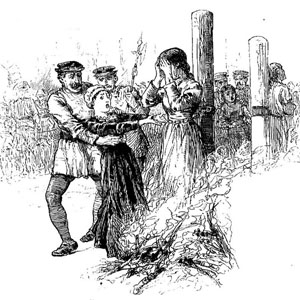
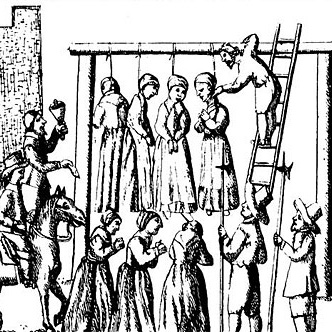
Killing Witches As The Best Way To Kill Witchcraft Cover Burning and hanging were the most popular forms of execution for accused witches in medieval Europe. Burning seems to have been most common in continental Europe while hanging was more common in Britain -- and thus also in the American colonies later as well. The death penalty was imposed on a wide variety of crimes in this era, but witchcraft in particular was punished by death on the basis of Exodus 22:18: "Thou shalt not suffer a witch to live" and Leviticus 20:27: "A man also or woman that hath a familiar spirit, or that is a wizard, shall surely be put to death: they shall stone them with stones."

The heretics who were the earlier targets of the Inquisition were almost never executed at first. They typically had a chance to repent and submit to the Church; only after relapsing into heresy did they generally become subject to execution. Even then, they might still be given another chance to repent. Witches received almost the exact opposite treatment: execution was typically applied after the first accusation and only rarely were accused witches allowed to go free after repenting.

This helps demonstrate the level of threat which the Church made out of witches and witchcraft. Witches couldn't be allowed to live no matter what -- not even if they were willing to admit all that they were accused of and fully repent. Their evil was too much of an existential threat to Christian society and they had to be completely excised, not unlike cancer which has to be cut out lest it kill the entire body. There was simply no tolerance or patience for the witches -- they had to be eliminated, whatever the cost.

Some have claimed that as many as nine million women were executed as witches, even though few could possibly have been truly guilty of witchcraft, and that because this represented a deliberate attempt to kill women generally it should be dubbed a "Women's Holocaust." More recent research demonstrates that many accused witches were men, not just women, and that number of those executed is far lower. Estimates today range from 60,000 to 40,000. Even if we are especially pessimistic, we probably can't go higher than 100,000 people killed across all Europe and over an extended period of time. That's obviously very bad, but not quite a "Holocaust."

Books You Might Enjoy:

William Godwin - The Lives Of The Necromancers
Dr Leo Martello - Weird Ways Of Witchcraft
William Butler Yeats - The Secret Rose And Rosa Alchemica
Allen Greenfield - A True History Of Witchcraft
Michael Harrison - The Roots Of Witchcraft

Popular Posts