Showing posts with label book of shadows. Show all posts

Friday, October 8, 2010

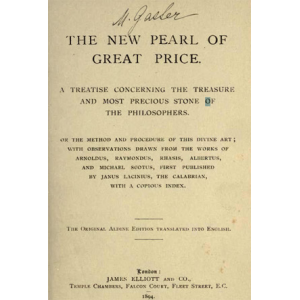
The New Pearl Of Great Price

The New Pearl Of Great Price Cover

Book: The New Pearl Of Great Price by Janus Lacinius Therapus

A treatise concerning the treasure and most precious stone of the philosophers. Or the method and procedure of this divine art ; with observations drawn from the works of Arnoldus, Raymondus, Rhasis, Albertus, and Michael Scotus (1894)

THIS work casts out cruel disease from the human body, disease produced by malignant humours ; and thus you are preserved. It will teach you how to regain the beautiful flower of youth, and how to secure a green and placid old age. All this may be yours, by the favour of the gods. Poverty will be triumphantly put to flight ; your treasure-house will be filled ; you will be able to succour the needy,
and to render the sacrifice of praise to great Jupiter.

TWO features of special interest attach to the " Pearl of Great Price," as written by Bonus of Ferrara, and edited by Janus Lacinius. In the first place, it is one of the earliest works printed on alchemy, and the original is a very beautiful specimen of typography. Concerning the latter point, it is only necessary to say that it was issued from the press of Aldus, appearing in 1546, with the privilege of Pope Paul III. and the Senate of Venice for the space of ten years. This edition is, of course, exceedingly rare, and is highly prized by collectors. In the second place, it is a very clear, methodical, and well-reasoned treatise, comparing favourably in these respects with the bulk of alchemical literature. A reader who is unacquainted with alchemy will probably not appreciate these points,
but any one who, like the present editor, has had occasion to become widely familiar with Hermetic authors, will do honour to the lucidity of Bonus.

Concerning" the adept himself, no biographical materials whatsoever are forthcoming, nor, as in most other cases, is there even a legend to fall back on. He is supposed to have been a native of Lombardy, and to have performed his alchemical labours at Pola, a maritime town of Istria, about 1330. He is sometimes described as Bonus of Ferraria,* and on this and other grounds Tiraboschi't identifies him with the "monk Ferarius".

This work attacks Lenglet du Fresnoy, the historian of alchemy, as an inexact writer, but Tiraboschi had no acquaintance whatsoever with alchemy, and does not seem to have read the Authors whom he endeavours to identify. Imaginative persons might, perhaps, be more inclined to question the equivocal name of Janus, the Calabrian Minorite Friar, and to suspect that his master Bonus was possibly his alter ego.


Download Janus Lacinius Therapus's eBook: The New Pearl Of Great Price

Free eBooks (Can Be Downloaded):

Isaac Bonewits - The Enemies Of Our Enemies
Aleister Crowley - The World Of Tarot
Ralph Blum - The New Book Of Runes
Anonymous - The Magical Library Of Harry Price
Janus Lacinius Therapus - The New Pearl Of Great Price.pdf

Tuesday, October 5, 2010

Solitary Wicca For Life Complete Guide To Mastering The Craft On Your Own

Solitary Wicca For Life Complete Guide To Mastering The Craft On Your Own Cover

Book: Solitary Wicca For Life Complete Guide To Mastering The Craft On Your Own by Arin Murphy Hiscock

If you prefer a solitary approach to worship and Witchcraft, this is the book for you. You need sound guidance and tools as you work alone to deepen your knowledge and strengthen your abilities.

Author Arin Murphy-Hiscock provides you with everything you need to take your spiritual practice to the next level. Solitary Wicca for Life encourages you to reach beyond the ordinary and create a unique path of worship, using techniques that go further than other texts:

- Advanced Circle Casting-advanced techniques and applications, plus methods for creating sacred space when a circle isn't necessary
- Enriching Ritual-tools and techniques that bring new depth to personal practice, including sacred drama, masks, ritual garb, and symbols
- Crafting Liturgy-Wiccan ritual defined stage by stage, as well as guidelines for writing invocations, prayers, meditations, and personalized rituals for esbats, sabbats, rites of passage, and more
- Drawing Down Deities-invoking deities for guidance, communion, worship, etc.
- Growing as a Solitary Wiccan-the means by which you'll enhance your spiritual growth and reach out to the world at large.

Solitary Wicca for Life is the essential reference handbook you need to reach deeper, go farther, and strengthen your solitary path-one day at a time.

I read lots of Wicca 101 books, especially those that seem to be aimed at the Solitary Practitioner. With many of them, I will find some points that I think the average solitary practitioner may relate to, or that someone, somewhere, will relate to. Many times, however, the material does not "click" with my own personal beliefs, or they do not take the "Traditional Path" when it comes to Wicca, but rather they are "Wiccanish". This is OK for someone else, but not necessarily for me. But I do not judge by my standards alone, but rather the viewpoint that everyone needs material that will relate to them personally.

Reading this book, however, there was more material here that I found I agreed with, related to and found to be "Traditional" with a Solitary spin than other books of this kind. And this, to me, was a big plus.

Ms. Murphy-Hiscock has taken Wicca back to the roots and explores adaptation to the Solitary way of practice. This is a Wicca 101 book, so it makes a good first handbook for the average new Solitary practitioner and yet, it provides some material that the advanced practitioner may want to review because of its accuracy, to augment their Wiccan practice, to add elements of the Traditional or just because it is well written and has much to ponder and contemplate.

I especially enjoyed her overview of Wicca Origins, and her separation of Traditional Wicca from the Eclectic practices that Wicca has evolved into. She covers well the Tenets of Wicca, discusses common metaphors and myths and separates some of the more widely accepted but none the less mistaken beliefs and practices that have crept into modern Wicca. She gives you a good idea of how to go back to the beginning, re-examine the issues and maybe take away a better representation of what it is that Wicca is really all about.

Arin Murphy-Hiscock has been a practicing Wiccan for ten years, five of those years as a solitary practitioner. She is the series editor of the For Life series and the author of Power Spellcraft for Life: The Art of Crafting and Casting for Positive Change. She lives in Montreal, Canada.

Buy Arin Murphy Hiscock's book: Solitary Wicca For Life Complete Guide To Mastering The Craft On Your Own

Free eBooks (Can Be Downloaded):

Pauline Bradford Mackie Hopkins - Ye Lyttle Salem Maide A Story Of Witchcraft Ocr Version
Janet Farrar - A Witches Bible The Complete Witches Handbook
Anthony Arndt - Blotar A Brief Guide To Asatru Ritual
Aj Drew - Wicca For Couples Making Magick Together
Right - Travel In Spiritual Worlds A Complete Guide On Astral Travels

Saturday, October 2, 2010

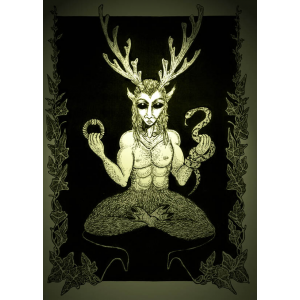
Invocation Of The Horned God

Invocation Of The Horned God Cover By the flame that burneth bright
O Horned One!

We call thy name into the night
O Horned One!

Thee we invoke by the moon led sea
By the standing stone and the twisted tree
Thee we invoke where gather thine own
By the nameless shrine forgotten and lone

Come where the round of the dance is trod
Horn and hoof of the goat-foot God
By moonlit meadow on dusky hill
When the haunted wood is hushed and still

Come to the charm of the chanted prayer
As the moon bewitches the midnight air
Evoke thy powers, that potent bide
In shining stream and secret tide

In fiery flame by starlight pale
In shadowy host that ride the gale
And by the fern-brakes fairy-haunted
Of forests wild and wood enchanted

Come! O Come!
To the heartbeats drum!

Come to us who gather below
When the broad white moon is climbing slow
Through the stars to the heavens height
We hear thy hoofs on the wind of night
As black tree branches shake and sigh
By joy and terror we know thee nigh

We speak the spell thy power unlocks
At Solstice, Sabbat, and Equinox

Word of virtue the veil to rend
From primal dawn to the wide world's end
Since time began---
The blessing of Pan!

Blessed be all in hearth and hold
Blessed in all worth more than gold
Blessed be in strength and love
Blessed be wher'er we rove

Vision fade not from our eyes
Of the pagan paradise
Past the gates of death and birth
Our inheritance of the earth

From our soul the song of spring
Fade not in our wandering

Our life with all life is one,
By blackest night or noonday sun
Eldest of gods, on thee we call
Blessing be on thy creatures all

by Doreen Valiente

Free eBooks (Can Be Downloaded):

John Ronald Tolkien - Introduction To The Elder Edda
Aleister Crowley - The Invocation Of Thoth
James Eschelman - Invocation Of Horus

What Is A Spell

What Is A Spell Cover A spell is a spoken or written formula that when used in an act of magick is intended to cause or influence a particular course of events. Belief in and the use of spells are universal and have been an integral part of religious practices since ancient times. Methods vary according to culture but all spell work is based on ritual.

Spells are closely related to Prayers, which are rituals consisting of a petition to the Gods or deities (whatever the religion or faith) for a desired outcome. It involves the visualization of a goal, a statement of desire for the goal, and ritualized movements of body positions (e.g., the bowing of the head, the clasping of the hands, the closing of the eyes etc). In magick, spells are closely related to various methods of mind power such as: creative visualization, positive thinking, and positive imaging (see “What is Magick”). All of which emphasize our mental images of the goal and our identification with it, repetition of our intent to achieve this goal, projection of our will, and a petition to the spirits, deities, or the divine force for their aid.

These types of spells are commonly used on a daily bases, the simple lighting of a candle starting the ritual process. Such daily spells constitute minor magick's such as: blessings, self-help, positive thoughts and the sending of helpful healing energies to others. Used on a daily bases it is not therefore necessary to undertake the cumbersome task of a full circle casting ritual (see Circle Casting).

Spells can be beneficial or harmful and can be worked on people, animals, and nature. Their purposes are limitless and include: healing, love, money, success, fertility, longevity, and protection from disaster, ill fortune, and evil. They can also be used to exorcise ghosts and spirits, for victory in battle, truth in divination, weather control, and the accomplishment of supernatural feats. When directed against enemies, spells can be used to cause illness, destruction, loss of love, impotence, barrenness, failure and even death. Spells can be cast to affect the self, or directed to affect another person.

A positive spell is often called a blessing, although such archaic terms as bewitchment and enchantment are still sometimes used. Negative spells are generally known as hexes or curses. A binding spell is one intended to prevent harm, avoid danger, or to stop someone from performing particular acts (e.g., halting a murder, preventing a rape, or even stopping the spread of gossip).

In most cultures, Witches, Sorcerers, Witch doctors, Magicians, and other magically empowered peoples, cast both beneficial and harmful spells as the need dictates. However in contemporary Paganism and Witchcraft, a set of ethics exists that prohibits the use of curses and negative spells against another (see the “Wiccan Rede” and the “Three Fold Law”). The acceptability of binding spells is divided, and is widely debated throughout the community.

Free eBooks (Can Be Downloaded):

Anonymous - Hypnotism Spells
Arthur Edward Waite - What Is Alchemy
Stephen Mcnallen - What Is Asatru

Wednesday, September 29, 2010

The Golden Verses Of Pythagoras

The Golden Verses Of Pythagoras Cover

Book: The Golden Verses Of Pythagoras by Antoine Fabre Dolivet

This is english translation of The Golden Verses of Pythagoras by Antoine Fabre d'Olivet (December 8, 1767-March 25, 1825) a French author poet, and composer whose biblical and philosophical hermeneutics infuenced many occultists, such as Eliphas Lvi and Gerard Encausse (Papus), and Ren Gunon.

The Golden Verses of Pythagoras are a collection of moral exhortations. They comprise 71 lines written in hexameter verse and are traditionally attributed to Pythagoras.

The exact origins of the golden verses are unknown and there are varying opinions regarding their dating. It appears that the verses may have been known as early as the third century BC but their existence as we know them cannot be confirmed prior to the fifth century AD.

The golden verses enjoyed great popularity and were widely distributed in late antiquity being often quoted. Their renown persisted during the medieval ages and into the renaissance.
The Neoplatonists used the golden verses as part of their preparatory program of moral instruction and a number of neoplatonic commentaries on the verses are extant.


Download Antoine Fabre Dolivet's eBook: The Golden Verses Of Pythagoras

Free eBooks (Can Be Downloaded):

Anonymous - The Gospel Of Thomas
Anton Josef Kirchweger - The Golden Chain Of Homer
Samuel Croxall - The Secret History Of Pythagoras
Antoine Fabre Dolivet - The Golden Verses Of Pythagoras

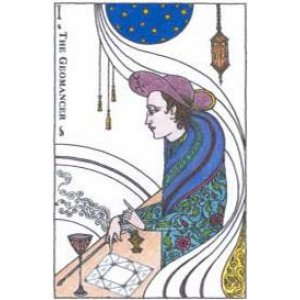
Astronomical Geomancy

Astronomical Geomancy Cover

Book: Astronomical Geomancy by Gerald Cremonensis

Astrological geomancy is an ancient method of divination. The word geomancy means earth divination and is believed to have come from the use of sand to generate the geomantic figures, the basis of prediction in geomancy. This also accounts for its Arabic name, ilm al-raml, literally the science or wisdom of the sand.

In the modern era the ancient art of divinatory geomancy has been confused with Chinese feng shui which is not a method of divination, but a science of spatial arrangement, architecture and landscaping. Divinatory geomancy has also had its name appropriated by the modern New Age study of ley lines and earth "energies" which are also not techniques of divination.
Contemporary practitioners of the traditional Western art of geomancy have taken to referring to it as divinatory or astrological geomancy to differentiate it from these more modern uses of the term. Astrological geomancy is a particularly appropriate term as much of the divinatory methodology used in geomancy comes from traditional astrology.

The origins of geomancy are shrouded in mystery, but the first manuscripts describing the practice appear in the 9th century AD in the advanced Islamic civilization of the Middle East. From there it spread to Europe in the 11th and 12th centuries as part of the reception of many arts and sciences, including the occult arts of astrology, alchemy and magic by the rapidly civilizing West. Known in Arabic as ilm al-raml, literally the science or wisdom of the sand, geomancy became quite popular as a divinatory technique because of its ease of learning and use. Here is an interesting article in pdf form by the Dutch academic Wim van Binsbergen on the Astrological Origin of Islamic Geomancy. Because of its close connection to astrology, geomancy has been called "the Daughter of Astrology" and known as terrestial astrology.

Download Gerald Cremonensis's eBook: Astronomical Geomancy

Free eBooks (Can Be Downloaded):

Anonymous - Gerald Cremonensis On Astrological Geomancy
Henry Cornelius Agrippa - Of Geomancy
Nick Farrell - Notes On Geomancy
Gerald Cremonensis - Astronomical Geomancy

The Magic Of Armadel

The Magic Of Armadel Cover

Book: The Magic Of Armadel by Solomonic Grimoires

The grimoire of Armadel translated from the original French and Latin of a manuscript in the Biblotheque l'Arsenal in Paris. This is classed as a Christian Grimoire and contains many important seals and sigils of the various demons and planetary spirits. First translated by S.L. McGregor Mathers in the late 1890’s. The Grimoire of Armadel remained unpublished until 1980.

What follows is an unabridged introduction taken directly from the version of the Grimoire by Frator Alastor:

“…….When Mathers made his translation he notice that the title page was the last page of the Grimoire, so he moved to the front but keep the rest of the chapters in the same order. He also notice that this Grimoire began speaking about the magick circle like if it where something that the reader should already know. Now it is my believe that the whole Grimoire was written backward, this is to say that you should read the last page first (the title page) then the last chapter and so on. If you read it this way you will see that make a lot of sense. In Mathers version the first chapter is a reference to the magick circle and the License to depart, it make no sense to begin a Grimoire that way since the license to depart is the last think that a magician read. Also if you fallow the Latin titles in Mathers version the text begin with the Sanhedrin, Jesus and go on to the creation of Adam and the demons and the angels etc. This order is completely the opposite of that one on the bible this is god first, then the angels, the demons, Adam, Jesus, the Crucifixion and the Sanhedrin. So neither to say I had inverted the orders of the chapters in Mathers version under the believing that this is the way that the magic was intended to be read.”

Download Solomonic Grimoires's eBook: The Magic Of Armadel

Free eBooks (Can Be Downloaded):

William Blake - The Marriage Of Heaven And Hell
John Musick - The Witch Of Salem
Reynold Nicholson - The Mystics Of Islam
Aubrey Bell - The Magic Of Spain
Solomonic Grimoires - The Magic Of Armadel

Tuesday, September 28, 2010

The Pungo Witch

The Pungo Witch Cover The Pungo Witch, as she has come to be called, or in real life, Grace Sherwood, was accused of bewitching a neighbor's crop in 1698. Allegations of other 'witchy' things escalated over time in the Princess Anne County government. Her accusers decided to test her by 'ducking,' or, trial by water, her innocence or guilt determined by whether she floated or drowned. Drowning, by the way, was the GOOD outcome.

On July 10th, 1706 at ten o'clock, Grace Sherwood was tied by her thumbs, cross-bound and dropped into the western branch of the Lynnhaven River near what is now known as Witchduck Point in Virginia. Unfortunately for Sherwood, she floated. Guilty of being a duck? No, guilty of being a witch. She was imprisoned, and eventually released, but Sherwood lived the rest of her life quietly unvindicated, and died in 1740.

I guess they taught her a lesson, huh? Grace Sherwood was a midwife who would often wear men's clothing while working her own homestead. She went to court a dozen times to either defend herself or sue her neighbors for slander, yet never turned her back on a woman in need of her skills. She never married. Thus one can assume that then, as now, a woman who takes care of herself, a confident, competent woman, is suspect at best, ducked at worst, but always, apparently, in need of being taught to mind her place.

In 2006, she was pardoned by the Governor of Virginia, Timothy M Kaine--300 years after her ordeal. The wheels of justice sure do run slow, sometimes, but at least they turn.

Free eBooks (Can Be Downloaded):

Anonymous - The Laws For Witches
Margaret Alice Murray - The God Of The Witches
Alfred Elton Van Vogt - The Witch

The 8th Book Of Moses

The 8th Book Of Moses Cover

Book: The 8th Book Of Moses by Ancient Grimoires

The Eighth Book of Moses, a magical treatise that otherwise has nothing to do with Moses and which is found in Greek Magical Papyrus (PGM) xiii in two versions. The end of this papyrus also mentions the "Hidden Book of Moses Concerning the Great Name," which may be another lost Moses work.

Download Ancient Grimoires's eBook: The 8th Book Of Moses

Free eBooks (Can Be Downloaded):

Solomonic Grimoires - The Book Of Secrets
Ancient Grimoires - The 6th And 7th Book Of Moses
Ancient Grimoires - The 8th Book Of Moses

Monday, September 27, 2010

The Secret Grimoire Of Turiel

The Secret Grimoire Of Turiel Cover

Book: The Secret Grimoire Of Turiel by Medieval Grimoires

Turiel in the Book of Enoch

Turiel in later translations was the 18th Watcher of the 20 leaders of the 200 fallen angels that are mentioned in an ancient work called the Book of Enoch. The name is believed to originate from tuwr, el (God) meaning "rock of God". The translation taken from Michael Knibbs work on the Ethiopic Book of Enoch is "Mountain of God" or "Rock of God".

Grimoire of Turiel

There is a grimoire called "The Secret Grimoire of Turiel" in which the magician is given instructions on how to contact Turiel. It was believed to have been written in about 1518, but may have been copied from something older. It came to light in 1927 after being sold to Marius Malchus in Spain by a defrocked priest and was then translated into English from the original Latin. However, since Turiel is only previously mentioned in the Book of Enoch, it is unlikely that Turiel would have been known in the west before the rediscovery of the Book of Enoch in the early 17th century. No version previous of 1927 has been brought to the public.

Download Medieval Grimoires's eBook: The Secret Grimoire Of Turiel

Free eBooks (Can Be Downloaded):

Anonymous - The Secret Book Of Artephius
Yacki Raizizun - The Secret Of Dreams
Parker Torrence - The Craft Grimoire Of Eclectic Magic
Austin Osman Spare - The Zoetic Grimoire Of Zos
Medieval Grimoires - The Secret Grimoire Of Turiel

Arnold Crowther Biography

Arnold Crowther Biography Cover Arnold Crowther was a skilled stage magician and ventriloquist with interests in paganism and witchcraft. He co-authored two books and a radio series on witchcraft, with his wife Patricia Crowther, and wrote numerous articles for a variety of magazines. His greatest claim to fame though comes as the connecting influence between Gerald B Gardner, and Aleister Crowley.

Born in Chatham, Kent, on the 6th October 1909, Crowther was one side of twin brothers. His mother was Scottish and his father, an optician came from Yorkshire. Crowther from an early age was fascinated with sleight-of-hand magic, ventriloquism, and puppeteering. From the age of eight he began practicing tricks and perfecting his technique in the secrecy of his bedroom. By the time he was twenty he was a professional magic act, working in cabaret, touring around the country and overseas.

His career peaked in 1938-39 when he was invited to entertain Princesses Elizabeth and Margaret at Buckingham Palace. This led him to numerous like engagements entertaining the landed gentry of England, and also into contact with many of the days leading occultists and magicians. At this time Crowther was a Freemason with interests in Buddhism, he didn’t enter the craft until very much later in 1960.

Crowther was a founder member and President of the Puppet Guild, and as a master puppeteer he made over 500 puppets during his career, mainly for use in his ventriloquism act. He also collected unusual puppets and oddities, regularly giving lectures at his Masons Hall, and to other interested societies, on curios from around the world.

Before the start of World War II, Crowther met Gerald Gardner and his wife Donna after they had been to view one of his lectures on curios. He and Gardner became good friends, sharing many similar interests. Crowther soon became a frequent visitor at the Gardner’s London flat, and from there they would venture out together and browse the many antique stalls at the nearby Caledonian Market. Rubbing shoulders with Gardner, Crowther soon became interested in the craft, however Gardner’s coven was still wary of adverse publicity. They felt that Crowther might use craft information in his act, and refused to accept him. Gardner predicted that “a very special person with fair hair” would initiate him when the time was right.

During the war years Crowther joined the Forces Entertainment’s Corps, and entertained troops all over Europe with his show “Black Magic”, the show also included an African Basuto choir. Crowther would perform where and whenever he was required, like on the 10th November 1943 while en-route from Tripoli to Malta, he performed aboard a DC 3 airplane flying at 4,000 feet.

For a time during the war Crowther was stationed in Paris, and there he first learned of his past life as a Tibetan beggar monk. He and an officer went to visit palmist, “Madame Brux”, who invited them to a seance. After introductions the medium went into a trance and began to communicate with a masculine spirit. The spirit claimed to have been Crowthers teacher in a previous life, and was his guide in this present one. The spirit reported that Crowther had been a student in a Tibetan lamasery, he mentioned the name “Younghusband” and that he had been killed in a battle. “Your possessions will be returned to you,” said the medium, and an object fell onto the seance table. It was a Tibetan prayer wheel inscribed with “OM MA NI PAD ME HUNG” (Translation)

After the war had ended other Tibetan objects came into his possession, they included: a butter lamp, a trumpet made from a human thighbone, a drum made of a human skull, and a small rattle hand-drum. An expert explained to Crowther that the “Zi-jed-pa” (The Mild Doer), a homeless medicant class of Yogi regarded as saints, used such items. They believed they would attain Nirvana after death and not have to be reborn again.

That being so, why then had he been reincarnated as Crowther he reasoned? The expert explained that if he, as the monk, had killed someone, then he would have to be reincarnated to balance the karma. Later at an exhibition of Tibetan curios in London, Crowther discovered that a Colonel “Younghusband” had led a military attack against Tibet in 1904. During the attack “Younghusband” had killed another soldier, before he himself was killed.

Crowther returned to the public stage after the war, and continued to tour about the country. During his travels he met and made the acquaintance of Aleister Crowley. It wasn’t long before he introduced his friend Gardner to Crowley on the 1st May 1947. An entry in Crowther’s dairy for that date reads: “Dr. G.B.Gardner Ph.D. Singapore and aleister crowley Prof, a magician, came to tea…”

In 1958 while travelling to perform on the Isle of White, Crowther met a lady “with fair hair”, Patricia Dawson. She was performing in the same show as he, and they soon discovered a mutual interest in witchcraft. Crowther offered to introduce her to his friend Gardner. Over the following two years and after regularly meeting with him, Gardner initiated Patricia on the 6th June 1960 at his home in Castletown, Isle of Man. Patricia in turn initiated Crowther, and the prediction Gardner had made to Crowther many years earlier, came true.

Later that same year on the 8th November 1960, Arnold Crowther and Patricia Dawson where married in a private handfasting ceremony, officiated by Gerald Gardner. The following day on the 9th November they married again in a civil ceremony, this attracted the attention of the media and was heavily publicized. The Crowthers settled in Sheffield and used the media publicity to spread the word about witchcraft, and started many new covens throughout the country.

Crowther passed into the next world on the 1st May 1974. “Or did he”? If from his past life as “Colonel Younghusband”, he revisited as “Arnold Crowther”, has not his karma been corrected? One wonders if he has finally achieved Nirvana?

In addition to his collaborated works with his wife Patricia, Crowther’s other published credits include: “Let’s Put On A Show” (1964), a book of “how-to-do” magic, illustrated by himself. “Linda and the Lollipop Man” (1973), a road safety book for children, and “Hex Certificate” (Late 1970’s), a collection of cartoons he drew on witchcraft themes. His autobiography “Hand in Glove”, has not been published, but was serialized on BBC Radio in Bristol, Sheffield, Medway and Leeds between 1975 and 1977.

Free eBooks (Can Be Downloaded):

Reformed Druids - Anthology 06 The Green Books
Aleister Crowley - Ahab And Other Poems
Anthony Arndt - Asatru The Northern Way
Moon Eclipses

Moon Eclipses Cover A lunar eclipse occurs whenever the moon passes through some portion of the Earth’s shadow. This can only occur when the Sun, Earth and Moon are aligned exactly, or very closely, with the Earth in the middle. As such there is always a Full Moon on the night of a lunar eclipse. Every year there are at least two partial lunar eclipses, while total eclipses are much less common. The type and length of an eclipse depends upon the moon’s location relative to its orbit of the earth. As of writing this article the most recent total eclipse occurred on the 21st February 2008. The next eclipse, allbeit a partial one, will occur on the 16th August 2008. The next total eclipse is due on the 21st December 2010. Unlike a solar eclipse, which can only be seen from a number of small areas around the world, a lunar eclipse can be seen from anywhere on the night side of the Earth.

Free eBooks (Can Be Downloaded):

Charlotte Fell Smith - John Dee
Charles Baize - Pagan Scriptures
Nicolas Schreck - Demons Of The Flesh

Sunday, September 26, 2010

The Golden Bough A Study Of Magic And Religion

The Golden Bough A Study Of Magic And Religion Cover

Book: The Golden Bough A Study Of Magic And Religion by Sir James George Frazer

The Golden Bough: A Study in Magic and Religion is a wide-ranging, comparative study of mythology and religion, written by Scottish anthropologist Sir James George Frazer (1854–1941). It first was published in two volumes in 1890; the third edition, published 1906–15, comprised twelve volumes. It was aimed at a broad literate audience raised on tales as told in such publications as Thomas Bulfinch's The Age of Fable, or Stories of Gods and Heroes (1855). It offered a modernist approach to discussing religion, treating it dispassionately as a cultural phenomenon rather than from a theological perspective. The impact of The Golden Bough on contemporary European literature was substantial.

The book scandalized the British public upon its first publication, because it included the Christian story of Jesus in its comparative study, thus inviting an agnostic reading of the Lamb of God as a relic of a pagan religion. Frazer removed his analysis of the Crucifixion to a speculative appendix for the third edition, and it was entirely missing from the single-volume abridged edition.

Its influence on the emerging discipline of anthropology was pervasive and undeniable. For example, Bronislaw Malinowski, stricken with tuberculosis shortly after receiving his doctorate in physics and mathematics, read Frazer's work in the original English to distract himself from his illness. "No sooner had I read this great work than I became immersed in it and enslaved by it. I realized then that anthropology, as presented by Sir James Frazer, is a great science, worthy of as much devotion as any of her elder and more exact studies and I became bound to the service of Frazerian anthropology."

Despite whatever controversy the work may have generated, and its critical reception amongst other scholars, The Golden Bough had a tremendous effect on the literature of the period. Robert Graves adapted Frazer's concept of the dying king who is sacrificed for the good of the kingdom to the romantic idea of the poet's necessary suffering for the sake of his Muse-Goddess in his Frazer-esque book on poetry, rituals, and myths, The White Goddess, which was published in 1948. William Butler Yeats makes reference to it in his poem, "Sailing to Byzantium." H. P. Lovecraft mentions the book in his short story "The Call of Cthulhu." T. S. Eliot acknowledged indebtedness to Frazer in his first note to his poem The Waste Land. William Carlos Williams references it as well in Book Two, part two, of his extended poem in five books, Paterson. James Joyce, Ernest Hemingway, D. H. Lawrence, Aleister Crowley, Ezra Pound, Mary Renault, Joseph Campbell, Naomi Mitchison (in her The Corn King and the Spring Queen), and Camille Paglia are but a few authors deeply influenced by The Golden Bough. Its literary impact has given it continued life, even as its direct influence in anthropology has waned.

Download Sir James George Frazer's eBook: The Golden Bough A Study Of Magic And Religion

Free eBooks (Can Be Downloaded):

Lynn Thorndike - A History Of Magic And Experimental Science
Robert Ellwood - The Encyclopedia Of World Religions
Susan Greenwood - The Nature Of Magic An Anthropology Of Consciousness
Don Karr - The Study Of Solomonic Magic In English
Sir James George Frazer - The Golden Bough A Study Of Magic And Religion

The Philosophers Stone

The Philosophers Stone Cover

Book: The Philosophers Stone by Israel Regardie

My book has been praised as a good meaningful book by some reviewers and by many readers, to judge from the mail I have received during the past thirty years. It is patently an open sesame to one level of interpretation. The Occult Review, now defunct, published a critical review by Archibald Cockren who took me rather severely to task for asserting that alchemical texts should be interpreted solely in terms of psychological and mystical terms. He himself, I subsequently discovered, had written a book Alchemy Rediscovered and Restored. Of course I immediately procured a copy. Since I was peeved by his review, I did not feel that his book had very much to offer—so I dismissed both offhand. I was about to write the editor of The Occult Review a scorching letter, but reason intervened so that fortunately it never got written.

The opportunity is rarely given to an author in his lifetime “to eat crow” and to enjoy it. This lot, it pleases me to say, is mine—after thirty years. Not that I would significantly change much of what I wrote then. I admitted that I had not “proceeded to the praxis” but I felt then and still do that a mystical and psychological interpretation of some alchemical texts was legitimate. There is unequivocally this aspect of the subject. Certainly Jacob Boehme and Henry Khunrath, for example, cannot be interpreted except in these terms.

The Philosophers Stone with these preliminary comments, should answer a wide-felt need which has called forth this new edition. I hope, being in print once more, it will bring new light and knowledge and values to present-day students who may be still groping in the dark areas of the occult towards alchemy, where a guiding hand needs to be extended.
So, to close this Introduction, I must use the ancient Rosicrucian greeting, and the close of a Golden Dawn ritual:
May what we have partaken here sustain us in our search for the Quintessence; the Stone of the Philosophers, True Wisdom and perfect Happiness, the Summum Bonum.


Download Israel Regardie's eBook: The Philosophers Stone

Free eBooks (Can Be Downloaded):

Yogi Ramacharaka - Yogi Philosophy
Louis Claude De Saint Martin - Theosophic Correspondence
Andrew Lang - The Witch And Other Stories
John Mitchell - The Philosophy Of Witchcraft
Israel Regardie - The Philosophers Stone

Carl Llewellyn Weschcke Biography

Carl Llewellyn Weschcke Biography Cover Carl Weschcke is president of Llewellyn Worldwide Ltd, one of the largest publishers of occult and New Age books in the world. He is also a Magician, a Tantric practitioner, a Pagan and a former Wiccan High Priest who played a leading role in the rise and spread of Wicca and Neo-Paganism in America during the 1960’s and 70’s.

Weschcke was born into a Roman Catholic family on the 10th of September 1930 in St. Paul, Minnesota. Early in his life his paternal grandfather, who at the time was vice-president of the American Theosophical Society, exposed him to metaphysics and the occult. For his 12th birthday he presented the young Weschcke with his own astrological chart, after and guided by his grandfather, he became fascinated with astronomy, religion, the occult and reincarnation. His parents were vegetarian naturalists who practiced mind reading techniques, and were happy to discuss occult subjects with him. Even one of the houses they lived in had strange and mysterious thumps and bangs in the night, which were attributed to the ghosts of the deceased former owners. Such were the influences that shaped Weschcke’s early life and future path.

Weschcke was educated at the St. Paul Academy and graduated in 1948. He then went on to study at the Babson Business Institute in Massachusetts graduating in 1951 with a Bachelor of Science degree in Business Administration. After graduating he went to work in the family’s Pharmaceutical business, but found the work unfulfilling. He had a dream of becoming a publisher, which led him back to school studying for a doctorate in philosophy at the University of Minnesota. However, his longing to get involved with publishing caused him to leave the university before completing his course, and in 1960 he purchased the little known Llewellyn Publishing Co.

The Llewellyn Publishing Co. was the brainchild of the Welsh astrologer, Lewellyn George, who founded the Llewellyn Publishing Co. in Portland, Oregon during 1901. At that time it was a small mail order business with a limited focus specializing in selling three Astrology books and Calendars. Lewellyn George later moved the company to Los Angeles where he died in 1954. Weschche purchased the business in 1960 and moved it to St. Paul in Minnesota where he began to rebuild it. He quickly expanded the business to include a complete line of books on Astrology and the Occult, and within a decade was publishing some thirty to fifty titles a year, including audio and videotapes. He also launched a series of magazines including: New Dimension, Gnostica, Astrology Now, New Times and New World.

In 1973, Weschcke helped to form and organize the 'Council of American Witches' and became its first Chairman. During his brief tenure as Chairman he drafted the now famous 'Thirteen Principles of Belief' statement, which he considers his proudest accomplishment for the Craft. The statement was later incorporated into the U.S. Army’s handbook for Chaplains. That same year his wife gave birth to their son who they named Gabriel.

By the mid-1970’s Weschcke began to wind down his public activities, feeling his publishing business was starting to stagnate. Weschcke believed his constant media publicity and its resulting attention was the cause of it, and so resolved to do something about it. Selling the haunted mansion on Summit Avenue he moved the family to the country where he could spend and devote more time to them. He restructured the business by closing the bookstore, dropping the festivals and increasing the number of book titles they were publishing. He also included computer software to his range of audio and videotapes.

The Weschckes continue to support the Wiccan and Pagan communities primarily through their publishing, and many of their Authors are sent out to organized conferences and activities. Today, most of their time is taken up by the demands of their business, which by the mid 1990’s had grown into a medium sized publishing house issuing about 100 new titles a year, spanning the general Spirituality and New Age markets. Their son Gabriel, holds a master’s degree in publishing science from Pace University, New York, and now works for the business as its regional sales manger.

Weschcke holds two honorary doctorates, one in magick, and was for a time the Grandmaster of Aurum Solis, an international magickal Order originally founded in England in 1897, but now based in St. Paul. He withdrew from the Order in 1991 and is currently not affiliated with any group. His media prominence during the 1960's and 70's did much to bring Wicca and paganism into the light of acceptability in a skeptical American society.

Free eBooks (Can Be Downloaded):

Valentina Izmirlieva - All The Names Of The Lord
Ann Moura - Green Witchcraft
Michael Night Sky - Carl Liewellyn Weschcke Bringing Magick To The Masses

Salem Witch Trials

Salem Witch Trials Cover

Book: Salem Witch Trials by Kirstie Alley

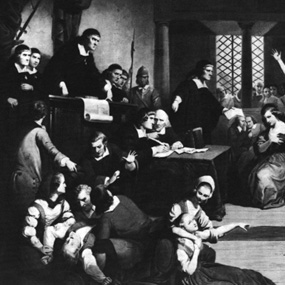
Salem, Massachusetts. A small town--with no clear governing body--became embroiled in a scandal that forever stands as one of the darkest chapters in American history. For those accused of witchcraft by their neighbors and friends, there was little chance of clearing their names; the mass paranoia that ravaged through the community took the lives of 19 innocent men and women. With an all-star cast of Kirstie Alley, Rebecca De Mornay, Kristin Booth, Shirley MacLaine, Peter Ustinov and Alan Bates, Salem Witch Trials dramatically revisits 1692 colonial America and the haunting legacy it holds.

"Salem Witch Trials" is a compelling 2003 CBS mini-series that featured many familiar and veteran actors and for the most part, stayed true to the historical events that came to be known as the Salem Witch Trials.

The mini-series begins on a rather odd note - it is right in the middle of a trial where the afflicted girls [who are the ones accusing people of witchcraft]go into hysterics and start wailing and screaming, then the accused start transforming into 'demons' [with rather striking make-up and 'flying' special effects]. Thankfully, this only lasts a couple of minutes [the production could have done without it], and viewers are taken back via flashback to six months prior where the events began.

The story focuses on the Puritans residing in the village of Salem, Massachusetts, and the year is 1691. There is no charter from England and hence, the Puritans basically govern themselves without any written law. Those who commit crimes or sins are publicly humiliated [there is a scene where women deemed guilty of sinful conduct are paraded naked whilst tied to a wagon]. The family that is the focal point in this series is the Putnam family - Ann Putnam [Kirstie Alley] gives birth to a stillborn child and is full of grief. Her husband Thomas Putnam [Jay O Sanders] is a bitter man, having lost a lot of his land and wealth to others who are more entrepreneurial. They have a son and daughter and young Annie Putnam [Katie Boland] senses the tension between her parents and finds herself being neglected, hence her desire to act out as a means of gaining attention.

The storyline is riveting and moves along at a steady but sure pace, building momentum as the horror unfolds - the acting is also solid and credible - Kirstie Alley's Ann Putnam is a conflicted and tortured soul. Her grief over her dead child causes her to turn to a village medicine woman, Bridgitte Bishop who is later accused as a witch, and this in turn causes her immense guilt [for turning 'away' from God]. She is by turns horrified and self-righteous at the situation in Salem. This is one of Alley's best dramatic performances to date. Henry Czerny's Rev Parris is credibly done, acting out the part of a so-called man of God who decries against self-interest whilst shamelessly practising it for self-preservation. Then there is young Katie Boland as Annie Putnam who incites revulsion for her performance as the misguided accuser.Rebecca de Mornay plays Rev Parris' wife who is mortified by the events in Salem and finally leaves her husband.

There are also veteran actors who have done an incredible job with their roles here - Shirley Maclaine plays the ill-fated Rebecca Nurse, one of the accused who also happens to be a pillar in society, a devout mother and elderly woman who maintains her faith and sense of humor in the bleakest of times. Peter Ustinov plays the Magistrate William Stoughton, a man so absorbed in proving the accused guilty that he never once questions his judgements. And there is Alan Bates playing Gvernor Sir William Phips, who initially acts the dandy and seems disinterested but who eventually realises something is seriously wrong in Salem.

The sets and costumes lend an authentic feel to the story, making the Salem of 1691-'92 come alive onscreen. All in all, this is a first-class production and will appeal to history buffs, educators [though with some nudity I'm not sure if it would be appropriate for classroom viewing] and period & historical drama fans.Highly recommended!

Buy Kirstie Alley's book: Salem Witch Trials

Free eBooks (Can Be Downloaded):

John Musick - The Witch Of Salem
Friedrich Adler - The Witchcraft Trial In Moscow
Marian Green - A Witch Alone

Sunday, August 22, 2010

Am I Really A Witch

Am I Really A Witch Cover According to some old Elizabethan superstition, if you possess all of these you were considered to be a witch.

Superstition 1 - Witches were able to fly ( this explained how witches could move quickly across impossible distances. A broomstick was then added to the superstition as these became common household Articles used by women) - Well, I do clean with a broom (me).

Superstition 2 - A witch was often portrayed as an old crone or hag ( with no man to defend her against accusations of witchcraft) - I don't have a man (yet) and I do feel old these days (me).

Superstition 3 - Witches are closely associated with living alone (house in the wood) - I live alone in a place made of wood (me).

Superstition 4 - Witches were known to keep animals like the Cat, Frog, Pig, Raven, Goat, Wolf, Goose, Crow, Bat and Mouse which were believed to be the forms adopted by a Witches Familiar (an evil spirit, in animal form, who was used by the witch to perform evil deeds and cast malevolent spells) - I do own three cats and you know if I could, I would own every one of these (me).

Superstition 5 - Witches brewed magic potions over a cauldron (Wise women had knowledge of herbs such as mandrake, datura, monkshood, cannabis, belladonna, henbane and hemlock) - And I love cooking and brewing up good food and some include herbs (me).

And last but not least, my very own and I bet you haven't noticed this...I do have a mole on my nose. Fact. :)

EEEEK! I'M A WITCH! I quote Practical Magic....."there's a little witch in all of us". :) Are you one? :)

Books You Might Enjoy:

Anonymous - So My Kid Is A Witch
Carl Mccolman - The Well Read Witch
Marian Green - A Witch Alone

Friday, August 13, 2010

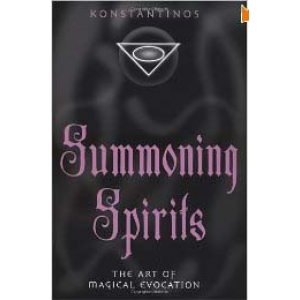
Summoning Spirits The Art Of Magical Evocation

Summoning Spirits The Art Of Magical Evocation Cover

Book: Summoning Spirits The Art Of Magical Evocation by Konstantinos

If you are interested in summoning up elementals,Planetary spirits, Angels and Goetic beings this is the book to get. Though I do a diffrent ceremony for goetic spirits. I do use the methods in this book for the other beings. The auther gives very good and solid information on the Elementals, Angels, Planetary spirits and Goetic beings. But dont be decieved sometimes evoking these beings are not very easy at all. Be prepared for successes as well as failures. This is a great book to get on the subject of evoking these forces. Now you can learn how to evoke and communicate with 50 spirit entities and make use of their abilities, when you get Summoning Spirits by Konstantinos.

Evoking spirits is one of the Most Powerful magical techniques you can use-but, until now, most of the material available on evocation has been virtually unusable because it was written by those with little practical evocation experience. Summoning Spirits was written by a practicing magician who has successfully performed many evocations. With his guidance and clear directions, performing evocations will be easy and safe for anyone.

- Learn to safely evoke powerful spirits to aid you with any task
- Create sigils charged with the energy of spirits to magnify the effects of your evocations
- Make an etheric egregore, a manufactured spirit that will perform the task of your choice
- Perform easy exercises to train your magical abilities and to develop clairvoyance and clairaudience
- Construct, prepare, and use special magical tools to aid your evocations

Summoning Spirits is a complete manual for evoking entities to effect positive changes in your life. Learn how the spirits that dwell on the other planes can be evoked to the astral and physical planes to help you obtain mystical abilities, locate hidden "treasure," and even command a spirit "army" to protect your home while you're away.

Summoning Spirits describes the specific attributes and abilities of 50 entities that you can evoke to uncover valuable knowledge, and who will help you succeed in nearly any task, magical or mundane.

Whether you need help to face life's challenges or to work a minor miracle, you will find the art of Magical Evocation a tremendously potent tool for change. Included are information and theory, as well as full instructions for all the rituals you will need to prepare for and then evoke spirits. No other book makes this ancient magical technique as easy to understand and use, as does this one. That's why you must get Summoning Spirits.

"Summoning Spirits" is the one of best books I have read so far in regards to the ancient and powerful art of magickal evocation. Although I have only just recently purchased this book, I have found it to be very informative, educational and interesting. As an individual aspiring to master this ancient magickal art, and science, I had found Konstantinos's advice and guidance quite beneficial about only working with benevolent spirits such as Angelic, Planetary and Elementary entities. However, I will be looking forward to summoning the Goetic entities as well, as I believe that a magician should have a 'magickal and spiritual balance' between both benevolent and malevolent entities, in addition to mastering them. All in all, a great book for a magician wishing to practice magickal evocation. In addition, I am especially looking forward to evoking the divine and beautiful Archangels and striving to unite and become 'one' with Divinity, which Konstantinos mentions is the 'true' defintion and purpose of magick. A truly magickal and spiritually inspiring book. I know that I will always enjoy and value keeping it as part of my personal magickal library to cherish, reflect upon, and treasure the ancient magickal wisdom and power within it.

Buy Konstantinos's book: Summoning Spirits The Art Of Magical Evocation

Free eBooks (Can Be Downloaded):

Jarl Fossum - Seth In The Magical Texts
Phil Hine - Aspects Of Evocation
John Dee - The Practice Of Enochian Evocation
Malcolm Mcgrath - Practical Magickal Evocation
Konstantinos - Summoning Spirits The Art Of Magical Evocation

Thursday, July 29, 2010

Witches And The Book Of Shadows

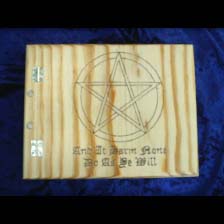
Witches And The Book Of Shadows Cover The book of shadows is a Witches Bible, a place where spells, rituals, and often inspirations are written. Traditionally most Witches hand write everything into their BoS, however in the high tech age of computers there are many modern witches who put their entire BoS on disc. There are even programs designed to format your computer Book of Shadows. Many Books of Shadow are handed down from past generations. I would recommend that if you are just starting one, you choose a very special and large journal, hard cover, or hand crafted wood, leather, or other sturdy material, rather than a spiral notebook, or writing tablet. This book should be planned with the intent of it being around for a long time and used often.

The BOS usually starts out with a Title Page and may be called something as simple as, My Book of Shadows or something more creative like, My Triple Moon Book of Inspiration. You should include a Dedication page dedicating your work to whichever Goddess, and/or God you recognize, and a Blessing page where you put a simple blessing spell for your Book of Shadows and all the writings within.

It might be a good idea to include a line or two about your book being invisible to non-believers, or some type protection, that will prevent ill events from snoops.

I highly recommend a table of contents, or index section, as you will find it difficult to locate a needed piece of information later on, when your book is full. A section on your chosen path, or your personal philosophy is a good addition.

Your Book of Shadows will usually contain a list of all celebration rituals, especially the Sabats, which are the major turnings of the year. Also you will probably include all the esbats and moon phases of the year. You may want to include a section for celebrating births, deaths, handfastings (marriages), and even add rituals for blessing a new home, a business or a new job. With all these special events, there are correspondences that go with them, such as deities, gems and minerals, herbs, oils, colors, astrological symbols, and planetary influences. As with most celebrations there will be certain foods, decorations, ect.

Books You Might Enjoy:

Gerald Gardner - The Garnerian Book Of Shadows
Idres Shah - The Book Of Power
Sasha Fierce - The Book Of Shadows

Sunday, July 25, 2010

Witch Hunting Multitude Of Myths

Witch Hunting Multitude Of Myths Cover Historians have now realized that witch-hunting was not primarily a medieval phenomenon. It peaked in the 17th century, during the rationalist age of Descartes, Newton, and St. Vincent de Paul. Persecuting suspected witches was not an elite plot against the poor; not was practicing witchcraft a mode of peasant resistance. Catholics and Protestants hunted witches with comparable vigor. Church and state alike tried and executed them. It took more than pure Reason to end the witch craze.

Nor were witches secret pagans serving an ancient Triple Goddess and Horned God, as the neopagans claim. In fact, no witch was ever executed for worshipping a pagan deity. Matilda Gage's estimate of nine million women burned is more than 200 times the best current estimate of 30,000 to 50,000 killed during the 400 years from 1400 to 1800 -- a large number but no Holocaust. And it wasn't all a burning time. Witches were hanged, strangled, and beheaded as well. Witch-hunting was not woman-hunting: At least 20 percent of all suspected witches were male. Midwives were not especially targeted; nor were witches liquidated as obstacles to professionalized medicine and mechanistic science.

This revised set of facts should not entirely comfort Catholics, however. Catholics have been misled -- at times deliberately misled -- about the Church's role in the witch-hunts by apologists eager to present the Church as innocent of witches' blood so as to refute the Enlightenment theory that witch-burning was almost entirely a Catholic phenomenon. Catholics should know that the thinking that set the great witch-hunt in motion was developed by Catholic clerics before the Reformation.

But the great witch-hunt was nonetheless remarkably slow in coming. Many cultures around the world believed for millennia -- and still believe -- in witches. In typical folklore, past and present, witches are night-flying evildoers who inflict harm on others by supernatural means, such as curses, the evil eye, and magic substances. Witchcraft is usually thought of as an innate power, unlike sorcery, whose magical spells must be learned. What Christianity uniquely added to those traditional beliefs was Satan. God's enemies were said to join Satan's band of demons through a pact and worship him at monstrous bacchanals called "sabbats," where they parodied the liturgy.

The Church inherited Roman and Germanic laws regarding maleficent magic, laws that treated witchcraft as a crime. But to St. Augustine, concrete witchcraft consisted of idolatry and illusion rather than harm to others. Following Augustine, an Anonymous ninth-century text, Canon Episcopi, became part of the Church's canon law, declaring that belief in the reality of night-flying witches was heresy because there was no such thing as an actual witch. Although the idolatry and heresy associated with witchcraft resided only in the will, not in actual deeds, they were nevertheless sinful, Augustine wrote. Punishment was in order -- but not burning.

The High Middle Ages of the twelfth and 13th centuries saw the bloody suppression of heretics, notably the Cathars in Provence. Measures against Jews, magicians, and sexual deviants also grew harsher. These groups were associated with a stereotyped set of blasphemies, orgies, and outrages, including infanticide and cannibalism. Starting in 1232, the papal Inquisition dispatched roving specialists to detect and punish heretics outside existing legal systems.

Then, the idea that witchcraft was a reality rather than a heretical illusion suddenly made a comeback. The inquisitors who had cut their teeth on heretics were devouring accused witches as well by the end of the Middle Ages. This was not simply a matter of shifting scapegoats to suit market demand. In a society that feared supernatural menaces working through human conspiracies, the sinister folk figure of the esoterically schooled magician apparently fused with that of the petty village wise-woman or cunning man to create the new phenomenon of the diabolical witch.

After the first wisps of this change in the late 14th century, the flames burst forth around 1425 in the Savoy region, in what is now southeast France, and in the canton of Valais in Switzerland, near the borders of France and Italy. About 500 more witch trials followed before the Reformation began in 1517.

Books You Might Enjoy:

Richard Alan Miller - The Magical And Ritual Use Of Herbs
Edna Kenton - The Book Of Earths
Michael Johnstone - The Ultimate Encyclopedia Of Spells

Popular Posts