Showing posts with label money spells. Show all posts

Thursday, October 21, 2010

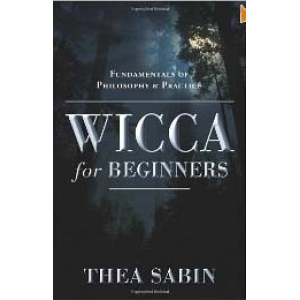
Wicca For Beginners Fundamentals Of Philosophy And Practice

Wicca For Beginners Fundamentals Of Philosophy And Practice Cover

Book: Wicca For Beginners Fundamentals Of Philosophy And Practice by Thea Sabin

In her first book-length work, Sabin presents a first-rate, fresh and thorough addition to the burgeoning field of earth-based Spiritual Practice volumes. Sometimes using examples that young people can relate to (SATs, dying grandmothers), she opens the door to this path for people of all ages who want concrete beginnings to "work actively and spiritually to develop as a person." Sabin covers well the familiar territory of the calendar, circle, pentagram, tools, etc., but she shines distinctively in several areas. The first is in Wiccan history, written in a light, informative style that magically mines depth, breadth and brevity. Another is in the emphasis on personal will and ethical practices that transcend reliance on external paraphernalia. She also deftly shows how the various tools and spells can be put into use, but always encourages practitioners to utilize their own experiences, environment and spiritual intelligence to shape their practice. Especially helpful are the criteria to assess groups and potential teachers, and the volume is capped by a fine bibliography. Sabin advocates consistent study, practice and evolved learning. Gently admonishing her reader not to become a "one-book wonder," Sabin has nearly voided her own advice with this important first effort that is perfect for novice Wiccans.

As a teacher of Wicca for many years, I'm always looking for better materials to use for training. I am grateful to Ms. Sabin for providing what will undoubtedly be the introductory book I will recommend for the foreseeable future. She presents the basics without pushing any given path or tradition, often presenting varying Interpretations and viewpoints in a non-judgemental manner. This is a solid foundation for seekers to use as a springboard to whatever flavor of Wicca they choose to explore. I appreciate that she addresses ethics within Wicca, which many authors seem to avoid, or present in a highly simplistic manner. The book is clearly meant for beginners, hence the title, and is possibly the best overall introduction I have yet seen.

I bought this book to learn more about the Wiccan Religion as my girlfriend is wiccan and I had no prior (correct) knowledge of the religion. This book offers an excellent intro to the history, philosophy and basic practices of the religion as the title suggest. Its also doesn't read like a textbook so its fun and to read. In general I would reccomend this book to anyone just starting out who wants to learn more about the religion.

Buy Thea Sabin's book: Wicca For Beginners Fundamentals Of Philosophy And Practice

Free eBooks (Can Be Downloaded):

Henry Cornelius Agrippa - Occult Philosophy And Magick Book I
Johannes Kepler - Concerning The More Certain Fundamentals Of Astrology
Anonymous - Wicca Beliefs And Practices

Tuesday, October 12, 2010

Black Magic And The Occult

Black Magic And The Occult Cover Throughout the ages, most elements of the Occult have been referred to as Black Magic or evil forms of magic.. This is common misunderstanding, as most elements of the Occult and its understanding are focused on the good element of the energy.. The black arts is more a personal aspect from a confused magician or sorcery.. All magic or energy wielding that is designed to intentionally harm another will in the end, end up harming the wielder and I will explain why..?

What is Black Magic ?

First of all let’s sum up Black magic or Evil magic as some call it. Many people are doing this form of magic without even knowing throughout there lives, manipulating people, manipulating greed, controlling the energy in a negative way which benefits themselves only.. If we can better understand these forms of energy manipulation or control it is then easier to protect ourselves from this common aspect of life.

An example of Misunderstood Black Magic

A good example of Black magic is any form of energy, that negatively effects your health or power to make choices (internal freedom).. It could be an influence at work with your boss where you are so used to being told what to do you are unaware of what it is doing to you.. It could be chasing the money to the point where money becomes your life and emotional response to others does not exist.. Another example could be in an abusive relationship where one partner gets pleasure out of hurting the other, do not confuse this with anything else this is emotional black magic..
It comes back on The Wielder of the Black Magic User..

Now that I have named a few examples I will explain why it will eventually negatively effect the wielder who tampers with negative or Black magic.. Similar to what Einstein said every action deserves a equal and opposite reaction it is similar with energy.. If you keep taking and taking and using it negatively, it will return on you and the effects could be devastating.. It could make you depressed or suicidal or even cause cancer to name a few.. It is important to make sure all use of the energy which we are all apart is always positive, that way only more positive can return..

Victims of Black Magic – Protect Yourself!

The unfortunate side of this is the victims, if you are a victim of energy harm or black magic it is important to try to defend yourself with your own energy.. Be positive and get advice from those that have massive amounts of energy levels, there are plenty of good magic users all around us who do not know they wield for good or might not even be aware of energy but always are willing to help..

Once you have advice or help you need to identify the wielder and confront them with emotional protection.. You cannot ask them about black magic as most will be like what the.. But you can tell them how they make you feel and then say you will never effect me like this again and be strong.. Sometimes moving away can help but you must confront these energy abusers first as they can leave a energy trail that can hurt you for months.. Sometimes black magic wielders will go for those that they think they can control easier or who are overly nice. If this is the case, you need to address this immediately if you notice it happening to another.. It is recommended to confront the wielder and explain an explanation and ask them to stop doing it..

I hope this post helps people understand a bit more on energy, which exists in everything and what makes Black magic, if you can think of anything else, feel free to comment below..

Books in PDF format to read:

Naomi Janowitz - Magic In The Roman World
George Moir - Magic And Witchcraft

Saturday, October 2, 2010

Drawing Down The Moon Witches Druids Goddess Worshippers And Other Pagans In America

Drawing Down The Moon Witches Druids Goddess Worshippers And Other Pagans In America Cover

Book: Drawing Down The Moon Witches Druids Goddess Worshippers And Other Pagans In America by Margot Adler

Popular demand for this clear-sighted compendium of information about the rebirth of Pagan religions hasn't waned since its initial publication in 1979. Distinguished by the journalism of National Public Radio columnist Margot Adler, Drawing Down the Moon explains this diverse and burgeoning religion's philosophies and activities while dispelling stereotypes that have long been associated with it. Most people don't realize that pagan simply refers to pre-Christian polytheistic nature religions, such as the various Native American creeds, Japanese Shinto, Celtic Druid, and Western European Wicca. Originally, the word pagan meant "country dweller" and was a derogatory term in Rome in the third century A.D., not unlike calling someone a hick today. If you find yourself feeling queasy when you hear the words witch or pagan, a healthy dose of reeducation via Drawing Down the Moon could be the cure.

I read this book when it was first published and recommned it to anyone who wants to become more enlightened about the topic. I have a social science background, and thus a general understanding of the various world views of traditional societies who are in my opinion closer to old Mother Earth than most of us "moderns" who spend far too much time caught up in our technology. Margot Adler (granddaughter of the famous psychologist) went exploring (ethnographic field work) and this book is the result.

She does not promote any of the world views she describes, she plays the good ethnographer and records what she finds. She participates on several occasions, and thus becomes the "participant observer" recorder. I didn't know much about the revival of "paganism" and had never heard of Wicca before I read Adler's book. I learned that in spite of the professed enlightenment of our modern age, many fear the practices described. Why? Basically, the practice of Wicca seems to be a female oriented way of life--focusing on nature, life, a spiritual path. I for one am continuing to read about Wicca and explore what others are doing.

I figure some of the so-called witches etc. are not what they purport to be, just as some of the agressive so-called Christians driving with bumper stickers that advertise their "faith" are not what they purport to be. I recommend Adler's book if you are interested in comparative religion, are looking for a new way of living or just curious about a somewhat maligned and often persecuted group of mostly women.

Buy Margot Adler's book: Drawing Down The Moon Witches Druids Goddess Worshippers And Other Pagans In America

Free eBooks (Can Be Downloaded):

Mw Macdowall - Asgard And The Gods The Tales And Traditions Of Our Northern Ancestors Ver 2
Leo Joachim Frachtenberg - Allusions To Witchcraft And Other Primitve Beliefs In The Zoroastrian Literature
Robin Artisson - Dance Of The Witches Opening The Devil Eye
Gerina Dunwich - A Witchs Guide To Ghost And The Supernatural
Damon Leff - A Pagan Witches Touchstone Witchcraft And Witch Hunts In South Africa

Fairy Gold

Fairy Gold Cover

Book: Fairy Gold by Basil Crouch

Basil Crouch A.K.A. Basil LaCroix is one of those old-time great Magicians who learned by the pragmatics of worldly travels in lieu of the theoretics found in most books. Basil spent his youth in a circus amongst the main artistes who were pure Romany, all members of the Manouche Tribe who revere Sara the Black Virgin & Jacques deMolay (GrandMaster of the Templars). The leading Witchdoctor taught him many trix of Magick. He also learned many strange Spells from an Australian Aborigine Witchdoctor. In the late 1960's he masterminded 'coven-style' Occult groups consisting of 6 or 7 women, reaching very advanced stages of development, like producing actual Apports using thoughtform entities, just mindblowing stuff. His teachings excited alot of jealousy within Occult Societies who wanted this kind of thing kept secret. (from reader)

Download Basil Crouch's eBook: Fairy Gold

Free eBooks (Can Be Downloaded):

Aleister Crowley - Liber 831 Iod
Franceska De Grandis - Be A Goddess
Aleister Crowley - Gargoyles
Basil Crouch - Fairy Gold

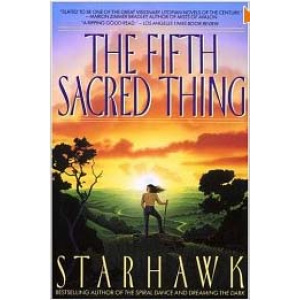
The Fifth Sacred Thing

The Fifth Sacred Thing Cover

Book: The Fifth Sacred Thing by Starhawk

I love this book. I didn't like it at first, but I decided to give it an hour before I made up my mind. Now I am really glad I stuck with it, because it is one of the richest, most thought-provoking books I have ever read.

I had this book on my shelf for several years before I actually read it. Although it obviously sounded good enough at the time I bought it, I feared that it would be preachy and overbearing. It was nothing of the sort. The characters are complex; flawed at times, saintly at others. The story is compelling, combining plots about the personal growth of the various characters, adventure stories as Bird escapes from prison and Madrone ventures into the southern wilds to help the freedom fighters, and the ultimate show down between the San Franciscans and the Stewards. It is a bit simplistic, perhaps, but that didn't stop me from wishing things in reality were more like they are in Maya and Madrone's world. The attempts to portray this world as one free of any racial or sexual bigotry do get a bit heavy handed at times, but never so much that it interfered with my enjoyment of the story. I would recommend this book to anyone, and in fact immediately after I finished Ran out and bought a copy to give as a gift this Christmas.

One of the greatest questions is - how do people resist the violent advances of others without becoming violent themselves? We can look to others for inspiration - HH the Dalai Lama, Gandhi, MLK - there have been a few who have managed to hold on to their ideals despite the crimes inflicted upon them. But how do we do this ourselves? How do we maintain peace within ourselves?

This book discusses these issues on a societal level, but the wisdom you will gain can be applied on a personal level. You will likely find yourself rethinking how you view numerous things - from illness to monogamy.

And the story is interesting and creative, with characters you will come to care about. This is a fantastic book. Go ahead and give it some time - you will probably love it, too!

Buy Starhawk's book: The Fifth Sacred Thing

Free eBooks (Can Be Downloaded):

Friedrich Max Muller - The Sacred Books Of The East
Solomonic Grimoires - The Book Of Secrets
Aleister Crowley - His Secret Sin

Thursday, September 30, 2010

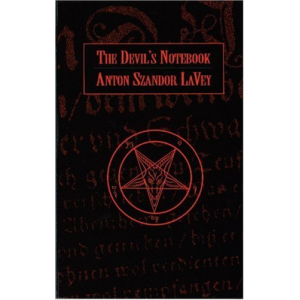
The Devil Notebook

The Devil Notebook Cover

Book: The Devil Notebook by Anton Szandor Lavey

Anton Szandor LaVey was a man full of biting wit, iconoclastic insight and, above all, a most astute and adroit observer of human folly and misinterpretation, himself being subjected to the latter more than anyone in recent memory.

In this book, published after two decades of inactivity (to the world of print), LaVey sheds light on many interesting topics, bringing his usual dose of sardonic humor to the printed page.

A particular essay comes to mind when I think of this book- it's called "Hatha Toilet Seat Meditaion," and if it doesn't solicit laughter from you, nothing will. For those of you who are familiar with it, I'm certain you're grinning right now. For those who aren't, read the book and find out why.

Other essays focus on some pretty forbiding topics, and the level of candor expressed by LaVey never lets us forget that while the media may have portrayed him as several things- none of which were especially flattering- we will continue to respect him for the insight he shared with us, remembering the first time we read the "Satanic Bible," a book that for many of us described the thoughts we'd always thought, but never knew anyone else did.

In general The Devil Notebook is very useful and practical black magic book that does explain (with some deals hidden) the ways of satanic practices. The author knows the material, and its well laid out with clear - but as I say some missing - instructions. However, the book does deliver much material. I read an interesting but rare satanic gem called the Question of Lucifer, about how far Lucifer has penetrated into the upper ranks of power and elite. It was fascinating, and very, very scary, depending on if you are on the White or black magic side. That book unknowingly exposed some satanic secrets and left a lot open for us to see, more than the author expected - if you are willing to read it. Be warned!

Download Anton Szandor Lavey's eBook: The Devil Notebook

Free eBooks (Can Be Downloaded):

Mark Mirabello - The Odin Brotherhood
Rabbi Michael Laitman - The Open Book
Anton Szandor Lavey - The Devil Notebook

Wednesday, September 29, 2010

Her Hidden Children The Rise Of Wicca And Paganism In America

Her Hidden Children The Rise Of Wicca And Paganism In America Cover

Book: Her Hidden Children The Rise Of Wicca And Paganism In America by Chas Clifton

I found this book among many in my local bookstore and purchased it on the fact that the cover was eerily close to a vision in a dream I had over a year ago. I have never been happier to have had such a dream! This book, I found, was completely amazing.

While many books on Paganism focus on practice, perhaps a few focusing on philosophy, very few focus on any actual scholarship. This specific book focuses on the history of contemporary Paganism, from Gerald Gardner to more modern influential groups, such as the Church of All Worlds. The depths the author, Mr. Chas S. Clifton, provides for anyone interested in history and Pagan academia runs deeps.

Since the release of Ronald Hutton's "Triumph of The Moon" back in 2000, I have yearned for a book that would take an in-depth look at the history of modern Paganism in America. So I was more than a little excited and hopeful when I heard that Pagan academic Chas Clifton was rising to the task in his new book "Her Hidden Children: The Rise of Wicca and Paganism in America". Finally a book that would take a look at how modern Paganism and Wicca took root in American soil and became one of the fastest growing faiths in the country.

Clifton - knowing that he could in no way cover everything that has happened from the 1930s to the present - has chosen with this book to lay down some basic parameters for talking about modern Pagan history in America. First he concentrates on Wicca: it being the largest and most influential modern Pagan religion in America. Secondly, when moving out from Wicca he generally stays with groups that claim to follow "nature" or "earth" religions. Not getting much attention in this history are the "reconstructionist" Pagan faiths and feminist Wicca.

The author begins with examining Gerald Gardner and the beginning of British Wicca, looking at both Gardner's claims of a long-line of witches and historical evidence to this claim. Following this, the author discusses how Wicca came to America and how it spread.

The second chapter focuses on the change of Wicca from a Mystery Religion to a "nature" religion. The author brings to use the idea that Wicca combined a triple-form of nature, ranging from the Cosmic, Natural (Earthly), and Erotic. He shows us how Wicca became changed through the changing social changes affecting America during this time.

Throughout the rest of the book, Mr. Clifton shows his readers the struggles and effects Wicca has had in America (such as, for example, the effort to change the image of the popular "Witch), the influence Paganism has had in Popular Culture (and vice versa), and a look at other Pagan groups that have influenced Paganism on a whole (which may, or may not, have started before Wicca).

If one is interested in the history of Paganism, specifically Wicca, this is a great book to sate that interest. This book is a wonderful example of Pagan scholarship so needed in the Pagan community. I highly recommend this book to anyone wishing to be a Pagan, claiming to be a Pagan, or vaguely interested in knowing about Pagans.

Buy Chas Clifton's book: Her Hidden Children The Rise Of Wicca And Paganism In America

Free eBooks (Can Be Downloaded):

Michael Ford - The Calling To The First Of Witch Blood An Invocation Of Cain
Sirona Knight - A Witch Like Me The Spiritual Journeys Of Today Pagan Practitioners
Lawton Winslade - Teen Witches Wiccans And Wanna Blessed Be
Abner Cheney Goodell - Further Notes On The History Of Witchcraft In Massachusetts
Al Selden Leif - 6 Questions On Wicca And Paganism

Historical Summary Of The European Witch Hunts

Historical  Summary Of The European Witch Hunts Cover The European witch Craze started roughly during conclusion of the 15th century and peaked during the first half of the seventeenth century. The belief that women were sinful and had the power of the devil within them developed out of the Middle Ages. The Reformation further promoted the idea of a satanic kingdom of evil on earth with which to justify persecutions. Theologians sought to prove that accused witches represented the devil.

The first and most significant written cumulative concept of witchcraft available to a large audience was the Malleus Maleficarum written by Sprenger and Kraemer. It was first published in 1486 and reprinted fourteen times before 1520. The document made an important contribution to the widespread witch hunt. Most people accused of witchcraft were rural, poor, and single women. The hunts are often seen as a massive effort to keep women in their place. Women were seen as evil, and unclean people whose weakness could summon the devil for sexual intercourse.

The Malleus Maleficarum document ignited a widespread hunt for the so-called witches described in it. During the hunt, witches were accused of "impractical" and "traceless" crimes such as intercourse with the devil, unregistered babies from hidden pregnancies who were supposedly eaten or sacrificed, and even natural disasters. However there is no record of any solid evidence for any of these accused crimes.

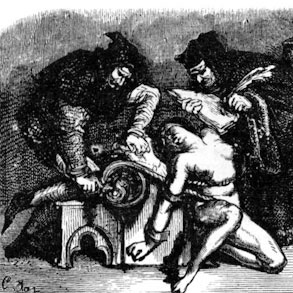
Often these hunts were instigated by hysterical children, or nuns who accused relatives, and neighbors of these outrageous crimes. Witnesses were often bribed or threatened in order to prosecute the accused. The accused would then be tortured until they confessed. The methods of torture were very cruel and painful, and almost all who were put through the various devices would confess. In some cases the accused would die of torture, and very few survived the ordeal without confessing. However, the accused was set free if they survived the torture without a confession. After the forced confession, the trial took place. These trials were run by genuine believers of witchcraft. The aim of the trial was to exterminate the witches as conspirators with the devil. When the accused was declared guilty, they were usually executed.

Although, there are many estimates as to how many actual people were killed during these hunts, most estimates show the number well below the one-million mark. The actual number of documented executions, is generally considered to be under one hundred thousand. Of all that were executed, only a minority were men, and of those men, many are those who tried to protect accused women from the hunters.

Free eBooks (Can Be Downloaded):

Sharynne Nicmacha - The Star Of Life A Historical And Spiritual History Of The Pentagram
Martin Van Buren Perley - A Short History Of The Salem Village Witchcraft Trials
Tuesday Lobsang Rampa - Wisdom Of The Ancients
Michael Bailey - Historical Dictionary Of Witchcraft
Charles Kirkpatrick Sharpe - A Historical Account Of The Belief In Witchcraft In Scotland

Tuesday, September 28, 2010

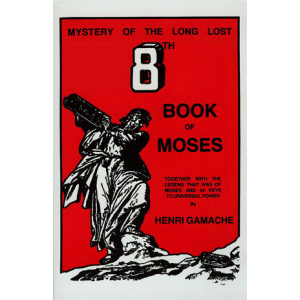
The 8th Book Of Moses

The 8th Book Of Moses Cover

Book: The 8th Book Of Moses by Ancient Grimoires

The Eighth Book of Moses, a magical treatise that otherwise has nothing to do with Moses and which is found in Greek Magical Papyrus (PGM) xiii in two versions. The end of this papyrus also mentions the "Hidden Book of Moses Concerning the Great Name," which may be another lost Moses work.

Download Ancient Grimoires's eBook: The 8th Book Of Moses

Free eBooks (Can Be Downloaded):

Solomonic Grimoires - The Book Of Secrets
Ancient Grimoires - The 6th And 7th Book Of Moses
Ancient Grimoires - The 8th Book Of Moses

Sunday, September 26, 2010

Alex Sanders Biography

Alex Sanders Biography Cover Alex Sanders – the “King of the Witches” as he became known - was responsible for founding the Alexandrian Tradition of Wicca, now one of the main traditions of the Wicca/Witchcraft movement. But his reign was fraught with criticism and controversy.

Alex Sanders was born Orrel Alexander Carter on the 06th June 1926 in a house on Moon St, Birkenhead. He was the eldest of six children to parents Hannah and Harold Carter. His father Harold Carter was a music hall entertainer who suffered from alcoholism, and soon after the birth of Alex, moved the family to Grape St in Manchester, there he unofficially changed the family name to Sanders. Alex was unaware of his official surname until he applied for a passport later in life, at which time he officailly changed his name to Sanders by deed poll.

As a young boy Sanders suffered with tuberculosis and would regularly visit with his grandmother in Wales, where he could benefit from the Welsh fresh air. At the age of seven, he is believed to have happened upon his grandmother “Mary Biddy” performing some sort of pagan ritual. Taken by surprise she immediately swore young Sanders to secrecy, and initiated him on the spot claiming, “Now, you are one of us”. Thus he became her student and started on the path of the Old Religion.

Sanders was a natural psychic who learned all he could from his grandmother. He claimed that she gave him her “Book of Shadows” to copy and taught him all the rites and magic of the witches including clairvoyance by scrying in inky water and using his grandmother's crystal. Sanders also claimed that following the Blitz during WWII and just a few months before her death at age 74, his grandmother conferred upon him the second and third grade initiations involving ritual sex. After her death he tried to contact other witches, and though failing continued with his studies while working for a time as a healer in Spiritualist Churches under the pseudonym of Paul Dallas.

In the early 60’s, Sanders is reported to have sought entrance to some Gardnerian covens (see Gerald Gardner), including that run by "Patricia and Arnold Crowther", who refused to accept him. Not to be put off so easily, he somehow managed to obtain a copy of the Gardnerian Book of Shadows. This he copied (badly from all accounts) and embellished it with a few of his own amendments. He then used this as the bases to found his own coven, claiming it to be a copy of his grandmother’s Book of Shadows.

Sanders was a born showman who avidly courted publicity. In September of 1962 he even succeeded in convincing the Manchester Evening News to run a front-page article about Wicca. As a result he soon attracted a large following. During this period Sanders and his coven worked from his home at 24 Egerton Road North, Chorlton-cum-Hardy, Manchester. One of his initiates was "Maxine Morris", a Roman Catholic 20 years his junior. After her initiation, they handfasted and she became his High Priestess. They were married in a civil ceremony in 1968 and moved into a basement flat near Nottinghill Gate, London. Later that same year, Maxine bore him a daughter they called "Maya".

From their new home the Sanders’ ran his London coven and taught training classes, he claimed to have initiated more than 1,623 witches working in 100 covens around the country, all-practicing what had become known as the Alexandrian Tradition. At one meeting, a gathering of sixteen of his covens, Sanders was bestowed with the title of “King of the Witches”. Sanders frequently appeared in ritual photos as robed or wearing only a loincloth while Witches surrounding him were naked. His explanation for this was that the old “Witch laws” required that the Elder of a coven should be easily identifiable from the other coven members.

In 1968-69, Sanders with Maxine appeared in and gave technical advice on a film called “Legend of the Witches”. During the press preview of the film, they met with and were introduced to "Stewart Farrar", then a reporter for the Reveille. Stewart would later be initiated by Maxine, and move on to become famous himself as a witch and author.

Without doubt Alex Sanders was a controversial and flamboyant man, who without scruples plagiarized the work of others to embellish he own. Whither he did so with malice, remains a question? Personally I don’t think so. More I assume through innocuous indifference, and mainly for the benefit of his students, even though it resulted in criticism from many in the craft. He was also without doubt a very skilled witch, and powerful magician, whose contribution to the newly evolving movement, brought witchcraft back into the public arena and changed the face of Wicca. He helped to influence many newcomers entering the craft and Alexandrian Wicca remains today one of the largest traditions of the craft.

Free eBooks (Can Be Downloaded):

Aleister Crowley - Alice An Adultery
Albert Pike - Morals And Dogma
Aleister Crowley - Alexandra

The Art Of Hypnotism Self Hypnosis And Hypnotizing Others

The Art Of Hypnotism Self Hypnosis And Hypnotizing Others Cover Many years ago I went to a Hypnotist to learn the Art. He taught me how to hypnotize myself and others. It is actually an easy process involving very little study and practice. You must remember.... not everyone can be hypnotized. Some people are so wrapped up in their thoughts of every day worries that they can not simply concentrate. In order to be hypnotized... you must be able to relax and clear your mind just the same as you would during meditation..
I would suggest trying it on yourself before trying it on others. Here are the steps to hypnotizing yourself....

1. Sit on a couch in the upright position and close your eyes and your arms at your side or in your lap. Do not move around. Just sit there and relax for a minute.

2. Clear your mind of all thoughts. How do you do this?.... simply imagine a big Dumpster or a very large metal box on your mental screen. Then see it open and put all your thoughts and worries in it one by one.... bills... your lovelife.... problems.... your children.... your job... everything you can think of. Then close the lid and lock it! Then push it off your mental screen.

3. Now sit there quietly with no thoughts for a minute. When you are ready to start... do not forget to tell yourself as you go through each part of the body that you are becoming more and more relaxed as you go. YOU MUST TELL YOURSELF THIS!

4. Now... start with your head.... imagine every part of your head relaxing... start with your eyes.... then go to your ears.... the mouth... all your facial muscles. spend time with each part to make sure it is fully relaxed.

5. Now go to your neck and do the same.

6. Now go to your whole chest and stomach region and start with your heart... slow it down and make it at peace. Relax all you chest muscles and then your stomach area.

7. Now relax your arms feeling them going limp. Relax every muscle in your arms one by one including your fingers.

8. Next go to the groin area and relax all the muscle there.

9. Now it is time to do your legs.... start with the thighs and work your way down to the feet relaxing each and every toe.

By this time you should be like a big lump of silly putty... totally relaxed and and at peace. Now here comes the fun part. This is where you will get to hypnotize yourself and see if it really works.....

1. Site there with you arms in you lap and or at your side and tell yourself that your right arm is getting very light. It is getting very, very light. Keep telling yourself this and feel how it is getting lighter. Tell yourself that it is getting so light that is is staring to raise up off your lap. Feel it it getting light as you keep telling yourself this and feel it raising up off you lap. It is getting lighter by the second and it is raising up higher and higher until it is up in the air.

2. Once you have achieved this and your arm is up in the air you may tell yourself it is getting heavy again and lower it to your lap. You will now tell yourself that you will awaken fully refreshed with energy and a clear mind.

3. Open your eyes and evaluate what you have done. Write down your experience in your magical journal. If you did not have success... try again later that day and keep trying until you are satisfied. If it never works for you.... you may be one of those who cannot be hypnotized.

Now.... this method can be used on someone else. Try it on your best friend... except you are the one who will be telling them to relax each part of their body. Then do the arm raising stunt with them and see if it works. Remember.... as you go through each part of the body with them... tell them they are getting more and more relaxed and sleepy. If this works then you can try more difficult things like making them do funny things...

Remember... DO NOT MAKE PEOPLE DO THINGS THAT WILL HURT THEM OR OTHERS!

You can also use this method to remember things and program yourself to lose weight or study better or what ever you so choose!

If you have been successful.... Congratulations! You now know how to Hypnotize!

Free eBooks (Can Be Downloaded):

Wouter Hanegraaff - Dictionary Of Gnosis And Western Esotericism
Ernest Abraham Hart - Hypnotism Mesmerism And The New Witchcraft
Israel Regardie - The Art Of True Healing
Robert Ambelain - Martinism History And Doctrine

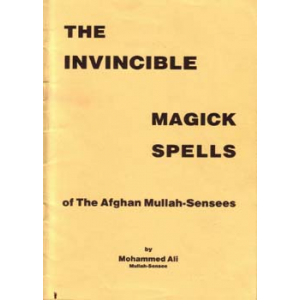
Invincible Magick Spells Of The Afghan Mullah Sensees

Invincible Magick Spells Of The Afghan Mullah Sensees Cover

Book: Invincible Magick Spells Of The Afghan Mullah Sensees by Muhammad Ibn Arabi

All the spells and signs are from the mountains of Afghanistan and the surrounding areas. All have been handed down from generation to generation, student to student. All are in their original form and have not been translated or altered so as to preserve the originality and power.

Download Muhammad Ibn Arabi's eBook: Invincible Magick Spells Of The Afghan Mullah Sensees

Free eBooks (Can Be Downloaded):

Peter Carroll - The Magical Pact Of The Illuminnates Of Thanateros
Medieval Grimoires - The Black Pullet Or The Hen With The Golden Eggs
Mcgiolla Cathain - Secret Magic Spells Of The Romany Gypsies
Muhammad Ibn Arabi - Invincible Magick Spells Of The Afghan Mullah Sensees

Sunday, September 19, 2010

The Continental Tarots

The Continental Tarots Cover

Book: The Continental Tarots by Christine Payne Towler

In the essay titled "The Major Arcana" I emphasize that "Something happened" to the Tarot in the late 1600s, when a new trend emerged in the images of the Major Arcana. I point to the Marseilles family of decks and the Etteilla Tarots to illustrate my point.

The images shown by Antoine Court de Gebelin in his book Le Monde Primitif further validates this idea.The remainder of this essay is about exploring "what happened." Let's review the situation of Tarot in the first half of the 1600s. Since the early 1400s, both handmade and woodblock Tarots showed a remarkable constancy of internal structure even though some packs were either edited or expanded to meet the needs of the various games for which they were created.

Tarot appeared in 72-card form in Italy around 1450, although this model may represents "splice" between preexisting symbol sets: the twenty-two Hebrew alphabet-keyed set called the Major Arcana, and the Turkish Mamluk cards of unknown provenance, a 15th century version of which can be seen in Volume 2 of Stuart Kaplan's Encyclopedia of Tarot (see essay on the Minor Arcana).

Kaplan also explains that the numerical order the Arcana appear in now is carried over from the French pack by Catelin Geofroy, published in 1557 (Vol. 1, p. 65). Some earlier fragmentary Tarots show Roman numerals on some of their Major Arcana, but not all of them, and not in the order we are now familiar with. Those very old woodblock decks tend instead to follow the list enumerated in a sermon written by an Italian friar in the late 15th century (see illustration opposite page 1 in Volume 1 of Kaplan's Encyclopedia of Tarot). There is also another order derived from the Charles VI pack that keeps Temperence, Fortitude and Justice together in a group. A very small minority of Tarots follow this order, including Etteilla’s Tarots.

Download Christine Payne Towler's eBook: The Continental Tarots

Downloadable books (free):

Pyotr Demianovich Ouspenskii - The Symbolism Of The Tarot
Robert Wang - The Qabalistic Tarot
Samuel Liddell Macgregor Mathers - The Tarot
Aleister Crowley - The Zodiac And The Tarot
Christine Payne Towler - The Continental Tarots

Thursday, July 29, 2010

How And Why I Became A Witch

How And Why I Became A Witch Cover I created this lens to allow others to peek into the life of a typical American witch, what we do, what we are and basic beliefs. I certainly do not speak for other witches, their beliefs or opinions. We are all individuals just like anyone else. I am trying to explain (not defend) witchcraft, some facts about real witches, discuss "wanna-be witches," black and white magick, and more. I also feature recommended products, tools, music, links of interest and other information. To learn how to perform your own spells, whether you're a witch or not (it doesn't matter) visit this guide to spellcrafting for witches or non-witches.
I am a solitary witch. I am not Wiccan, per se. I have a few different beliefs but many are similar to Wicca. I really don't label myself into any particular denomination but the closest to any would be Traditional. It has taken me several years to truly believe I am most likely a Natural Witch. This doesn't make me bad or good, it just makes me who I am. This is who I was born to be.

Please feel free to question, comment or share your own stories in the comment section. Recommend your own witch, pagan or spiritual links there, too. I'd love to hear from you, witch or non-witch!

Books You Might Enjoy:

Michael Magee - Robin Hood And The Witches
Anton Szandor Lavey - The Satanic Rituals
Howard Phillips Lovecraft - Cults Of Cthulhu
Ann Moura - Green Witchcraft

Wednesday, July 28, 2010

Good Witch Or Bad Witch

Good Witch Or Bad Witch Cover There are many types of witches. That is a fact. However, most witches do not use their powers or abilities for inflicting harm unto others. This is a very common misconception. A large amount of witches use their abilities to aid others in not only soul-searching tasks but to rid and teach how to rid negative energies from one's life. We are often judged as worshipers of a "devil" or "Satan." That is a big contradiction to most of us. A majority of witches do not even believe in a "God of the Devils" aka "Satan." However, we are often scrutinized for stating this because some will say (just as in the olden times) "If you believe in the devil, you are a worshiper...If you say you don't....you are more susceptible to his powers." It is a TOTAL catch 22 for all witches. That was also the method used in the witch Trials.

One suggestion: Please don't ask a witch if he or she "is a good witch or a bad witch." That is just the same as asking a Christian if "they are a good Christian or a bad Christian." Besides, you may get an answer you didn't expect!

Books You Might Enjoy:

Zoroaster - The Chaldean Oracles
Ro Winstedt - Shaman Saiva And Sufi
Carl Mccolman - The Well Read Witch
Anonymous - Witchcraft A Guide To Magic

Tuesday, July 27, 2010

Witches Misogyny And Patriarchy

Witches Misogyny And Patriarchy Cover The persecution of witches reached its zenith at a time when Christianity's attitudes against sex had long since turned into full-blown misogyny. It is amazing how celibate men became obsessed with the sexuality of women. As it is stated in Malleus Maleficarum: "All witchcraft comes from carnal lust, which is in women insatiable." Another section describes how witches were known to "...collect male organs in great numbers, as many as twenty or thirty members together, and put them in a bird's nest."

Evidently they were not entirely stingy with their collections -- there is the story of a man who went to a witch to have his lost penis restored: "She told the afflicted man to climb a certain tree, and that he might take which he like out of a nest in which there were several members. And when he tried to take a big one, the witch said: You must not take that one; adding, because it belonged to a parish priest."

And some people say that religion isn't really all about wishful thinking!

These sentiments were nothing unique or unusual -- indeed, they are a result of centuries of mean-spirited sexual pathology on the part of church theologians. The philosopher Boethius, for example, wrote in The Consolation of Philosophy that "Woman is a temple built upon a sewer." Later, in the tenth century, Odo of Cluny stated "To embrace a woman is to embrace a sack of manure."

Women were regarded as impediments to true spirituality and union with God, which helps explain why investigators focused on women more than men. The church had a long-standing prejudice against women, and this was given vent when the doctrine of devil worship was emphasized as an enemy which the church had to confront and destroy. This animus hasn't entirely disappeared even today. Women aren't persecuted and tortured, but they are deliberately kept out of positions of authority and responsibility reserved exclusively for men.

Books You Might Enjoy:

William Blake - The Marriage Of Heaven And Hell
Vovim Baghie - The Grand Satanic Ritual
Walter Scott - Letters On Demonology And Witchcraft
Frater Fp - Sigils In Theory And Practice

Saturday, July 24, 2010

Who Is A Witch

Who Is A Witch Cover The origin of the word witch predates the Anglo-Saxon period. Etymologically, the word has been derived from an Old English masculine noun wicca, the feminine being wicce. The word ‘wicker’ in old German also stood for a soothsayer. A soothsayer is a fortune-teller or psychic.

In routine usage, a witch is a feminine noun for wizard or sorcerer, but the former has different functional connotations from its masculine counterpart. While a wizard or a sorcerer may have some element of manipulativeness in their craft, a witch, though a practitioner of witchcraft, is far from being a crafty person. A witch is essentially a very noble and deeply religious person whose purity of heart combined with spiritual and meditation practices bestow her with a deeply religious and mysterious aura. A witch does not act with any ulterior motives, not to mention any machinations in her pursuits. A witch is a very compassionate person, gifted with supernatural powers and works for the alleviation of pain and suffering of her fellow human beings and brings them the much needed solace and succor.

A highly misunderstood, deeply suspected, much maligned and doggedly hounded person especially during the middle ages, a witch has regained lost ground and has acquired a respectable position in the society. Colloquially, the term witch, applied most often to a female, also includes male practitioners of witchcraft, especially Wicca. Witches believe in certain ethical codes and strictly adhere to them.

A witch engaged in her witchcraft practices spells developed by worshiping many deities primarily the supreme Goddess and sometimes her consort the God. The craft or workings of a witch are used for healing the acute health problems. For curing these problems, she uses the personal powers in combination with energies within candles, stones, herbs and other natural items. Witch practices witchcraft to help better the world and mankind. A witch certainly is not ugly, nefarious, dreadful hag who worships the devil or hurts the people as the stereotype image presents her to be.

A witch derives her strength from Paganism, which is influenced by ancient, primarily pre-Christian and sometimes pre-Judaic religion. A witch has deep faith in the elements of Nature such as earth, fire, nature, air, and water. Fire cleanses and has an aura that transports her into the astral world and enables her to view this world with psychic clarity. Water purifies.connects with the Goddess herself. The air is an all-enveloping blanket of gods. It wraps around the witch and lifts her to the divine immenseness and freedom of the skies. The spirit of the witch gets united with the air and floats freely in the sky. The witch achieves this uplifted state through meditation, perseverance and sometimes she is blissfully born with these talents.

A witch is just as ordinary looking person as any one in your neighborhood. She can be a housewife with kids doing her daily domestic chores. She too has her share of emotions, but they function more at a macro level than at personal. So if she is feeling sad, the sadness is not just due to some personal vested interest, but it is born out of the suffering of the world around her. Another difference between a witch and an ordinary woman is that a witch can commune with her goddess. The commune is just meant to bare her soul reaching a complete state of oneness. A witch may even cry before the alter of her goddess whenever she feels a spiritual vacuum and wants to replenish it with godliness.

A witch performs her craft using many rituals such as worshiping alone or in covens in the alter room. She lights candles, incense, chants incantations and worships her deities or goddesses. She meditates while staring into the candle flames and in the course of meditation, she feels her spirit leaving her body and enters into trance. A witch gets lost in the awesome power of the Fire with her mind dancing with the flames of the candles. Insightful images deluge her head and become a permanent part of her psyche.

Witches also practice necromancy and summon spirits of the dead to gain knowledge of the future events from them. These spirits are called Operative Spirits or the Spirits of divination.

Books You Might Enjoy:

Michael Bailey - Historical Dictionary Of Witchcraft
Howard Phillips Lovecraft - Cults Of Cthulhu
Mike Nichols - Eight Sabbats Of Witchcraft
Louise Huebner - Witchcraft For All
Paul Huson - Mastering Witchcraft

Wednesday, July 21, 2010

The Witch Hunter Baedeker

The Witch Hunter Baedeker Cover Meanwhile, witch-hunters' manuals multiplied, most notably the infamous Malleus Maleficarum (Hammer of Witches), published in 1486. Its authors, Jacob Sprenger and Heinrich Kraemer, were experienced Dominican inquisitors who had burned 48 witches in one diocese alone and had obtained a papal bull approving their mission. Reversing the old principle of the Canon Episcopi, Sprenger and Kraemer proclaimed that not believing in the reality of witches was heresy. Witches regularly did physical as well as spiritual harm to others, they wrote, and allegiance to the devil defined witchcraft. Sprenger and Kraemer exhorted secular authorities to fight witches by any means necessary.

Malleus Maleficarum (notice the feminine possessive of "witches") was a vicious misogynist tract. It depicted women as the sexual playmates of Satan, declaring: "All witchcraft comes from carnal lust, which is in women insatiable." Ironically, Sprenger also had a deep devotion to Mary. He helped to shape the modern rosary and founded the first rosary confraternity.

Malleus Maleficarum did not cover its ground completely, failing to discuss the actual pact that witches made with the devil, the sabbat, familiars (imps in animal form who aided witches), and night-flying. But those elements did not always appear in witchcraft cases. By itself, the Malleus started no new witch-panics, but it was freely used by later witchcraft writers, Protestant and Catholic alike. The Spanish inquisitors were nearly alone in scoffing at its lack of sophistication.

The demonologists who absorbed the Malleus were highly cultured men, such as the Protestant Jean Bodin, "the Aristotle of the 16th century," and his contemporary, the Jesuit classicist Martin del Rio. Those theoreticians pounded home the principle of the crimen exceptum: Because witchcraft was so vile an offense, accused witches had no legal rights. "Not one witch in a million would be accused or punished," Bodin boasted, "if the procedure were governed by ordinary rules." Anyone who defended accused witches or denied their crimes deserved the same punishment as witches, Bodin wrote.

Socially elite persecutors, demonologists, and judges relentlessly hunted witches with the zeal of modern revolutionaries pursuing a political utopia. No cost was too great, because witch-hunting served the greater good of Christendom, in their view. They believed that witchcraft inverted society's key values, disturbed godly order, challenged the divine right of kings -- the ancient doctrine that rulers derive their right to rule from God -- and diminished the majesty of God. It was thought that witch-hunting saved souls and averted the wrath of God by purging society of evil as the End Times loomed.

Commoners, by contrast, simply wanted relief from the evildoers of folklore who, they believed, were harming them, their children, their cattle, and their crops. It was grassroots complaints that started most witch-hunts. If authorities were too slow to act, peasants were capable of lynching suspected neighbors.

Although maleficium -- physical harm -- loomed much larger than diabolism in common people's accusations against suspected witches, their folk beliefs cross-fertilized the learned ones of Bodin and others in complex ways. Through sermons, gossip, trial accounts, and luridly illustrated "witch-books" (especially popular in Germany), everyone learned what witches did and how to detect them.


Books You Might Enjoy:

Aleister Crowley - The Sixth Chakra Of The Human Body
Louise Huebner - Witchcraft For All
Aleister Crowley - The Winged Beetle
Tarostar - The Witchs Spellcraft Revised
Margaret Alice Murray - The Witch Cult In Western Europe

Tuesday, July 20, 2010

The Real Witch

The Real Witch Cover A complete account of the ingredients of the witch-idea or even of the genuine witch-cult would fill a volume like this. We should have to go back to the very dawn of religion or, if the theory of Sir J.G. Frazer is correct, before its dawn. Frazer holds that magic preceded religion. I contend that magic and the belief in spirits developed separately. But they are blended in the early idea of the witch: a man or woman who receives magical powers by a league with evil spirits.

Something corresponding to the witch is found, and is dreaded and abhorred, in every stage of human evolution. The spirits of the dead were very soon regarded as in very large part malignant and malevolent, and certain persons were held to act in conjunction with them and practice "black magic"; to raise destructive storms, to blight crops or cattle, to cause disease, sterility, or death. Sometimes this persisted quite apart from belief in spirits. The Romans were not much more definite than the Babylonians in their beliefs about a future life, yet they believed very emphatically in magic and its evil powers. The magician was exposed to a sentence of death in Roman law and was often executed. The ground of the law was, of course, purely secular. The practicer of black magic was dangerous to the community.

The Babylonians and Assyrians (and Persians) believed that myriads of evil spirits or devils hovered about the face of the earth and caused all the evils of humanity; and that there was a special class of these malignant beings who moved about at night, inspired bad dreams, and even sucked the blood of sleepers. This belief in legions of devils passed through the Jews, into Christianity, and the particular belief in night-prowlers and blood-suckers or entrail-suckers (vampires, harpies, etc.) obtained currency amongst the Greeks and Romans. The Greek and Latin word strix, which properly means the screech-owl (so naturally associated with the legend), was applied to these dreaded night- birds.

The Fathers of the Church, particularly St. Augustine, the most influential of them all, denounced magic as "pagan" and as a collusion with the devils. The synods of Elvira (306), Ancyra (314), and Laodicea (375), and the sermons of St. Chrysostom and the other great preachers, show that the new Christians brought with them the magical practices as well as the vices of the pagan world. It does not seem to have been enough to denounce these as pagan, so St. Augustine worked out a more deadly theory: the diviner or magician, in whose powers he firmly believed, was in league with the devil. And the Bible was quite clear about such people. It (Leviticus xx, 27 and Exodus xxii, 18) defined a witch as one who "hath a familiar spirit" and condemned him or her to death. Moreover, the Latin and Catholic Bible translates verse 5 of Psalm xcvi (Psalm xcv in the Catholic Bible): "The gods of the heathen are devils." paganism and devilism coincided.

The change was lamentable and is responsible for the ghastly tragedy of later years. The Roman persecution of magicians was based entirely on the belief that they had abnormal powers and the progress of enlightenment might have undermined this belief. But if magic meant collusion with the devil, belief in it was sure to be magnified very considerably under a religion which taught that the world swarmed with devils. It was precisely the elaboration of this devil-doctrine by the great theologians of the Middle Ages which caused the appalling witch-massacres of the fifteenth, sixteenth, and seventeenth centuries. What surprises one at first is that there was comparatively little persecution of witches before the thirteenth century. It was this wonderful thirteenth century, of which modern Catholics are so proud, that inaugurated the massacres on a large scale. A famous philosopher has called it the most stupid century in the whole of the Middle Ages, and certainly it was the most tyrannical, most superstitious, and most sanguinary.

As far as magic is concerned, the Church never wavered, and the practice of its children never relaxed. The situation is analogous to that of the virtue of chastity. The law was clear: the practice almost universally ignored it. On the other hand, there was no consistent attitude in the Church in regard to the striga (as the strix was now called), the blood-sucking nocturnal creature. The Salic Law in south Germany sentenced the atriga to death. The Lombard Law treated the idea as a superstition. Under Charlemagne a synod held at Paderborn in 785 enacted (canon 6): "Whosoever, deceived by the devil, believes, as the pagans did, that any person is a witch and can devour men, and therefore burns that person, and gives her flesh to others to eat, shall be put to death." individual churchmen were just as much at variance. Some believed in the striga: others did not.

Characteristically, what the Church was concerned about most was magic of an erotic nature. In 860 the great archbishop of Rheims, Hincmar, held a solemn inquiry into this, as the king's concubine was supposed to have used such magic on the queen, and he concluded that it was genuine deviltry. On the whole, there were few executions of witches until the eleventh century, when we begin to find isolated executions more frequently in the chronicles.

I am, however, more concerned with the other aspects of witchcraft: the suggestion of an organization contained in the belief that witches flew in the air at night in droves or to an appointed gathering place. It is usually said that there was no organization of witches until the thirteenth century, which would be quite inconsistent with the view that witchcraft was the ancient pagan religion of Europe. The historical truth is not so simple, and it is interesting.

At the end of the tenth century Abbot Regino made a large collection of Church laws and canons, and one of these is concerned with witches. Where and when this canon was passed we do not know. Some scholars trace it to the Synod of Ancyra, in 314, which is impossible, for the Roman world was then almost entirely pagan. It seems to come from some synod of the sixth century. It says:

And we must not overlook this, that certain wicked women, who have turned aside to Satan, seduced by the illusions and phantasms of the demons, believe and profess that during the night they ride with Diana the goddess of the pagans [another version says, or with Herodias] and an innumerable crowd of women on certain beasts, and pass over great spaces of the earth during the night, obeying her commands as their mistress, and on certain nights are summoned to her service. Would that these had perished in their perfidy and had not dragged many with them to destruction! For an innumerable multitude, deceived by this false opinion, believe that these things are true and so depart from the faith and fall into the error of the pagans, believing that there is some divinity apart from the one God, (Migne edition.)

The abbot goes on to say that all this is the work of the devil who assumes various forms to tempt silly women. The law is reproduced again a few years later in the collection of Bishop Burkhard of Worms (Decreta, bk. ix, chap. 5), who adds the vampire- idea: that women claim that they can, even while they lie in bed with their husbands, fly out in the air and suck the heart and entrails out of other men who are abed.

A life of Pope Damasus (of the fourth century) pretends that as early as 367 a Roman synod took cognizance of these women who rode on beasts at night with Herodias. This life is probably spurious, but it is clear that by the sixth century (to which the canon seems to belong) there was something very like organized witchcraft in Europe. We will not press the words "innumerable multitude," but clearly numbers of women met by night to honor Diana, the goddess of the moon and of fertility.

This does not surprise us. Europe never voluntarily accepted Christianity. Paganism was driven into dark corners, but age by age the Church had to thunder against it. The women in particular clung to their Diana, if not to the still older mother-earth goddess. Sterility was a curse in those days, however convenient it may seem to moderns. Everything that could counteract it and beat the blood- magic, the aid of a goddess, or even the mutual inspiration of a human orgy -- was treasured. The cold advice of Christianity to pray to Mary, was found less effective in practice and less congenial than the nocturnal adventure, But it had to be conducted with secrecy and cunning, and it seemed as if the women must fly through the air to the point of assembly.

Where I venture to differ from Miss Murray is when she supposes that these more or less organized gatherings persisted and reappeared as the witches of the fifteenth and sixteenth centuries. The Dianists disappear, and for centuries the Church deals only with individual magicians, male or female. But a new element was meantime entering European life, and the reader will find that it throws a fascinating light upon witchcraft. It is usual to say that Thomas Aquinas with his absurd demonology, and the Inquisition with its terrible scent for heresy, created witchcraft. Let us try another line.

The true religious history of Europe has never yet been written. Possibly the full truth will never be known, as there has been so much suppression and distortion of facts; but we do know that the accepted version is false. Christianity was imposed by force upon a reluctant world. The current idea of a "conversion" of the Roman world to it is not more false than the almost universal belief that it was meekly accepted, if not profoundly cherished, until modern times. Although our forefathers were robbed of their schools and detained for ages in the densest ignorance, it is to their credit that age after age they, in immense multitudes, rebelled against the corrupt priestcraft and the absurd legend of the Christian religion. It is only by the bloody use of force on a colossal scale that the Church maintained its dominion for so many centuries.

Witchcraft was one expression of the constant effort of the race to rid itself of the religion imposed on it. One of the chief rival religions to Christianity in the fourth century had been Manichaeism, and the writings of St. Augustine, who was at first a Manichaean, but later one of the worst slanderers of the religion, show us how heroically its adherents fought for their creed even long after imperial decrees had declared, under pain of confiscation and death, that Christianity was to be the sole religion of the empire.

I need say of it here only that it was an ascetic religion, and that it was based essentially on the ancient Persian belief in two supreme principles, one of light and goodness, the other of darkness and evil. Manichaeism was crushed by the aid of the imperial troops but Manichaean ideas were destined still to play a great part in Europe. And one aspect of the religion deserves special notice. It has been, I suppose, the custom of religious bodies from time immemorial to slander and vilify rival bodies. The Romans themselves put the darkest interpretations on the secret gatherings of the Christians; they were said to indulge in sensual orgies, to worship a god with an ass's head and to kill babies for sacramental purposes. So in time the Christians vilified the Manichees; though St. Jerome candidly admits that they were men and women of far stricter virtue than the Christians themselves. Augustine, however, was chiefly instrumental in defaming them.

In writing his life, I discovered a carefully overlooked passage in which, posing as the first Inquisitor, he made a public examination of two Manichees. The first was a girl of twelve, and from the lips of this child the pious elderly bishop drew the confession, by leading questions, that the Manichees made their sacrament of human semen and flour. The second victim was a sacred virgin of the sect, and Augustine at once charged her with what he had put into the mouth of the little girl. To make the sacrament, he said, she had lain nude on the ground, a little heap of flour beside her, and the priests had ... She protested that she was a virgin, but Augustine's midwives examined her and declared that she was not. Then, Augustine says, she confessed the whole "abominable crime"; in other words, she escaped the drastic punishment of her heresy by letting the bishop have his way and feigning conversion. Later we hear of similar examinations on Manichaean women and confessions of intercourse with "the devil" (probably meaning his representative, the Manichaean priest).

Here, I am convinced, is the origin of one of the ingredients of the early myth of the witch; though in the fully developed witch-cult there was unquestionably a large amount of "intercourse with the devil." However that may be, the Manichaean ideas were merely thrust out of sight, and they broke out again from time to time. One of the most famous heretics of the Greek Church, Paul of Samosata, was the son of a Manichaean mother and his heresy combined the Manichaean principle of two supreme powers with an early form of Protestantism or evangelical Christianity. The Greek Church and Empire -- which, let us remember, had never been tainted by barbarian invasions -- were now, in the eighth century, appallingly corrupt, and this purer religion, as it was, spread widely, especially among the Armenians. Emperor after emperor tried to suppress it. The Empress Theodora put to death no less than one hundred thousand members of the sect; or, in a few years, made fifty times as many martyrs as the pagans had in three centuries. Finally, in the tenth century, no less than two hundred thousand members of the sect were transplanted from Armenia to Thrace, to form a living bulwark against the encroachments of the Bulgars.

But within a short time the worthy Paulicians had spread their gospel peacefully among the Bulgars, and Europe was confronted with a new heresy, the Bogomiles. You have probably never heard of the Bogomiles, but you will surely have heard of those famous heretics of the south of France, the Albigensians, who were drowned by the greatest of the Popes, Innocent III, in their own blood. They (and the Waldensians, the Cathari, the Patarenes, and other obscure bodies of the time) were inspired by the Bogomiles and had the same tincture of Manichaean ideas. The orthodox Catholics of France called them bougres (Bulgars) and it was thus that the innocent name of a people became the worst swear-word of French and English tongues. They were reproached with having a pope in Bulgaria. In short, from the tenth century onward this revolt against orthodox Christianity and its corrupt priests and monks spread over Europe like a prairie fire.

The reader will already have perceived that here we have the clue to the appearance of witchcraft as a secret and organized cult. The Dianists of the sixth and seventh centuries had gone, and until the twelfth century we find only a few isolated executions of witches for practicing black magic. In the twelfth century these become more frequent. In the thirteenth century the swords of the troops and the fires of the Inquisition suppress heresy; and from that time on witchcraft is recognized by the Church as a secret heresy and a widespread organization.

The Paulicians, Bogomiles, Albigensians, etc., were, as usual, slandered by the orthodox. Psellus, one of the leading Greek orthodox writers of the tenth century, wrote a book "On the Operations of the Devils," in which he included almost as many fables as in his lives of the martyrs. The heretics, he says, used to meet at night by candle light and invoke the devils. When these appeared in the shape of animals, the lights were extinguished and the worshipers indulged in an orgy of sexuality with the devils and with each other. This amiable story passed all over Europe and was applied to the heretics everywhere. It will be enough to quote a letter of Pope Gregory IX to show the connection with witchcraft. In 1233 Gregory wrote to the bishops of Germany, urging them to seek out and persecute the heretics. The letter (given in the Latin in the "Annales" of Ravnaldus, year 1233, p. 89) is one of those weird compositions which bring a smile to the lips when one hears Catholics claim some special divine interest in their church and its popes, but it is too long to be quoted here in full.

The Pope says that amongst these heretics "when a neophyte is received there appears to him a kind of frog," though some say it is a toad. Some kiss it shamelessly on the buttocks, others on the mouth, drawing the tongue and spittle of the animal into their mouths. Sometimes this toad is "as big as a goose or a duck." The neophyte next encounters a "man of extraordinary paleness, with deep black eyes, and so thin that his skin seems to be stretched over his bones." The neophyte kisses him and finds that he is "as cold as ice." The worshipers then sit to table, and a large black cat comes out of a statue, and all of them in the order of their dignity, kiss its buttocks. After a time the lights are extinguished and there is the usual orgy of sexual intercourse. If, the Pope gravely explains, there are more men than women, or women than men, they resort to sodomy. The candles are relit, and they sit again at table, when from a dark corner of the room comes a man "shining like the sun from the loins upward, but rough as a cat below." To this devil the neophyte is presented, and the faithful also give consecrated hosts which they have stolen from the churches where they have communicated.

This is almost exactly an account of a witch meeting, and the Pope adds another significant detail. These heretics, he says, declare that God is a tyrant, and that he unjustly condemned Lucifer to hell. Lucifer is the real creator of the world and prince of men, and in the end he will regain his place.

In point of fact, the Paulicians and Bogomiles and their kin had quaintly mixed the old Persian belief with some of the speculations of the Gnostics. The ancient Persians had believed that the evil principle had created matter which was evil. To Christians the evil principle was Lucifer, and the new heretics contended that Lucifer was one of the two sons of God, unjustly cast off by an overbearing father. He became their "prince" and "lord," and (unlike the Persians) they believed that he would ultimately triumph. This belief either led to or was due to -- the details are necessarily obscure, as we know the tenets only from bitter enemies -- another departure from Manichaeism. The Manichaeans had been very ascetic, deeming the flesh (as part of the creation of the evil principle) an evil thing; and it is clear that the Albigensians and other European heretics also led strict lives. But the glorification of Lucifer meant that matter and the flesh could scarcely be regarded as evil, and a reaction into orgies was inevitable. The witches, at least, had such orgies.

Here we have almost the whole of the ingredients of the witch- cult before our eyes. John of Salisbury, bishop of Chartres in the twelfth century, and others refused to believe in the striga. Pope Silvester II (Gerbert) was himself accused of magic. Moorish influence was beginning to teach Europe the elements of wisdom. And, curiously enough, it was the crown of this new development, the Scholastic movement, which completed the evolution of the witch and let loose the murderous forces of the Church.

Books You Might Enjoy:

John Dee - The Calls Of Enoch
Phil Hine - Oven Ready Chaos
Marian Green - A Witch Alone
Carl Mccolman - The Well Read Witch

Saturday, July 17, 2010

Joan Of Arc Witch And Heretic

Joan Of Arc Witch And Heretic Cover Although accusations of witchcraft seem to have been most commonly made against older women who lived on the margins of society and who may have become socially troublesome, there is also evidence that women who were too powerful could become targets as well. Joan of Arc is one famous example of a woman who achieved a great deal but was then burned as a witch for her trouble.

Joan of Arc, who has become the patron saint of France, was a peasant girl who experienced mystical visions of St. Michael, St. Catherine, and St. Margaret during the Hundred Years War which convinced her that she was destined by God to lead the French to victory over the English invaders.

In 1429 she convinced the dauphin Charles VII to let her demonstrate that she had the ability to match her ambitions and she led French forces to liberate the city of Orleans from an English siege. She was eventually taken prisoner by the Burgundians, allies of England, and turned over to the English who burned her at the stake as a witch on the argument that her claims of direct communication with God were heretical and an act of disobedience to the Church.

Not until June 16, 1456, did Pope Callistus III declare Joan of Arc to be innocent on the charges of heresy and witchcraft. It can be difficult for powerful institutions to admit error of any sort, but especially when the errors involve grave injustices that cause the suffering and death of innocent people. Everyone likes to think of themselves are pure of heart and doing good work, even when they are hurting others. Sometimes the need to justify one's actions leads one to justifications of brutality, cruelty, and violence in general -- and thus a betrayal of whatever moral principles they thought they held to begin with.

Books You Might Enjoy:

Paul Huson - Mastering Witchcraft
Gabor Klaniczay - Witchcraft Mythologies And Persecutions
John Yarker - The Anglo Saxon Chronicle
Marian Green - A Witch Alone

Popular Posts