Showing posts with label white magic. Show all posts

Saturday, October 9, 2010

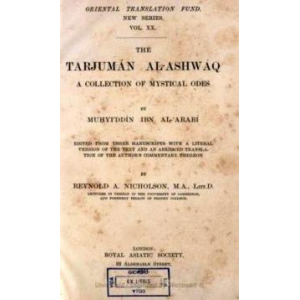
Tarjuman Al Ashwaq A Collection Of Mystical Odes

Tarjuman Al Ashwaq A Collection Of Mystical Odes Cover

Book: Tarjuman Al Ashwaq A Collection Of Mystical Odes by Muhammad Ibn Arabi

The Tarjuman al-Ashwaq (Muhyi al-Din Muhammad ibn 'Ali Ibn al-'Arabi) with the Arabic text, translated by Reynold A. Nicholson Together With a partial translation of the commentary by Ibn 'Arabi'

The Tarjuman al-Ashwaq or "Interpreter of Desires" by Ibn 'Arabi is acknowledged as one of the major works of Sufi literature, alongside those of the great Persian poets Attar, Jalaluddin Rumi, Hafiz and Jami.

In keeping with the poetical tradition of Islam, there is a continuing ambiguity in the verses as to whether they are love poems disguised as mystical odes, or Mystical Odes expressed in the language of human love. The timeless beauty and imagery of the verses cannot be denied, and may be interpreted at many levels. "Gnostics," says Ibn 'Arabi, "cannot impart their feelings to other men; they can only indicate them symbolically to those who have begun to experience the like." In response to the accusation by a religious scholar that these were just sensual poems, Ibn 'Arabi wrote a commentary on the Tarjuman which is partially translated here.

This was one of the first Translations of a book by Ibn 'Arabi into a European langauage, made by the great translator of Rumi's Mathnawi, Reynold A. Nicholson. In both cases his translation was of such outstanding quality that it was more than fifty years before other translators began to try their hands at these texts, and his translations still stand the test of time.

Download Muhammad Ibn Arabi's eBook: Tarjuman Al Ashwaq A Collection Of Mystical Odes

Free eBooks (Can Be Downloaded):

Basil Valentine - Triumphal Chariot Of Antimony
Hilda Roderick Ellis - Road To Hel A Study Of The Conception Of The Dead
Right - Travel In Spiritual Worlds A Complete Guide On Astral Travels
Mark Ludwig Stinson - Heathen Gods A Collection Of Essays Ver 2
Muhammad Ibn Arabi - Tarjuman Al Ashwaq A Collection Of Mystical Odes

Friday, October 8, 2010

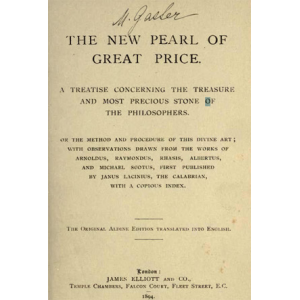
The New Pearl Of Great Price

The New Pearl Of Great Price Cover

Book: The New Pearl Of Great Price by Janus Lacinius Therapus

A treatise concerning the treasure and most precious stone of the philosophers. Or the method and procedure of this divine art ; with observations drawn from the works of Arnoldus, Raymondus, Rhasis, Albertus, and Michael Scotus (1894)

THIS work casts out cruel disease from the human body, disease produced by malignant humours ; and thus you are preserved. It will teach you how to regain the beautiful flower of youth, and how to secure a green and placid old age. All this may be yours, by the favour of the gods. Poverty will be triumphantly put to flight ; your treasure-house will be filled ; you will be able to succour the needy,
and to render the sacrifice of praise to great Jupiter.

TWO features of special interest attach to the " Pearl of Great Price," as written by Bonus of Ferrara, and edited by Janus Lacinius. In the first place, it is one of the earliest works printed on alchemy, and the original is a very beautiful specimen of typography. Concerning the latter point, it is only necessary to say that it was issued from the press of Aldus, appearing in 1546, with the privilege of Pope Paul III. and the Senate of Venice for the space of ten years. This edition is, of course, exceedingly rare, and is highly prized by collectors. In the second place, it is a very clear, methodical, and well-reasoned treatise, comparing favourably in these respects with the bulk of alchemical literature. A reader who is unacquainted with alchemy will probably not appreciate these points,
but any one who, like the present editor, has had occasion to become widely familiar with Hermetic authors, will do honour to the lucidity of Bonus.

Concerning" the adept himself, no biographical materials whatsoever are forthcoming, nor, as in most other cases, is there even a legend to fall back on. He is supposed to have been a native of Lombardy, and to have performed his alchemical labours at Pola, a maritime town of Istria, about 1330. He is sometimes described as Bonus of Ferraria,* and on this and other grounds Tiraboschi't identifies him with the "monk Ferarius".

This work attacks Lenglet du Fresnoy, the historian of alchemy, as an inexact writer, but Tiraboschi had no acquaintance whatsoever with alchemy, and does not seem to have read the Authors whom he endeavours to identify. Imaginative persons might, perhaps, be more inclined to question the equivocal name of Janus, the Calabrian Minorite Friar, and to suspect that his master Bonus was possibly his alter ego.


Download Janus Lacinius Therapus's eBook: The New Pearl Of Great Price

Free eBooks (Can Be Downloaded):

Isaac Bonewits - The Enemies Of Our Enemies
Aleister Crowley - The World Of Tarot
Ralph Blum - The New Book Of Runes
Anonymous - The Magical Library Of Harry Price
Janus Lacinius Therapus - The New Pearl Of Great Price.pdf

Tuesday, October 5, 2010

Solitary Wicca For Life Complete Guide To Mastering The Craft On Your Own

Solitary Wicca For Life Complete Guide To Mastering The Craft On Your Own Cover

Book: Solitary Wicca For Life Complete Guide To Mastering The Craft On Your Own by Arin Murphy Hiscock

If you prefer a solitary approach to worship and Witchcraft, this is the book for you. You need sound guidance and tools as you work alone to deepen your knowledge and strengthen your abilities.

Author Arin Murphy-Hiscock provides you with everything you need to take your spiritual practice to the next level. Solitary Wicca for Life encourages you to reach beyond the ordinary and create a unique path of worship, using techniques that go further than other texts:

- Advanced Circle Casting-advanced techniques and applications, plus methods for creating sacred space when a circle isn't necessary
- Enriching Ritual-tools and techniques that bring new depth to personal practice, including sacred drama, masks, ritual garb, and symbols
- Crafting Liturgy-Wiccan ritual defined stage by stage, as well as guidelines for writing invocations, prayers, meditations, and personalized rituals for esbats, sabbats, rites of passage, and more
- Drawing Down Deities-invoking deities for guidance, communion, worship, etc.
- Growing as a Solitary Wiccan-the means by which you'll enhance your spiritual growth and reach out to the world at large.

Solitary Wicca for Life is the essential reference handbook you need to reach deeper, go farther, and strengthen your solitary path-one day at a time.

I read lots of Wicca 101 books, especially those that seem to be aimed at the Solitary Practitioner. With many of them, I will find some points that I think the average solitary practitioner may relate to, or that someone, somewhere, will relate to. Many times, however, the material does not "click" with my own personal beliefs, or they do not take the "Traditional Path" when it comes to Wicca, but rather they are "Wiccanish". This is OK for someone else, but not necessarily for me. But I do not judge by my standards alone, but rather the viewpoint that everyone needs material that will relate to them personally.

Reading this book, however, there was more material here that I found I agreed with, related to and found to be "Traditional" with a Solitary spin than other books of this kind. And this, to me, was a big plus.

Ms. Murphy-Hiscock has taken Wicca back to the roots and explores adaptation to the Solitary way of practice. This is a Wicca 101 book, so it makes a good first handbook for the average new Solitary practitioner and yet, it provides some material that the advanced practitioner may want to review because of its accuracy, to augment their Wiccan practice, to add elements of the Traditional or just because it is well written and has much to ponder and contemplate.

I especially enjoyed her overview of Wicca Origins, and her separation of Traditional Wicca from the Eclectic practices that Wicca has evolved into. She covers well the Tenets of Wicca, discusses common metaphors and myths and separates some of the more widely accepted but none the less mistaken beliefs and practices that have crept into modern Wicca. She gives you a good idea of how to go back to the beginning, re-examine the issues and maybe take away a better representation of what it is that Wicca is really all about.

Arin Murphy-Hiscock has been a practicing Wiccan for ten years, five of those years as a solitary practitioner. She is the series editor of the For Life series and the author of Power Spellcraft for Life: The Art of Crafting and Casting for Positive Change. She lives in Montreal, Canada.

Buy Arin Murphy Hiscock's book: Solitary Wicca For Life Complete Guide To Mastering The Craft On Your Own

Free eBooks (Can Be Downloaded):

Pauline Bradford Mackie Hopkins - Ye Lyttle Salem Maide A Story Of Witchcraft Ocr Version
Janet Farrar - A Witches Bible The Complete Witches Handbook
Anthony Arndt - Blotar A Brief Guide To Asatru Ritual
Aj Drew - Wicca For Couples Making Magick Together
Right - Travel In Spiritual Worlds A Complete Guide On Astral Travels

Sunday, October 3, 2010

The Great Rite Invocation

The Great Rite Invocation Cover Assist me to erect the ancient altar
At which in days past all worshipped
The great altar of all things
For in times of old, woman was the altar
Thus was the altar made and placed
And the sacred place was the point within the center of the circle
As we have of old been taught
That the point within the center is the origin of all things
Therefore should we adore it
Therefore whom we adore we also invoke
O circle of stars

Whereof our Father is but the younger brother
Marvel beyond imagination, soul of infinite space
Before whom time is ashamed
The mind bewildered, and the understanding dark
Not unto thee may we attain unless thine image be love
Therefore by seed and root, and stem and bud
And leaf and flower and fruit, do we invoke thee
O Queen of Space, O Jewel of Light
Continuous One of the Heavens

Let it be ever thus
That man speak not of thee as One, but as None
And let them not speak of thee at all
Since thou art continuous
For thou art the point within the Circle, which we adore
The point of life without which we would not be
And in this way truly are erected the holy pillars
In beauty and in strength were they erected
To the wonder and glory of all men

Altar of mysteries manifold, the sacred circle’s secret point
Thus do I sign thee as old, with kisses of my lips anoint
Open for me the secret way, the pathway of intelligence
Beyond the gates of night and day, beyond the bounds of time and sense
Beyond the mysteries aright, the five true points of fellowship
Here where the Lance and Grail unite
And feet, and knees, and breast, and lip

Stewart and Janet Farrar – 1984.

Free eBooks (Can Be Downloaded):

Aleister Crowley - Invocation
Friedrich Adler - The Witchcraft Trial In Moscow
Michael Sharp - The Great Awakening
Aleister Crowley - The Supreme Ritual The Invocation Of Horus
John Dee - The Practice Of Enochian Evocation

Saturday, October 2, 2010

Fairy Gold

Fairy Gold Cover

Book: Fairy Gold by Basil Crouch

Basil Crouch A.K.A. Basil LaCroix is one of those old-time great Magicians who learned by the pragmatics of worldly travels in lieu of the theoretics found in most books. Basil spent his youth in a circus amongst the main artistes who were pure Romany, all members of the Manouche Tribe who revere Sara the Black Virgin & Jacques deMolay (GrandMaster of the Templars). The leading Witchdoctor taught him many trix of Magick. He also learned many strange Spells from an Australian Aborigine Witchdoctor. In the late 1960's he masterminded 'coven-style' Occult groups consisting of 6 or 7 women, reaching very advanced stages of development, like producing actual Apports using thoughtform entities, just mindblowing stuff. His teachings excited alot of jealousy within Occult Societies who wanted this kind of thing kept secret. (from reader)

Download Basil Crouch's eBook: Fairy Gold

Free eBooks (Can Be Downloaded):

Aleister Crowley - Liber 831 Iod
Franceska De Grandis - Be A Goddess
Aleister Crowley - Gargoyles
Basil Crouch - Fairy Gold

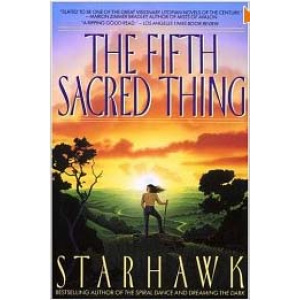
The Fifth Sacred Thing

The Fifth Sacred Thing Cover

Book: The Fifth Sacred Thing by Starhawk

I love this book. I didn't like it at first, but I decided to give it an hour before I made up my mind. Now I am really glad I stuck with it, because it is one of the richest, most thought-provoking books I have ever read.

I had this book on my shelf for several years before I actually read it. Although it obviously sounded good enough at the time I bought it, I feared that it would be preachy and overbearing. It was nothing of the sort. The characters are complex; flawed at times, saintly at others. The story is compelling, combining plots about the personal growth of the various characters, adventure stories as Bird escapes from prison and Madrone ventures into the southern wilds to help the freedom fighters, and the ultimate show down between the San Franciscans and the Stewards. It is a bit simplistic, perhaps, but that didn't stop me from wishing things in reality were more like they are in Maya and Madrone's world. The attempts to portray this world as one free of any racial or sexual bigotry do get a bit heavy handed at times, but never so much that it interfered with my enjoyment of the story. I would recommend this book to anyone, and in fact immediately after I finished Ran out and bought a copy to give as a gift this Christmas.

One of the greatest questions is - how do people resist the violent advances of others without becoming violent themselves? We can look to others for inspiration - HH the Dalai Lama, Gandhi, MLK - there have been a few who have managed to hold on to their ideals despite the crimes inflicted upon them. But how do we do this ourselves? How do we maintain peace within ourselves?

This book discusses these issues on a societal level, but the wisdom you will gain can be applied on a personal level. You will likely find yourself rethinking how you view numerous things - from illness to monogamy.

And the story is interesting and creative, with characters you will come to care about. This is a fantastic book. Go ahead and give it some time - you will probably love it, too!

Buy Starhawk's book: The Fifth Sacred Thing

Free eBooks (Can Be Downloaded):

Friedrich Max Muller - The Sacred Books Of The East
Solomonic Grimoires - The Book Of Secrets
Aleister Crowley - His Secret Sin

Thursday, September 30, 2010

The Sacred Magic Of Abramelin The Mage Book 3

The Sacred Magic Of Abramelin The Mage Book 3 Cover

Book: The Sacred Magic Of Abramelin The Mage Book 3 by Abramelin The Mage

Volume III of The Book of the Sacred Magic of Abramelin the Mage.

The Book of Abramelin tells the story of an Egyptian mage named Abramelin, or Abra-Melin, who taught a system of magic to Abraham of Worms, a German Jew presumed to have lived from c.1362 - c.1458. The system of magic from this book regained popularity in the 19th and 20th centuries due to the efforts of Mathers' translation, The Book of the Sacred Magic of Abramelin the Mage, its import within the Hermetic Order of the Golden Dawn, and later within the mystical system of Thelema (created in 1904 by Aleister Crowley).

Unfortunately, Mathers used the least-reliable manuscript copy as the basis for his translation, and it contains many errors and omissions. The later English translation by Georg Dehn and Steven Guth, based on the earliest and most complete sources, is more scholarly and comprehensive. Dehn attributed authorship of The Book of Abramelin to Rabbi Yaakov Moelin (Hebrew ca. 1365–1427), a German Jewish Talmudist.

Structure of the book

The grimoire is framed as a sort of epistolary novel or autobiography in which Abraham of Worms describes his journey from Germany to Egypt and reveals Abramelin's magical and Kabbalistic secrets to his son Lamech. Internally the text dates itself to the year 1458.

The story involves Abraham of Worms passing his magical and Kabbalistic secrets on to his son, and tells how he acquired his knowledge. Abraham recounts how he found Abramelin The Mage living in the desert outside an Egyptian town, Arachi or Araki, which borders the Nile. Abramelin's home sat atop a small hill surrounded by trees. He was an Egyptian mage and taught a powerful form of Kabbalistic magic to Abraham. He was a "venerable aged man", and very courteous and kind. He discussed nothing but "the Fear of God", leading a well-regulated life, and the evils of the "acquisition of riches and goods."

Abramelin extracted a promise from Abraham that he would give up his "false dogmas" and live "in the Way and Law of the Lord." He then gave Abraham two manuscript books to copy for himself, asking for ten gold florins, which he took with the intention of distributing to seventy-two poor persons in Arachi. Upon his return fifteen days later, after having disposed of the payment money, Abramelin extracted an oath from Abraham to "serve and fear" the Lord, and to "live and die in His most Holy Law." After this, Abramelin gave Abraham the "Divine Science" and "True Magic" embedded within the two manuscripts, which he was to follow and give to only those whom he knew well.

Origin of the manuscript

The book exists in the form of six manuscripts and an early printed edition. The provenance of the text has not been definitively identified. The earliest manuscripts are two versions that date from about 1608, are written in German and are now found in Wolfenbuttel Another two manuscripts are in Dresden, and date from about 1700 and 1750 respectively.

The first printed version, also in German, dates to 1725 and was printed in Cologne by Peter Hammer. A partial copy in Hebrew is found in the Bodleian Library in Oxford, and dates from around 1740. A manuscript copy existed in French in the Bibliotheque de l'Arsenal in Paris, an institution founded in 1797. The French copy has since disappeared, but is available on microfilm.

All German copies of the text consist of four books: an autobiographical account of the travels of Abraham of Worms to Egypt, a book of assorted materials from the corpus of the practical Kabbalah (including some which is duplicated in the German-Jewish grimoire called "The Sixth and 7th Books of Moses") and the two books of magic given by Abramelin to Abraham. The well-known English translation by S.L. MacGregor Mathers from the French Manuscript in Paris contains only three of the four books. The Hebrew version in Oxford is limited to Book One, without reference to the further books.

Of all the extant sources, the German manuscripts in Wolfenbuttel and Dresden are taken by scholars to be the authoritative texts. According to respected Kabbalah scholar Gershom Scholem, the Hebrew version in Oxford was translated into Hebrew from German. An analysis of the spelling and language usage in the French manuscript indicates that it dates to the 18th century, and that it was also likely copied from a German original. Although the author quotes from the Jewish Book of Psalms, the version given is not from the Hebrew; rather, it is from the Latin Vulgate, a translation of the Bible employed by Roman Catholics at that time.

The German esoteric scholar Georg Dehn has argued that the author of The Book of Abramelin was Rabbi Yaakov Moelin (Hebrew 1365–1427), a German Jewish Talmudist and posek (authority on Jewish law). (ref Georg Dehn, The Book of Abramelin: A New Translation, transl. by Steven Guth, Ibis Publishing, 2006)

Magic word squares

The practical magic of Abramelin (found in both Book III of the French text, and Book IV of the German original) centers around a set of talismans composed of magic word squares. These are similar to traditional magic squares, though the latter are usually composed of numbers, while Abramelin's squares contain letters. Commonly word squares are used as puzzles or as teaching aids for students. In the context of Abramelin, the focus becomes mystical—so that each square should contain words or names that relate to the magical goal of the square. A parallel is found in the famous Sator Arepo Tenet Opera Rotas word square, an altered version of which is also found among Abramelin's squares.

For example, a square entitled "To walk under water for as long as you want" contains the word MAIAM, the Hebrew and Arabic word for "water". A square for recovering treasures of jewelry begins with the word TIPHARAH (a variant of Tiferet), which can mean "golden ring" in Hebrew and is also the name of the sphere of "Beauty" on the Kabbalistic Tree of Life.

Download Abramelin The Mage's eBook: The Sacred Magic Of Abramelin The Mage Book 3

Free eBooks (Can Be Downloaded):

Aleister Crowley - The Sixth Chakra Of The Human Body
Manly Palmer Hall - The Secret Teachings Of All Ages
Solomonic Grimoires - The Magic Of Armadel
Abramelin The Mage - The Sacred Magic Of Abramelin The Mage Book 2
Abramelin The Mage - The Sacred Magic Of Abramelin The Mage Book 3

Wednesday, September 29, 2010

Historical Summary Of The European Witch Hunts

Historical  Summary Of The European Witch Hunts Cover The European witch Craze started roughly during conclusion of the 15th century and peaked during the first half of the seventeenth century. The belief that women were sinful and had the power of the devil within them developed out of the Middle Ages. The Reformation further promoted the idea of a satanic kingdom of evil on earth with which to justify persecutions. Theologians sought to prove that accused witches represented the devil.

The first and most significant written cumulative concept of witchcraft available to a large audience was the Malleus Maleficarum written by Sprenger and Kraemer. It was first published in 1486 and reprinted fourteen times before 1520. The document made an important contribution to the widespread witch hunt. Most people accused of witchcraft were rural, poor, and single women. The hunts are often seen as a massive effort to keep women in their place. Women were seen as evil, and unclean people whose weakness could summon the devil for sexual intercourse.

The Malleus Maleficarum document ignited a widespread hunt for the so-called witches described in it. During the hunt, witches were accused of "impractical" and "traceless" crimes such as intercourse with the devil, unregistered babies from hidden pregnancies who were supposedly eaten or sacrificed, and even natural disasters. However there is no record of any solid evidence for any of these accused crimes.

Often these hunts were instigated by hysterical children, or nuns who accused relatives, and neighbors of these outrageous crimes. Witnesses were often bribed or threatened in order to prosecute the accused. The accused would then be tortured until they confessed. The methods of torture were very cruel and painful, and almost all who were put through the various devices would confess. In some cases the accused would die of torture, and very few survived the ordeal without confessing. However, the accused was set free if they survived the torture without a confession. After the forced confession, the trial took place. These trials were run by genuine believers of witchcraft. The aim of the trial was to exterminate the witches as conspirators with the devil. When the accused was declared guilty, they were usually executed.

Although, there are many estimates as to how many actual people were killed during these hunts, most estimates show the number well below the one-million mark. The actual number of documented executions, is generally considered to be under one hundred thousand. Of all that were executed, only a minority were men, and of those men, many are those who tried to protect accused women from the hunters.

Free eBooks (Can Be Downloaded):

Sharynne Nicmacha - The Star Of Life A Historical And Spiritual History Of The Pentagram
Martin Van Buren Perley - A Short History Of The Salem Village Witchcraft Trials
Tuesday Lobsang Rampa - Wisdom Of The Ancients
Michael Bailey - Historical Dictionary Of Witchcraft
Charles Kirkpatrick Sharpe - A Historical Account Of The Belief In Witchcraft In Scotland

Tuesday, September 28, 2010

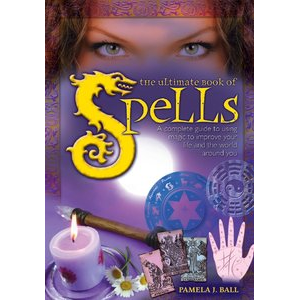
The Ultimate Book Of Spells

The Ultimate Book Of Spells Cover

Book: The Ultimate Book Of Spells by Pamela Ball

The Ultimate book of spells - A Complete Guide to Using Magic to Improve Your Life and the World Around You (2007) Arcturus Publishing ISBN 978-1-84193-577-5

This book is essential reference for anyone wishing to take control of their lives and become confident in the art of spell making...The book includes over 250 spells and techniques, covering every aspect of life and spiritual development. Whether it is creating opportunities for love, doubling your money or protecting your teenage daughter, there is a spell for everyone...With sections on the folkloric history of magic, astrology, divination and mysticism, the book provides the reader with a complete background to the art of magic. The complex social and cultural influence of spells is revealed, as well as their power to enrich and transform modern lives.

The desire to change and improve that which we have has been around for many thousands of years, if not since man first walked the earth. Magic and spell working have always been a part of that, and indeed still are today. Anyone who practises any form of magic, including spell working, needs to be grounded. This means having h feet firmly planted in reality and also having a basic knowledge of what
magic is and is not, what spells can and can’t do and what – with practice – you can do with the tools, information and knowledge you have. This book sets out to give you that information in as succinct a manner as possible.

Download Pamela Ball's eBook: The Ultimate Book Of Spells

Free eBooks (Can Be Downloaded):

Ancient Grimoires - The 6th And 7th Book Of Moses
Anonymous - Book Of Spells
Ancient Grimoires - The 8th Book Of Moses
Michael Johnstone - The Ultimate Encyclopedia Of Spells
Pamela Ball - The Ultimate Book Of Spells.pdf

Monday, September 27, 2010

Moon Eclipses

Moon Eclipses Cover A lunar eclipse occurs whenever the moon passes through some portion of the Earth’s shadow. This can only occur when the Sun, Earth and Moon are aligned exactly, or very closely, with the Earth in the middle. As such there is always a Full Moon on the night of a lunar eclipse. Every year there are at least two partial lunar eclipses, while total eclipses are much less common. The type and length of an eclipse depends upon the moon’s location relative to its orbit of the earth. As of writing this article the most recent total eclipse occurred on the 21st February 2008. The next eclipse, allbeit a partial one, will occur on the 16th August 2008. The next total eclipse is due on the 21st December 2010. Unlike a solar eclipse, which can only be seen from a number of small areas around the world, a lunar eclipse can be seen from anywhere on the night side of the Earth.

Free eBooks (Can Be Downloaded):

Charlotte Fell Smith - John Dee
Charles Baize - Pagan Scriptures
Nicolas Schreck - Demons Of The Flesh

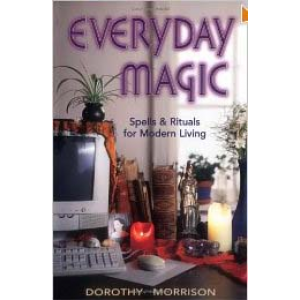
Everyday Magic Spells And Rituals For Modern Living

Everyday Magic Spells And Rituals For Modern Living Cover

Book: Everyday Magic Spells And Rituals For Modern Living by Dorothy Morrison

Is it time for a change? Is it time to improve your life with a better job, a happier home, or more romance? Then you need Everyday Magic by Dorothy Morrison! This is magic for modern Wiccans, and for everyone regardless of their religious affiliation. It is filled with hundreds of spells, chants, rituals, charms and formulas for incenses and oils. Every one is tested and powerful yet easy to use.

Everyday Magic is a well written book and it fit into my everyday living just as if it had been written for me personally. The modern day methods of dealing with the "old ways" of the craft amazed me. To go to a thrift store and pick up a cheap blender instead of trying to do so many herbal blends with the mortar. I was so mermerized with so many of Dorothy's modern gimmicks. Being able to improvise has always been big with me, Dorothy seems to do the same in her book.

Sure, there are spells for romance and prosperity. Those are as important today as they were a thousand years ago. But this book also presents magic that deals with today's problems. Speed up your computer's modem. Make sure your luggage arrives safely; ease labor pains; free yourself from anger; find a parking spot. These are all things we need and that you can do by following the simple instructions in this book!

One of the roadblocks to successful magical workings that many people face is finding the proper oils and incenses. Morrison's solution: Make them yourself! But don't use the old techniques that take hours, days, or even weeks to accomplish. Instead, you'll learn how to use common appliances such as a drip coffee maker, a blender, and a crock pot to create your own powerful incenses, oils, washes, brews, and more. What a practical timesaver!

And saving time in today's world is what this book is all about. Of course, if the spells, charms, rituals and techniques weren't practical and effective, saving time would be meaningless. Well, what you'll learn here is powerful -- and is presented by a woman who has been a Witch for more than 20 years and taught on two continents!

Dorothy Morrison has a daring point of view that magic is not just compatible with technology--the two can actually help one another. Since technology has made our lives more productive, surely it can enhance our magic too. (Have you ever thought of making your herbal infusions in an automatic-drip coffeemaker?) Technological assistance with magic is only part of the story. Morrison has filled a grimoire with charms that protect from car trouble and ensure the safe and timely arrival of luggage while traveling, and spells to keep a computer from crashing, which makes life in the 20th century a little less harrowing. Rather than fighting the progress of the electronic age, Morrison has tapped into the wealth it has to offer, and she shares her discoveries with anyone adventurous enough to try them.

The spells and rituals in here are all based on today's available materials. Trying to find something called dragon's blood was not easy for me. In this book, Dorothy makes it all so simple and still so effective. Spells of interest to the modern twentieth century housemate and businessperson. Spells and rituals that make so much sense and are so easily adaptable for my and others active lives.

I recommend, as I have many times, reading this book. I have read many and find this one to my liking on a high rating of "Way to go, Dorothy Morrison"
Excellent book and will keep an eye and ear open of reports of others from D. Morrison. Age, gender, and type of path are not even a stoppage point here. For all and then some.

Buy Dorothy Morrison's book: Everyday Magic Spells And Rituals For Modern Living

Free eBooks (Can Be Downloaded):

Kveldulf Gundarsson - Teutonic Magic The Magical And Spiritual Practices Of The Germanic Peoples
Tupman Tracy Ward - Theatre Magick Aleister Crowley And Rites Of Eleusis
Richard Alan Miller - The Magical And Ritual Use Of Herbs
Talismagick - Love Spells And Rituals For Love And Relationships

Sunday, September 19, 2010

The Continental Tarots

The Continental Tarots Cover

Book: The Continental Tarots by Christine Payne Towler

In the essay titled "The Major Arcana" I emphasize that "Something happened" to the Tarot in the late 1600s, when a new trend emerged in the images of the Major Arcana. I point to the Marseilles family of decks and the Etteilla Tarots to illustrate my point.

The images shown by Antoine Court de Gebelin in his book Le Monde Primitif further validates this idea.The remainder of this essay is about exploring "what happened." Let's review the situation of Tarot in the first half of the 1600s. Since the early 1400s, both handmade and woodblock Tarots showed a remarkable constancy of internal structure even though some packs were either edited or expanded to meet the needs of the various games for which they were created.

Tarot appeared in 72-card form in Italy around 1450, although this model may represents "splice" between preexisting symbol sets: the twenty-two Hebrew alphabet-keyed set called the Major Arcana, and the Turkish Mamluk cards of unknown provenance, a 15th century version of which can be seen in Volume 2 of Stuart Kaplan's Encyclopedia of Tarot (see essay on the Minor Arcana).

Kaplan also explains that the numerical order the Arcana appear in now is carried over from the French pack by Catelin Geofroy, published in 1557 (Vol. 1, p. 65). Some earlier fragmentary Tarots show Roman numerals on some of their Major Arcana, but not all of them, and not in the order we are now familiar with. Those very old woodblock decks tend instead to follow the list enumerated in a sermon written by an Italian friar in the late 15th century (see illustration opposite page 1 in Volume 1 of Kaplan's Encyclopedia of Tarot). There is also another order derived from the Charles VI pack that keeps Temperence, Fortitude and Justice together in a group. A very small minority of Tarots follow this order, including Etteilla’s Tarots.

Download Christine Payne Towler's eBook: The Continental Tarots

Downloadable books (free):

Pyotr Demianovich Ouspenskii - The Symbolism Of The Tarot
Robert Wang - The Qabalistic Tarot
Samuel Liddell Macgregor Mathers - The Tarot
Aleister Crowley - The Zodiac And The Tarot
Christine Payne Towler - The Continental Tarots

Friday, August 13, 2010

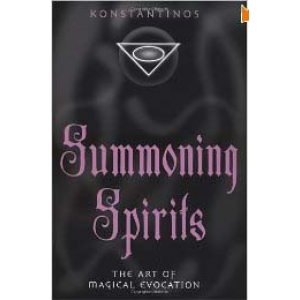
Summoning Spirits The Art Of Magical Evocation

Summoning Spirits The Art Of Magical Evocation Cover

Book: Summoning Spirits The Art Of Magical Evocation by Konstantinos

If you are interested in summoning up elementals,Planetary spirits, Angels and Goetic beings this is the book to get. Though I do a diffrent ceremony for goetic spirits. I do use the methods in this book for the other beings. The auther gives very good and solid information on the Elementals, Angels, Planetary spirits and Goetic beings. But dont be decieved sometimes evoking these beings are not very easy at all. Be prepared for successes as well as failures. This is a great book to get on the subject of evoking these forces. Now you can learn how to evoke and communicate with 50 spirit entities and make use of their abilities, when you get Summoning Spirits by Konstantinos.

Evoking spirits is one of the Most Powerful magical techniques you can use-but, until now, most of the material available on evocation has been virtually unusable because it was written by those with little practical evocation experience. Summoning Spirits was written by a practicing magician who has successfully performed many evocations. With his guidance and clear directions, performing evocations will be easy and safe for anyone.

- Learn to safely evoke powerful spirits to aid you with any task
- Create sigils charged with the energy of spirits to magnify the effects of your evocations
- Make an etheric egregore, a manufactured spirit that will perform the task of your choice
- Perform easy exercises to train your magical abilities and to develop clairvoyance and clairaudience
- Construct, prepare, and use special magical tools to aid your evocations

Summoning Spirits is a complete manual for evoking entities to effect positive changes in your life. Learn how the spirits that dwell on the other planes can be evoked to the astral and physical planes to help you obtain mystical abilities, locate hidden "treasure," and even command a spirit "army" to protect your home while you're away.

Summoning Spirits describes the specific attributes and abilities of 50 entities that you can evoke to uncover valuable knowledge, and who will help you succeed in nearly any task, magical or mundane.

Whether you need help to face life's challenges or to work a minor miracle, you will find the art of Magical Evocation a tremendously potent tool for change. Included are information and theory, as well as full instructions for all the rituals you will need to prepare for and then evoke spirits. No other book makes this ancient magical technique as easy to understand and use, as does this one. That's why you must get Summoning Spirits.

"Summoning Spirits" is the one of best books I have read so far in regards to the ancient and powerful art of magickal evocation. Although I have only just recently purchased this book, I have found it to be very informative, educational and interesting. As an individual aspiring to master this ancient magickal art, and science, I had found Konstantinos's advice and guidance quite beneficial about only working with benevolent spirits such as Angelic, Planetary and Elementary entities. However, I will be looking forward to summoning the Goetic entities as well, as I believe that a magician should have a 'magickal and spiritual balance' between both benevolent and malevolent entities, in addition to mastering them. All in all, a great book for a magician wishing to practice magickal evocation. In addition, I am especially looking forward to evoking the divine and beautiful Archangels and striving to unite and become 'one' with Divinity, which Konstantinos mentions is the 'true' defintion and purpose of magick. A truly magickal and spiritually inspiring book. I know that I will always enjoy and value keeping it as part of my personal magickal library to cherish, reflect upon, and treasure the ancient magickal wisdom and power within it.

Buy Konstantinos's book: Summoning Spirits The Art Of Magical Evocation

Free eBooks (Can Be Downloaded):

Jarl Fossum - Seth In The Magical Texts
Phil Hine - Aspects Of Evocation
John Dee - The Practice Of Enochian Evocation
Malcolm Mcgrath - Practical Magickal Evocation
Konstantinos - Summoning Spirits The Art Of Magical Evocation

Monday, August 2, 2010

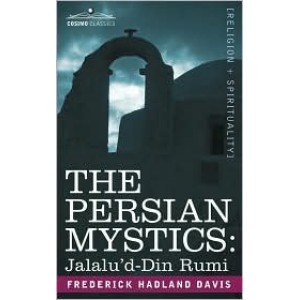
The Persian Mystics Jalaluddin Rumi

The Persian Mystics Jalaluddin Rumi Cover

Book: The Persian Mystics Jalaluddin Rumi by Frederick Hadland Davis

Rumi (1207-1273) was a Persian jurist and theologian best known for being perhaps the finest of all Sufi poets. His writings have been widely translated and remain especially popular in Iran, Afghanistan, and Tajikistan. Though written from a Sufi perspective, Rumi's poems on spiritual growth-here collected and edited by F. Hadland Davis and first published in 1907-cross all cultural and Religious bounds, and can still be heard today in many secular and religious settings.

The Persian Mystics: Jalalu'd-din Rumi includes selections from some of Rumi's most famous works, the "Divani Shamsi Tabriz" and the "Masnavi," as well as passages on his life and work, and the origin and nature of Sufism.

Download Frederick Hadland Davis's eBook: The Persian Mystics Jalaluddin Rumi

Free eBooks (Can Be Downloaded):

Reynold Nicholson - The Mystics Of Islam
Frederick Hadland Davis - The Persian Mystics Jami
Frederick Hadland Davis - The Persian Mystics Jalaluddin Rumi

Wednesday, July 28, 2010

Do Witches Really Cast Hexes

Do Witches Really Cast Hexes Cover People commonly personify witches as evil and all they do is curse and hex others. wiccans are strictly opposed to hexes and curses. Traditional witches (or "Trad Witches") do not have limitations. However, if the thought arises of casting a hex or curse we must ask ourselves if it ethical and completely necessary. Any witch will tell you that if it is regarding defense of loved ones and family the answer is often yes. On the other hand, if it relates to using magick against someone because they cut you off on the highway, then for the majority, the answer is no. See the section in this lens "Black & White Magick" for more on this. Also, for more information about magick, the natural powers of the universe, how to do spells and much more, visit Modern-Witchcraftand especially, Guide for Spells and How To's About Safely Using Magick for Success.

Books You Might Enjoy:

Jarl Fossum - Seth In The Magical Texts
Lau Soon Wah - The Powerful And Deadly Spells Of The Javanese
Julius Evola - Against The Neopagans
Anonymous - The Emerald Tablet Of Hermes

Saturday, July 24, 2010

Who Is A Witch

Who Is A Witch Cover The origin of the word witch predates the Anglo-Saxon period. Etymologically, the word has been derived from an Old English masculine noun wicca, the feminine being wicce. The word ‘wicker’ in old German also stood for a soothsayer. A soothsayer is a fortune-teller or psychic.

In routine usage, a witch is a feminine noun for wizard or sorcerer, but the former has different functional connotations from its masculine counterpart. While a wizard or a sorcerer may have some element of manipulativeness in their craft, a witch, though a practitioner of witchcraft, is far from being a crafty person. A witch is essentially a very noble and deeply religious person whose purity of heart combined with spiritual and meditation practices bestow her with a deeply religious and mysterious aura. A witch does not act with any ulterior motives, not to mention any machinations in her pursuits. A witch is a very compassionate person, gifted with supernatural powers and works for the alleviation of pain and suffering of her fellow human beings and brings them the much needed solace and succor.

A highly misunderstood, deeply suspected, much maligned and doggedly hounded person especially during the middle ages, a witch has regained lost ground and has acquired a respectable position in the society. Colloquially, the term witch, applied most often to a female, also includes male practitioners of witchcraft, especially Wicca. Witches believe in certain ethical codes and strictly adhere to them.

A witch engaged in her witchcraft practices spells developed by worshiping many deities primarily the supreme Goddess and sometimes her consort the God. The craft or workings of a witch are used for healing the acute health problems. For curing these problems, she uses the personal powers in combination with energies within candles, stones, herbs and other natural items. Witch practices witchcraft to help better the world and mankind. A witch certainly is not ugly, nefarious, dreadful hag who worships the devil or hurts the people as the stereotype image presents her to be.

A witch derives her strength from Paganism, which is influenced by ancient, primarily pre-Christian and sometimes pre-Judaic religion. A witch has deep faith in the elements of Nature such as earth, fire, nature, air, and water. Fire cleanses and has an aura that transports her into the astral world and enables her to view this world with psychic clarity. Water purifies.connects with the Goddess herself. The air is an all-enveloping blanket of gods. It wraps around the witch and lifts her to the divine immenseness and freedom of the skies. The spirit of the witch gets united with the air and floats freely in the sky. The witch achieves this uplifted state through meditation, perseverance and sometimes she is blissfully born with these talents.

A witch is just as ordinary looking person as any one in your neighborhood. She can be a housewife with kids doing her daily domestic chores. She too has her share of emotions, but they function more at a macro level than at personal. So if she is feeling sad, the sadness is not just due to some personal vested interest, but it is born out of the suffering of the world around her. Another difference between a witch and an ordinary woman is that a witch can commune with her goddess. The commune is just meant to bare her soul reaching a complete state of oneness. A witch may even cry before the alter of her goddess whenever she feels a spiritual vacuum and wants to replenish it with godliness.

A witch performs her craft using many rituals such as worshiping alone or in covens in the alter room. She lights candles, incense, chants incantations and worships her deities or goddesses. She meditates while staring into the candle flames and in the course of meditation, she feels her spirit leaving her body and enters into trance. A witch gets lost in the awesome power of the Fire with her mind dancing with the flames of the candles. Insightful images deluge her head and become a permanent part of her psyche.

Witches also practice necromancy and summon spirits of the dead to gain knowledge of the future events from them. These spirits are called Operative Spirits or the Spirits of divination.

Books You Might Enjoy:

Michael Bailey - Historical Dictionary Of Witchcraft
Howard Phillips Lovecraft - Cults Of Cthulhu
Mike Nichols - Eight Sabbats Of Witchcraft
Louise Huebner - Witchcraft For All
Paul Huson - Mastering Witchcraft

Thursday, July 22, 2010

What Is A Kitchen Witch

What Is A Kitchen Witch Cover What is Kitchen Witchery?:

There's a growing movement within modern paganism known as kitchen witchery. The kitchen is, after all, the heart and hearth of many modern households. When you have a gathering in your home, where do most of your guests hang out? Why, the kitchen, of course! Also, thanks to a declining economy, many more people are making meals from scratch and the kitchen has once again become a place where people spend hours, rather than minutes. So it's no surprise that kitchen witchery has seen a rise in popularity.
Meal Prep as Magic:

When you take the time to put meals together from the basic ingredients, you have a magical opportunity at hand. You can infuse every dish with intent and will. A meal can stop being something you dump out of a can, and start being a ritual in and of itself. When you take time to prepare something with your own hands, that lends it sacredness, and will make you want to spend time savoring it with your family, rather than just snarfing it down on your way out the door to soccer practice. By changing the way you view food, its preparation and its consumption, you can craft some practical magic at its simplest level.

Books You Might Enjoy:

Tarostar - The Witchs Spellcraft Revised
Aj Drew - A Wiccan Bible
Michael Harrison - The Roots Of Witchcraft

The Witch Hunts Of Early Modern Europe

The Witch Hunts Of Early Modern Europe Cover For three centuries of early modern European history, diverse societies were consumed by a panic over alleged witches in their midst. Witch-hunts, especially in Central Europe, resulted in the trial, torture, and execution of tens of thousands of victims, about three-quarters of whom were women. Arguably, neither before nor since have adult European women been selectively targeted for such largescale atrocities.

The witch-hunts of early modern Europe took place against a backdrop of rapid social, economic, and religious transformation. As we will see in the modern-day case-studies below, such generalized stress -- including the prevalence of epidemics and natural disasters -- is nearly always central to outbreaks of mass hysteria of this type. Jenny Gibbons' analysis ties the witch-hunts to other "panics" in early modern Europe:

Traditional [tolerant] attitudes towards witchcraft began to change in the 14th century, at the very end of the Middle Ages. ... Early 14th century central Europe was seized by a series of rumor-panics. Some malign conspiracy (Jews and lepers, Moslems, or Jews and witches) was attempting to destroy the Christian kingdoms through magick and poison. After the terrible devastation caused by the Black Death [bubonic plague] (1347-1349), these rumors increased in intensity and focused primarily on witches and "plague-spreaders." Witchcraft cases increased slowly but steadily from the 14th-15th century. The first mass trials appeared in the 15th century. At the beginning of the 16th century, as the first shock-waves from the Reformation hit, the number of witch trials actually dropped. Then, around 1550, the persecution skyrocketed. What we think of as "the Burning Times" -- the crazes, panics, and mass hysteria -- largely occurred in one century, from 1550-1650. In the 17th century, the Great Hunt passed nearly as suddenly as it had arisen. Trials dropped sharply after 1650 and disappeared completely by the end of the 18th century. (Gibbons, "Recent Developments in the Study of the Great European Witch Hunt".)

Gibbons' allusion to the Reformation reminds us that the clash between institutional Catholicism and emergent Protestantism contributed to the collapse of a stable world-view, which eventually led to panic and hyper-suspiciousness on the part of Catholic and Protestant authorities alike. Writes Nachman Ben-Yehuda, "This helps us understand why only the most rapidly developing countries, where the Catholic church was weakest, experienced a virulent witch craze (i.e., Germany, France, Switzerland). Where the Catholic church was strong (Spain, Italy, Portugal) hardly any witch craze occurred ... the Reformation was definitely the first time that the church had to cope with a large-scale threat to its very existence and legitimacy." But Ben-Yehuda adds that "Protestants persecuted witches with almost the same zeal as the Catholics ... Protestants and Catholics alike felt threatened." It is notable that the witch-hunts lost most of their momentum with the end of the Thirty Years War (Peace of Westphalia, 1648), which "gave official recognition and legitimacy to religious pluralism." (Ben-Yehuda, "The European Witch Craze of the 14th to 17th Centuries: A Sociologist's Perspective," American Journal of Sociology, 86: 1 [July 1980], pp. 15, 23.)

Books You Might Enjoy:

John Moore - A Modern Master Extract
Will Herberg - The Writings Of Martin Buber
Nathan Johnston - The Devil And Demonism In Early Modern England
Margaret Alice Murray - The Witch Cult In Western Europe
Diane Purkiss - The Witch In History Early Modern And Twentieth Century Representations

Wednesday, July 21, 2010

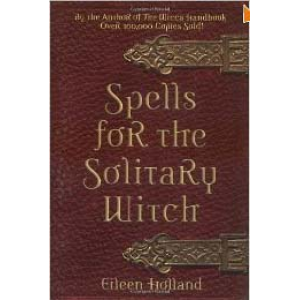
Spells For The Solitary Witch

Spells For The Solitary Witch Cover

Book: Spells For The Solitary Witch by Eileen Holland

This book "Spells for the Solitary Witch" focuses on spells and spell work specifically for the Solitary Practitioner. Clear and easy to follow, Spells for the Solitary Witch explains how to prepare and cast spells 87 spells in all together with the materials needed for each spell and the incantations to say that will ensure the best results. Tailored to the needs of solitary witches, Holland suggests alternatives to hard-to-find ingredients, as well as directions about where to find specific ingredients crucial to a spells success.

Written by a solitary witch and Wiccan priestess herself, Spells For The Solitary Witch is a simple walkthrough of ways to release hidden power for health, wellness, emotional enrichiment, and environmental harmony. Chapters discuss magick and its applications in love, life enhancement, and problem solving, as well as magickal candle gardens, tea potions, and more. Detailed instructions, specific incantations, detailed how-to's down to where one can easily obtain sesame oil or Tiger Balm, and much more make Spells For The Solitary Witch ideal for novice and experienced spellcasters alike.

Again we are presented with Ms. Holland's easy to read and follow style of writing. She lays her book out according to the kind of spells you may want to do, and lists her spells according to what you want to accomplish when working your spells.

I have to say her opening section, entitled :Before you Begin" is exceptional in explaining basic spellwork, what it is, what is magic, ethics when working magic, personal responsibility and terminology. This is an excellent reference on it's own and should be suggested to all beginning spellworkers as a point of essential reference. I wish Ms. Holland would have expanded this section, as she did it so well, but it does stand on it's own as a very good overview.

The sections on actual spellworking are divided into seven chapters, covering "Inner Work, "Goals, Hopes, Wishes", "Love", "Life Enhancement", "Problem Solving", "Magickal Candle Gardens", and "Tea Potions".

Each section has a selection of spells for various situations. Under "Inner Work" we find spells for acceptance, getting over it, even personal power talisman, a tool for building self-confidence. Each spell has complete instructions and directions on how to use the spells for each intent. A list of needs is followed by preparation and the actual spell working, which may include an incantation, ritual, and sometimes an "afterward" or review of what should be the focus and how you should react to the spellworking. With the Talisman, she discusses creating these talisman, the proper signs for you, day workings and Correspondences, and all you would need to know to create and use a personal talisman.

Going forward into the various chapters, each chapter contains spells referencing the chapter title. In "Goals, Hopes, Wishes" we have spells for goals you wish to reach, spells for special wishes, interview charms; all with discussions on your intents to what you want to achieve and how to work the spell.

The "Love" section has workings for personal enhancement, to bring love into your life. The "Life Enhancement" chapter has spells for home blessings, abundance, fertility, joy, and protection to name a few. "Problem Solving" covers dealing with major mistakes, fearsome problems, problematic persons and hard times.

What I note in her spells is that when a spell calls for a "potion" as in her Tragedy Potion (for someone who has just encountered a tragedy in their life and you offer them this potion to help calm nerves and help them center and balance) the ingredients are noted and the appropriate cautions are given. In this case, she gives a recipe for a hot cup of cocoa, with some oil of peppermint. She notes "Note: this potion isn't for you if you are lactose-intolerant, allergic to chocolate or peppermint or have any medical reason that precludes its use." Wise words from a wise witch.

The book contains many notes of wisdom. "Magickal Candle Gardens" focuses on candle magic to assist persons in need. The garden is built indoors, containing candles arranged for your specific purpose and using candles of specific shapes and size depending on the needs. After going over the plans and the layout, it looks to be something even I would consider as a special magical working, being attractive, practical and very especially magical.

The last chapter is about "Tea Potions" specifically, and again, contains potions to work on yourself for specific situations you may encounter, such as personal health, luck, creativity and success to name a few. She works some of the potions with runes, others with chant. The only note I have here is that she did not repeat her good advice about being allergic to certain herbs, as most of these teas are herbal in their base. Please use your own digression when preparing these teas and if allergic, then look for a substitute.

Eileen Holland is a solitary eclectic witch, a Wiccan priestess who calls her path Goddess Wicca. She is the author of several books about magick and witchcraft, including Spells for the Solitary Witch and the best-selling The Wicca Handbook. Eileen is the webmaster of www.open-sesame.com, a popular long-running Wiccan web-site. She lives in upstate New York.

Buy Eileen Holland's book: Spells For The Solitary Witch

Downloadable books (free):

Anonymous - Welcome To The Secrets Of The Root Witch
Scott Cunningham - Wicca A Guide For The Solitary Practitioner
Shanddaramon - Self Initiation For The Solitary Witch
Tuesday, July 20, 2010

The Salem Witchhunts And Drugs

The Salem Witchhunts And Drugs Cover After researching the Salem witch Hunts, I’ve come to the conclusion that teenagers will be teenagers regardless of when they existed in History. Teenage girls circa 1690’s living in colonial Salem had a pretty drab life. All these girls did was chores and attend church. And “an idle mind is the devil’s work shop”…no pun intended. Can you imagine today’s teenagers doing just that? Boredom filled their days until they met a slave from the West Indies named Tituba. Tituba had thrilling and spellbinding stories she shared with these girls. The stories of faraway places and exotic people captivated the girls. As the days progressed, the more peculiar Tituba’s stories got. With a lot of drama, and flare, Tituba spoke of forbidden practices such as witchcraft, sorcery, voodoo, and other dark practices. This made an impression on these young girls.

salemwitchSoon the girls exhibited odd behavior at home. They’d kicked and screamed, had fainting spells, spoke to apparitions, and complained of being bitten, and strangled by unseen hands. The more attention their families gave them, the more bizarre the outbursts. Just like a teenager… Soon the families and church became concerned and the only explanation they had for this was…it’s the devil’s work, and it must be stopped. After being questioned by their families and the church elders, the girls claimed that “witches” were the cause. The church leaders went on the hunt for the witches. They identified who they thought was a witch, most of which were elderly women. The poor women didn’t stand a chance…they all were tried (if you want to call it a trial) and hanged. In all, 20 women were hanged. These hunts and hangings went on for 2 years. The frenzy in these hunts was so bad that soon dogs were being accused of witchcraft. Two poor dogs were found guilty of witchcraft and were hanged.

How did this travesty happen? What motivated these young girls to do such a thing? The answer may lie in drugs. Some historians believe that the problem was Ergotism. Ergot is a fungus which grows in moldy grain and contains a mind-altering drug. Ergotism outbreaks, which affected entire regions, were common in Europe during the middle ages. But little was known of Ergot’s hallucinogenic effects in 17th century America. Today, ergot is used in drugs that help those with migraine headaches. If ergot is taken in its pure state, it becomes a powerful hallucinogenic. It is known to also cause disorientation, and even death.

The theory is that Tituba knew about the powerful drug in ergot, and introduced the young girls to the drug. Since Tituba knew a lot about sorcery, and voo-doo, it is speculated that she also knew of toxins, their sources, and effects. Historians believe that the girls were introduced to the grain and that they continued to consume it in greater quantities on their own. This can very well explain their bizarre behavior. Can we say that Tituba was also responsible for the 20 innocent women who were hanged? I believe that Tituba was playing with fire when she dabbled with the dark world and the drug world as well. I don’t think she ever expected what happened. But 20 innocent women paid the price nonetheless.

Books You Might Enjoy:

Anonymous - Healing Gemstones And Crystals
Jaroslav Nemec - Witchcraft And Medicine
Alice Bailey - Initiation Human And Solar
Kathryn Paulsen - Witches Potions And Spells

Popular Posts