Showing posts with label book of spells. Show all posts

Thursday, October 21, 2010

Comselha An Enochian Macrocosmic Ritual

Comselha An Enochian Macrocosmic Ritual Cover

Book: Comselha An Enochian Macrocosmic Ritual by Benjamin Rowe

The purpose of this ritual exercise is to invoke the transcendental power of the Enochian god, to transform it in turn through all the macrocosmic powers within the Elemental Tablets, and to organize them into a balanced form. At the same time, these powers are conditioned so that they express a particular view of the creation of which they are a part. As the final step, these energies are directed so that they energize the magician himself.

The magickal records covering the results of the first use of this exercise are available separately.

I have received several complaints about my published rituals recently. Some complain that they are too elaborate, others that they are too simple, and some question whether they really qualify as magickal rituals in the traditional sense.

The complaints of over-elaborateness stem from the fact that it is impossible to perform any significant part of the works in a single session. This is perfectly correct, and is done deliberately. My experience has been that the rewards given to the magician by the "angels" of the Enochian system are very precisely gauged to the amount of care and effort the magician puts into the work. Works that are planned, rehearsed, and carried out over a period of weeks or months are much more likely to produce significant initiations than any number of single-session efforts. The present work was designed to be performed in stages, with the expectation that each stage will be performed until the powers invoked achieve a self-sustaining presence in the magician’s temple before he passes on to the next stage. It can be expected that the rewards will be commensurate with the effort involved.

Complaints of excessive simplicity derive from lack of the pompous verbiage typically found in formal rituals, and the dearth of advice concerning symbols, implements, and materiel that would help to fire the imagination of the magician. There is a decidedly bare-bones feel to the descriptions. This is perhaps an expression of my own character as a magician; I find that complex pomp and ceremony put me off rather than enhancing the work. I have complete faith that every magician’s imagination and intuition will provide him with enhancements appropriate to his or her own character and style, and so see no need to provide more than the minimum schema necessary to accomplish the work successfully.

The differences between these rituals and more traditional forms derives from the nature of Enochian magick. In most systems, the primary difficulty is in producing a flow of the desired power. The major portions of the rituals are dedicated to simply getting the power to appear. Once it does appear, its direction to the desired end is a relatively simple matter.

In contrast, the Angelic Calls and Names provide a means by which even a beginning magician can easily call up a strong flow of force. But the forces involved are much more ambiguous than in other systems. Each appears to have many different natures depending on the level and orientation from which they are viewed; their manifestations seem to be potentially infinite. The primary work of a ritual must accordingly be to focus, direct, and condition them, through the use of the imagination, so that they manifest in a clear and manageable way. This work conforms to that necessity.

Additionally, the specific form used makes this work something resembling an inverse path-working exercise, going top-down rather than bottom-upwards. And as Frater Azoth has pointed out, there are resemblances to the mandala-workings and chakra-visualizations used in Tibetan Buddhism. They are certainly very similar in intent, though the similarity of form was unintentional.

Download Benjamin Rowe's eBook: Comselha An Enochian Macrocosmic Ritual

Books in PDF format to read:

Josh Norton - Charging An Enochian Tablet
Benjamin Rowe - Comselha An Enochian Macrocosmic Ritual

Tuesday, October 12, 2010

Black Magic And The Occult

Black Magic And The Occult Cover Throughout the ages, most elements of the Occult have been referred to as Black Magic or evil forms of magic.. This is common misunderstanding, as most elements of the Occult and its understanding are focused on the good element of the energy.. The black arts is more a personal aspect from a confused magician or sorcery.. All magic or energy wielding that is designed to intentionally harm another will in the end, end up harming the wielder and I will explain why..?

What is Black Magic ?

First of all let’s sum up Black magic or Evil magic as some call it. Many people are doing this form of magic without even knowing throughout there lives, manipulating people, manipulating greed, controlling the energy in a negative way which benefits themselves only.. If we can better understand these forms of energy manipulation or control it is then easier to protect ourselves from this common aspect of life.

An example of Misunderstood Black Magic

A good example of Black magic is any form of energy, that negatively effects your health or power to make choices (internal freedom).. It could be an influence at work with your boss where you are so used to being told what to do you are unaware of what it is doing to you.. It could be chasing the money to the point where money becomes your life and emotional response to others does not exist.. Another example could be in an abusive relationship where one partner gets pleasure out of hurting the other, do not confuse this with anything else this is emotional black magic..
It comes back on The Wielder of the Black Magic User..

Now that I have named a few examples I will explain why it will eventually negatively effect the wielder who tampers with negative or Black magic.. Similar to what Einstein said every action deserves a equal and opposite reaction it is similar with energy.. If you keep taking and taking and using it negatively, it will return on you and the effects could be devastating.. It could make you depressed or suicidal or even cause cancer to name a few.. It is important to make sure all use of the energy which we are all apart is always positive, that way only more positive can return..

Victims of Black Magic – Protect Yourself!

The unfortunate side of this is the victims, if you are a victim of energy harm or black magic it is important to try to defend yourself with your own energy.. Be positive and get advice from those that have massive amounts of energy levels, there are plenty of good magic users all around us who do not know they wield for good or might not even be aware of energy but always are willing to help..

Once you have advice or help you need to identify the wielder and confront them with emotional protection.. You cannot ask them about black magic as most will be like what the.. But you can tell them how they make you feel and then say you will never effect me like this again and be strong.. Sometimes moving away can help but you must confront these energy abusers first as they can leave a energy trail that can hurt you for months.. Sometimes black magic wielders will go for those that they think they can control easier or who are overly nice. If this is the case, you need to address this immediately if you notice it happening to another.. It is recommended to confront the wielder and explain an explanation and ask them to stop doing it..

I hope this post helps people understand a bit more on energy, which exists in everything and what makes Black magic, if you can think of anything else, feel free to comment below..

Books in PDF format to read:

Naomi Janowitz - Magic In The Roman World
George Moir - Magic And Witchcraft

Saturday, October 2, 2010

Drawing Down The Moon Witches Druids Goddess Worshippers And Other Pagans In America

Drawing Down The Moon Witches Druids Goddess Worshippers And Other Pagans In America Cover

Book: Drawing Down The Moon Witches Druids Goddess Worshippers And Other Pagans In America by Margot Adler

Popular demand for this clear-sighted compendium of information about the rebirth of Pagan religions hasn't waned since its initial publication in 1979. Distinguished by the journalism of National Public Radio columnist Margot Adler, Drawing Down the Moon explains this diverse and burgeoning religion's philosophies and activities while dispelling stereotypes that have long been associated with it. Most people don't realize that pagan simply refers to pre-Christian polytheistic nature religions, such as the various Native American creeds, Japanese Shinto, Celtic Druid, and Western European Wicca. Originally, the word pagan meant "country dweller" and was a derogatory term in Rome in the third century A.D., not unlike calling someone a hick today. If you find yourself feeling queasy when you hear the words witch or pagan, a healthy dose of reeducation via Drawing Down the Moon could be the cure.

I read this book when it was first published and recommned it to anyone who wants to become more enlightened about the topic. I have a social science background, and thus a general understanding of the various world views of traditional societies who are in my opinion closer to old Mother Earth than most of us "moderns" who spend far too much time caught up in our technology. Margot Adler (granddaughter of the famous psychologist) went exploring (ethnographic field work) and this book is the result.

She does not promote any of the world views she describes, she plays the good ethnographer and records what she finds. She participates on several occasions, and thus becomes the "participant observer" recorder. I didn't know much about the revival of "paganism" and had never heard of Wicca before I read Adler's book. I learned that in spite of the professed enlightenment of our modern age, many fear the practices described. Why? Basically, the practice of Wicca seems to be a female oriented way of life--focusing on nature, life, a spiritual path. I for one am continuing to read about Wicca and explore what others are doing.

I figure some of the so-called witches etc. are not what they purport to be, just as some of the agressive so-called Christians driving with bumper stickers that advertise their "faith" are not what they purport to be. I recommend Adler's book if you are interested in comparative religion, are looking for a new way of living or just curious about a somewhat maligned and often persecuted group of mostly women.

Buy Margot Adler's book: Drawing Down The Moon Witches Druids Goddess Worshippers And Other Pagans In America

Free eBooks (Can Be Downloaded):

Mw Macdowall - Asgard And The Gods The Tales And Traditions Of Our Northern Ancestors Ver 2
Leo Joachim Frachtenberg - Allusions To Witchcraft And Other Primitve Beliefs In The Zoroastrian Literature
Robin Artisson - Dance Of The Witches Opening The Devil Eye
Gerina Dunwich - A Witchs Guide To Ghost And The Supernatural
Damon Leff - A Pagan Witches Touchstone Witchcraft And Witch Hunts In South Africa

Thursday, September 30, 2010

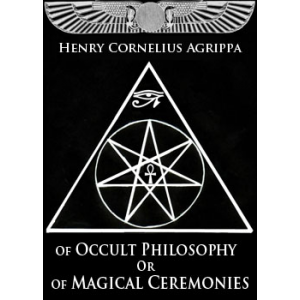
Of Occult Philosophy Or Of Magical Ceremonies The Book Iv

Of Occult Philosophy Or Of Magical Ceremonies The Book Iv Cover

Book: Of Occult Philosophy Or Of Magical Ceremonies The Book Iv by Henry Cornelius Agrippa

Of Occult philosophy Or Of Magical Ceremonies The Book IV of The Three Book of Occult Philosphy by Henry Cornelius Agrippa

The Three Book of Occult Philosphy purports to be the work of Henry Agrippa, the 16th century author of "Three Books of Occult Philosophy". But the 4th Book was obviously not written by Agrippa and bears no resemblance to his style of writing. Although it can be traced back to the 16th century as it is mentioned by Agrippa's student, Johann Weyer in his "De Praestigiis Daemonum", the work remains of uncertain provencance.

In part a partial summary of some of Agrippa's writings, this facsimile of the English translation by the 17th century Cambridge scholar Robert Turner, comprises spurious essays on Geomancy and Magick under the name of Agrippa, The Heptameron of Peter of Abano, and books on Astrology and Demonolgy, concluding with the Arbatel, a largely Judeo-Christian outlook on the dangers of magic.

It is a very quick and easy read, despite the portions dealing with Geomancy and Astrology that even those serious about such subjects would find largely frustrating and incomprehensible.

The work largely remains of pure historical interest with not much of serious substance to an undertanding of Magic and Occult Philiosphy.

This volume is a facsimile of Robert Turner's English translation (1654); the original volume first appeared (in Latin) in Marburg around 1554. The original volume included a large number of short texts of varying interest, but Robert Turner's (1654) (for unclear reasons) decided only to translate a few of them. This edition includes 6 short texts: Of Geomancy (H.C. Agrippa); Of Occult philosophy the Three Book (pseudo-Agrippa); Heptameron or Magical Elements (pseudo-Peter de Abano); Isagoge: An Introductory Discourse on the Nature of ... Spirits... (Georg Pictorius Villinganus); Of Astronomical Geomancy (Gerard of Cremona); and the Anonymous Arbatel of Magic. Only the Geomancy is actually by Agrippa, and it doesn't fit well with the other texts. The Three Book is, as another reviewer noted, certainly spurious; it purports to be Agrippa's "secret key" to the Occult Philosophy, of which he spoke in a letter to a friend. The Heptameron and the Arbatel are grimoires of some interest for those interested in black magic, as indeed is the Three Book itself; the Isagoge is a rather dull dialogue about spirits; and the Astronomical Geomancy is more or less impenetrable but perhaps interesting in a peculiar way. There have been a number of reprints of this volume, some now surprisingly valuable despite their modernity; all, however, have trimmed out one or more of the already few texts. As such, this is probably the best edition available. It is, like all Kessinger products, a cheaply-bound xerox facsimile of the original 17th-century text, but it's readable and includes everything. If you collect grimoires or magical texts, this is a very famous one, and you ought to have it; copies of the various Latin printings turn up with some regularity, and those with access to Latin would do better with those, although they are of course quite expensive. If you're looking for works by Agrippa, the Geomancy is all you'll find here, but it's interesting in a number of respects. If you want to know about Agrippa's ceremonial magic, however, you need to read book 3 of the Occult Philosophy, available in a nice Llewellyn edition.

Download Henry Cornelius Agrippa's eBook: Of Occult Philosophy Or Of Magical Ceremonies The Book Iv

Free eBooks (Can Be Downloaded):

Henry Cornelius Agrippa - Occult Philosophy And Magick Book Iii
Henry Cornelius Agrippa - Occult Philosophy And Magick Book Ii
Henry Cornelius Agrippa - Occult Philosophy And Magick Book I
Henry Cornelius Agrippa - Occult Philosophy And Magick Book Iv
Henry Cornelius Agrippa - Of Occult Philosophy Or Of Magical Ceremonies The Book Iv

Wednesday, September 29, 2010

Her Hidden Children The Rise Of Wicca And Paganism In America

Her Hidden Children The Rise Of Wicca And Paganism In America Cover

Book: Her Hidden Children The Rise Of Wicca And Paganism In America by Chas Clifton

I found this book among many in my local bookstore and purchased it on the fact that the cover was eerily close to a vision in a dream I had over a year ago. I have never been happier to have had such a dream! This book, I found, was completely amazing.

While many books on Paganism focus on practice, perhaps a few focusing on philosophy, very few focus on any actual scholarship. This specific book focuses on the history of contemporary Paganism, from Gerald Gardner to more modern influential groups, such as the Church of All Worlds. The depths the author, Mr. Chas S. Clifton, provides for anyone interested in history and Pagan academia runs deeps.

Since the release of Ronald Hutton's "Triumph of The Moon" back in 2000, I have yearned for a book that would take an in-depth look at the history of modern Paganism in America. So I was more than a little excited and hopeful when I heard that Pagan academic Chas Clifton was rising to the task in his new book "Her Hidden Children: The Rise of Wicca and Paganism in America". Finally a book that would take a look at how modern Paganism and Wicca took root in American soil and became one of the fastest growing faiths in the country.

Clifton - knowing that he could in no way cover everything that has happened from the 1930s to the present - has chosen with this book to lay down some basic parameters for talking about modern Pagan history in America. First he concentrates on Wicca: it being the largest and most influential modern Pagan religion in America. Secondly, when moving out from Wicca he generally stays with groups that claim to follow "nature" or "earth" religions. Not getting much attention in this history are the "reconstructionist" Pagan faiths and feminist Wicca.

The author begins with examining Gerald Gardner and the beginning of British Wicca, looking at both Gardner's claims of a long-line of witches and historical evidence to this claim. Following this, the author discusses how Wicca came to America and how it spread.

The second chapter focuses on the change of Wicca from a Mystery Religion to a "nature" religion. The author brings to use the idea that Wicca combined a triple-form of nature, ranging from the Cosmic, Natural (Earthly), and Erotic. He shows us how Wicca became changed through the changing social changes affecting America during this time.

Throughout the rest of the book, Mr. Clifton shows his readers the struggles and effects Wicca has had in America (such as, for example, the effort to change the image of the popular "Witch), the influence Paganism has had in Popular Culture (and vice versa), and a look at other Pagan groups that have influenced Paganism on a whole (which may, or may not, have started before Wicca).

If one is interested in the history of Paganism, specifically Wicca, this is a great book to sate that interest. This book is a wonderful example of Pagan scholarship so needed in the Pagan community. I highly recommend this book to anyone wishing to be a Pagan, claiming to be a Pagan, or vaguely interested in knowing about Pagans.

Buy Chas Clifton's book: Her Hidden Children The Rise Of Wicca And Paganism In America

Free eBooks (Can Be Downloaded):

Michael Ford - The Calling To The First Of Witch Blood An Invocation Of Cain
Sirona Knight - A Witch Like Me The Spiritual Journeys Of Today Pagan Practitioners
Lawton Winslade - Teen Witches Wiccans And Wanna Blessed Be
Abner Cheney Goodell - Further Notes On The History Of Witchcraft In Massachusetts
Al Selden Leif - 6 Questions On Wicca And Paganism

Astronomical Geomancy

Astronomical Geomancy Cover

Book: Astronomical Geomancy by Gerald Cremonensis

Astrological geomancy is an ancient method of divination. The word geomancy means earth divination and is believed to have come from the use of sand to generate the geomantic figures, the basis of prediction in geomancy. This also accounts for its Arabic name, ilm al-raml, literally the science or wisdom of the sand.

In the modern era the ancient art of divinatory geomancy has been confused with Chinese feng shui which is not a method of divination, but a science of spatial arrangement, architecture and landscaping. Divinatory geomancy has also had its name appropriated by the modern New Age study of ley lines and earth "energies" which are also not techniques of divination.
Contemporary practitioners of the traditional Western art of geomancy have taken to referring to it as divinatory or astrological geomancy to differentiate it from these more modern uses of the term. Astrological geomancy is a particularly appropriate term as much of the divinatory methodology used in geomancy comes from traditional astrology.

The origins of geomancy are shrouded in mystery, but the first manuscripts describing the practice appear in the 9th century AD in the advanced Islamic civilization of the Middle East. From there it spread to Europe in the 11th and 12th centuries as part of the reception of many arts and sciences, including the occult arts of astrology, alchemy and magic by the rapidly civilizing West. Known in Arabic as ilm al-raml, literally the science or wisdom of the sand, geomancy became quite popular as a divinatory technique because of its ease of learning and use. Here is an interesting article in pdf form by the Dutch academic Wim van Binsbergen on the Astrological Origin of Islamic Geomancy. Because of its close connection to astrology, geomancy has been called "the Daughter of Astrology" and known as terrestial astrology.

Download Gerald Cremonensis's eBook: Astronomical Geomancy

Free eBooks (Can Be Downloaded):

Anonymous - Gerald Cremonensis On Astrological Geomancy
Henry Cornelius Agrippa - Of Geomancy
Nick Farrell - Notes On Geomancy
Gerald Cremonensis - Astronomical Geomancy

The Magic Of Armadel

The Magic Of Armadel Cover

Book: The Magic Of Armadel by Solomonic Grimoires

The grimoire of Armadel translated from the original French and Latin of a manuscript in the Biblotheque l'Arsenal in Paris. This is classed as a Christian Grimoire and contains many important seals and sigils of the various demons and planetary spirits. First translated by S.L. McGregor Mathers in the late 1890’s. The Grimoire of Armadel remained unpublished until 1980.

What follows is an unabridged introduction taken directly from the version of the Grimoire by Frator Alastor:

“…….When Mathers made his translation he notice that the title page was the last page of the Grimoire, so he moved to the front but keep the rest of the chapters in the same order. He also notice that this Grimoire began speaking about the magick circle like if it where something that the reader should already know. Now it is my believe that the whole Grimoire was written backward, this is to say that you should read the last page first (the title page) then the last chapter and so on. If you read it this way you will see that make a lot of sense. In Mathers version the first chapter is a reference to the magick circle and the License to depart, it make no sense to begin a Grimoire that way since the license to depart is the last think that a magician read. Also if you fallow the Latin titles in Mathers version the text begin with the Sanhedrin, Jesus and go on to the creation of Adam and the demons and the angels etc. This order is completely the opposite of that one on the bible this is god first, then the angels, the demons, Adam, Jesus, the Crucifixion and the Sanhedrin. So neither to say I had inverted the orders of the chapters in Mathers version under the believing that this is the way that the magic was intended to be read.”

Download Solomonic Grimoires's eBook: The Magic Of Armadel

Free eBooks (Can Be Downloaded):

William Blake - The Marriage Of Heaven And Hell
John Musick - The Witch Of Salem
Reynold Nicholson - The Mystics Of Islam
Aubrey Bell - The Magic Of Spain
Solomonic Grimoires - The Magic Of Armadel

Historical Summary Of The European Witch Hunts

Historical  Summary Of The European Witch Hunts Cover The European witch Craze started roughly during conclusion of the 15th century and peaked during the first half of the seventeenth century. The belief that women were sinful and had the power of the devil within them developed out of the Middle Ages. The Reformation further promoted the idea of a satanic kingdom of evil on earth with which to justify persecutions. Theologians sought to prove that accused witches represented the devil.

The first and most significant written cumulative concept of witchcraft available to a large audience was the Malleus Maleficarum written by Sprenger and Kraemer. It was first published in 1486 and reprinted fourteen times before 1520. The document made an important contribution to the widespread witch hunt. Most people accused of witchcraft were rural, poor, and single women. The hunts are often seen as a massive effort to keep women in their place. Women were seen as evil, and unclean people whose weakness could summon the devil for sexual intercourse.

The Malleus Maleficarum document ignited a widespread hunt for the so-called witches described in it. During the hunt, witches were accused of "impractical" and "traceless" crimes such as intercourse with the devil, unregistered babies from hidden pregnancies who were supposedly eaten or sacrificed, and even natural disasters. However there is no record of any solid evidence for any of these accused crimes.

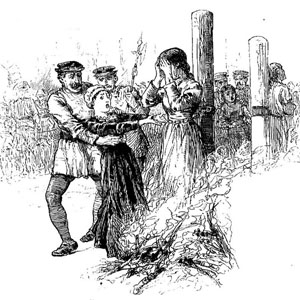
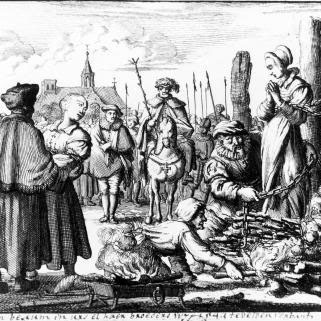
Often these hunts were instigated by hysterical children, or nuns who accused relatives, and neighbors of these outrageous crimes. Witnesses were often bribed or threatened in order to prosecute the accused. The accused would then be tortured until they confessed. The methods of torture were very cruel and painful, and almost all who were put through the various devices would confess. In some cases the accused would die of torture, and very few survived the ordeal without confessing. However, the accused was set free if they survived the torture without a confession. After the forced confession, the trial took place. These trials were run by genuine believers of witchcraft. The aim of the trial was to exterminate the witches as conspirators with the devil. When the accused was declared guilty, they were usually executed.

Although, there are many estimates as to how many actual people were killed during these hunts, most estimates show the number well below the one-million mark. The actual number of documented executions, is generally considered to be under one hundred thousand. Of all that were executed, only a minority were men, and of those men, many are those who tried to protect accused women from the hunters.

Free eBooks (Can Be Downloaded):

Sharynne Nicmacha - The Star Of Life A Historical And Spiritual History Of The Pentagram
Martin Van Buren Perley - A Short History Of The Salem Village Witchcraft Trials
Tuesday Lobsang Rampa - Wisdom Of The Ancients
Michael Bailey - Historical Dictionary Of Witchcraft
Charles Kirkpatrick Sharpe - A Historical Account Of The Belief In Witchcraft In Scotland

Tuesday, September 28, 2010

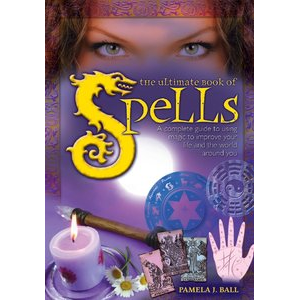
The Ultimate Book Of Spells

The Ultimate Book Of Spells Cover

Book: The Ultimate Book Of Spells by Pamela Ball

The Ultimate book of spells - A Complete Guide to Using Magic to Improve Your Life and the World Around You (2007) Arcturus Publishing ISBN 978-1-84193-577-5

This book is essential reference for anyone wishing to take control of their lives and become confident in the art of spell making...The book includes over 250 spells and techniques, covering every aspect of life and spiritual development. Whether it is creating opportunities for love, doubling your money or protecting your teenage daughter, there is a spell for everyone...With sections on the folkloric history of magic, astrology, divination and mysticism, the book provides the reader with a complete background to the art of magic. The complex social and cultural influence of spells is revealed, as well as their power to enrich and transform modern lives.

The desire to change and improve that which we have has been around for many thousands of years, if not since man first walked the earth. Magic and spell working have always been a part of that, and indeed still are today. Anyone who practises any form of magic, including spell working, needs to be grounded. This means having h feet firmly planted in reality and also having a basic knowledge of what
magic is and is not, what spells can and can’t do and what – with practice – you can do with the tools, information and knowledge you have. This book sets out to give you that information in as succinct a manner as possible.

Download Pamela Ball's eBook: The Ultimate Book Of Spells

Free eBooks (Can Be Downloaded):

Ancient Grimoires - The 6th And 7th Book Of Moses
Anonymous - Book Of Spells
Ancient Grimoires - The 8th Book Of Moses
Michael Johnstone - The Ultimate Encyclopedia Of Spells
Pamela Ball - The Ultimate Book Of Spells.pdf

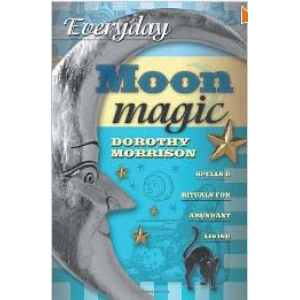
Everyday Moon Magic Spells And Rituals For Abundant Living

Everyday Moon Magic Spells And Rituals For Abundant Living Cover

Book: Everyday Moon Magic Spells And Rituals For Abundant Living by Dorothy Morrison

I've read a couple other Moon books, but this one is by far the best. Why? Because Ms. Morrison (much like another of my favorite authors, Patricia Telesco) has a certain and very special way of making things simple, accessable and right to the point without talking down to the reader, getting lost in Craft mumbo-jumbo or making things harder than they really need to be as I've seen so many times by other authors. There are no lectures, power trips or mind-numbing lists of hard-to-find ingredients here; no lofty words or flowery rituals. In fact, you probably already have many of the ingredients she mentions. This book is practical, useful, wonderfully organized and chock full of Moon facts, spells, rituals and other worthy and interesting tidbits that can indeed be used every day. I found it a fast read, which is good -this way I can get right into things :) If you've been disappointed, bored or overwhelmed by other Moon Magic books, give this one a try. Simply put, this book is a pleasure to read, use and own; it's one I'm sure I'll refer to often. I'm keeing this right next to my much-loved copy of Everyday Magic and will likely be following up with her companion book, Everyday Sun Magic.

That magical, mystical, glorious Moon-invite Her power into your life every day, from fixing your computer to blessing your pets. You'll learn how each Moon phase affects your spellwork, including the seldom-discussed energies of the true Blue Moon, the Black Moon, the void-of-course moon, and the lunar eclipse. Follow the Moon as She traverses each sign of the zodiac, and discover how each astrological phase affects magic, mundane events, and gardening-and how your personal Moon sign affects your magical work. Includes more than 140 modernized spells, chants, and rituals, along with Esbat celebrations for the Full Moon.

Dorothy Morrison has put together in this book a wonderful primer that is chock full of moon lore, moon mystery and moon magic. And because of all the bits of information collected here, even the experienced practitioner will read through this book and come away scratching their head saying "I didn't know that!"

Ms. Morrison includes in this book some of the history of moon lore and moon cycles. Included are bits of 'old sayings' and superstitions as well as names of the monthly moons and what they mean. She reviews the moon phases and effects. Ms. Morrison also discusses astrological terms referencing the moon and what they actually mean. For those who are not familiar or don't remember or are not sure, this section alone is worth the price of the book. Then she takes it a step further by explaining how these references apply in relationship to our magic and our lives. Times and cycles for ritual, magic and spells are also discussed and examined. Empowering moon rituals filled with positive affirmations for the building of personal self esteem, which Ms. Morrison is so good at writing, are here for you to incorporate into your own ritual material. And, of course, no book by Dorothy Morrison would be complete without a whole section of her wonderful spells.

As usual, Dorothy takes all this and puts it into a book that shows you, step by step, how to work this into your everyday life, making it a practical as well as informative book. There is so much more here that I've not included in this review because it would take pages to write about. Needless to say, Ms. Morrison has been thorough in her research. There is a table of contents to help you find what you are looking for as well as a bibliography. Add to that her easy to read format and no nonsense approach to teaching, and you have a winner here.


This is a book that should be considered when you are in the store looking for something practical, informative and just plain good to read and add to your library.

Originally from Texas, Dorothy Morrison now lives the magical life in Maine with her family. Dorothy is a member of the Pagan Poets Society and a charter member of M.A.G.I.C., a magical writers and artists organization. Dorothy is a Wiccan High Priestess of the Georgian Tradition, and has been an avid practitioner of the ancient arts for more than twenty years. She founded the Coven of the Crystal Garden in 1986, and spent many years teaching the Craft of Wicca to students both in the United States and in Australia. A former state championship archer and bow hunter, Dorothys current interests include Tarot work, magical herbalism, stonework, and computer networking.Dorothys work has been published in many journals and magazines, including Circle Network News, SageWoman, and Crone Chronicles. She is the author of the acclaimed Everyday Magic, Magical Needlework, In Praise of the Crone, Yule, Bud, Blossom & Leaf: The Magical Herb Gardeners Handbook, The Craft, and The Craft Companion, among other works..

Buy Dorothy Morrison's book: Everyday Moon Magic Spells And Rituals For Abundant Living

Free eBooks (Can Be Downloaded):

Lady Sabrina - Exploring Wicca The Beliefs Rites And Rituals Of The Wiccan Religion
Benjamin Rowe - A Modified Hexagram Ritual For Enochian Workings
Richard Alan Miller - The Magical And Ritual Use Of Herbs
Talismagick - Love Spells And Rituals For Love And Relationships

Sunday, September 26, 2010

Alex Sanders Biography

Alex Sanders Biography Cover Alex Sanders – the “King of the Witches” as he became known - was responsible for founding the Alexandrian Tradition of Wicca, now one of the main traditions of the Wicca/Witchcraft movement. But his reign was fraught with criticism and controversy.

Alex Sanders was born Orrel Alexander Carter on the 06th June 1926 in a house on Moon St, Birkenhead. He was the eldest of six children to parents Hannah and Harold Carter. His father Harold Carter was a music hall entertainer who suffered from alcoholism, and soon after the birth of Alex, moved the family to Grape St in Manchester, there he unofficially changed the family name to Sanders. Alex was unaware of his official surname until he applied for a passport later in life, at which time he officailly changed his name to Sanders by deed poll.

As a young boy Sanders suffered with tuberculosis and would regularly visit with his grandmother in Wales, where he could benefit from the Welsh fresh air. At the age of seven, he is believed to have happened upon his grandmother “Mary Biddy” performing some sort of pagan ritual. Taken by surprise she immediately swore young Sanders to secrecy, and initiated him on the spot claiming, “Now, you are one of us”. Thus he became her student and started on the path of the Old Religion.

Sanders was a natural psychic who learned all he could from his grandmother. He claimed that she gave him her “Book of Shadows” to copy and taught him all the rites and magic of the witches including clairvoyance by scrying in inky water and using his grandmother's crystal. Sanders also claimed that following the Blitz during WWII and just a few months before her death at age 74, his grandmother conferred upon him the second and third grade initiations involving ritual sex. After her death he tried to contact other witches, and though failing continued with his studies while working for a time as a healer in Spiritualist Churches under the pseudonym of Paul Dallas.

In the early 60’s, Sanders is reported to have sought entrance to some Gardnerian covens (see Gerald Gardner), including that run by "Patricia and Arnold Crowther", who refused to accept him. Not to be put off so easily, he somehow managed to obtain a copy of the Gardnerian Book of Shadows. This he copied (badly from all accounts) and embellished it with a few of his own amendments. He then used this as the bases to found his own coven, claiming it to be a copy of his grandmother’s Book of Shadows.

Sanders was a born showman who avidly courted publicity. In September of 1962 he even succeeded in convincing the Manchester Evening News to run a front-page article about Wicca. As a result he soon attracted a large following. During this period Sanders and his coven worked from his home at 24 Egerton Road North, Chorlton-cum-Hardy, Manchester. One of his initiates was "Maxine Morris", a Roman Catholic 20 years his junior. After her initiation, they handfasted and she became his High Priestess. They were married in a civil ceremony in 1968 and moved into a basement flat near Nottinghill Gate, London. Later that same year, Maxine bore him a daughter they called "Maya".

From their new home the Sanders’ ran his London coven and taught training classes, he claimed to have initiated more than 1,623 witches working in 100 covens around the country, all-practicing what had become known as the Alexandrian Tradition. At one meeting, a gathering of sixteen of his covens, Sanders was bestowed with the title of “King of the Witches”. Sanders frequently appeared in ritual photos as robed or wearing only a loincloth while Witches surrounding him were naked. His explanation for this was that the old “Witch laws” required that the Elder of a coven should be easily identifiable from the other coven members.

In 1968-69, Sanders with Maxine appeared in and gave technical advice on a film called “Legend of the Witches”. During the press preview of the film, they met with and were introduced to "Stewart Farrar", then a reporter for the Reveille. Stewart would later be initiated by Maxine, and move on to become famous himself as a witch and author.

Without doubt Alex Sanders was a controversial and flamboyant man, who without scruples plagiarized the work of others to embellish he own. Whither he did so with malice, remains a question? Personally I don’t think so. More I assume through innocuous indifference, and mainly for the benefit of his students, even though it resulted in criticism from many in the craft. He was also without doubt a very skilled witch, and powerful magician, whose contribution to the newly evolving movement, brought witchcraft back into the public arena and changed the face of Wicca. He helped to influence many newcomers entering the craft and Alexandrian Wicca remains today one of the largest traditions of the craft.

Free eBooks (Can Be Downloaded):

Aleister Crowley - Alice An Adultery
Albert Pike - Morals And Dogma
Aleister Crowley - Alexandra

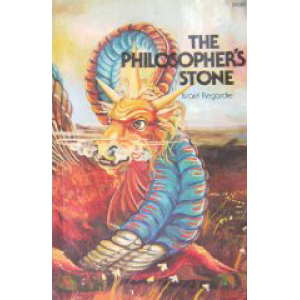
The Philosophers Stone

The Philosophers Stone Cover

Book: The Philosophers Stone by Israel Regardie

My book has been praised as a good meaningful book by some reviewers and by many readers, to judge from the mail I have received during the past thirty years. It is patently an open sesame to one level of interpretation. The Occult Review, now defunct, published a critical review by Archibald Cockren who took me rather severely to task for asserting that alchemical texts should be interpreted solely in terms of psychological and mystical terms. He himself, I subsequently discovered, had written a book Alchemy Rediscovered and Restored. Of course I immediately procured a copy. Since I was peeved by his review, I did not feel that his book had very much to offer—so I dismissed both offhand. I was about to write the editor of The Occult Review a scorching letter, but reason intervened so that fortunately it never got written.

The opportunity is rarely given to an author in his lifetime “to eat crow” and to enjoy it. This lot, it pleases me to say, is mine—after thirty years. Not that I would significantly change much of what I wrote then. I admitted that I had not “proceeded to the praxis” but I felt then and still do that a mystical and psychological interpretation of some alchemical texts was legitimate. There is unequivocally this aspect of the subject. Certainly Jacob Boehme and Henry Khunrath, for example, cannot be interpreted except in these terms.

The Philosophers Stone with these preliminary comments, should answer a wide-felt need which has called forth this new edition. I hope, being in print once more, it will bring new light and knowledge and values to present-day students who may be still groping in the dark areas of the occult towards alchemy, where a guiding hand needs to be extended.
So, to close this Introduction, I must use the ancient Rosicrucian greeting, and the close of a Golden Dawn ritual:
May what we have partaken here sustain us in our search for the Quintessence; the Stone of the Philosophers, True Wisdom and perfect Happiness, the Summum Bonum.


Download Israel Regardie's eBook: The Philosophers Stone

Free eBooks (Can Be Downloaded):

Yogi Ramacharaka - Yogi Philosophy
Louis Claude De Saint Martin - Theosophic Correspondence
Andrew Lang - The Witch And Other Stories
John Mitchell - The Philosophy Of Witchcraft
Israel Regardie - The Philosophers Stone

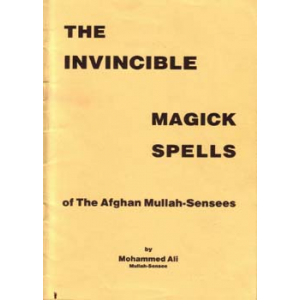
Invincible Magick Spells Of The Afghan Mullah Sensees

Invincible Magick Spells Of The Afghan Mullah Sensees Cover

Book: Invincible Magick Spells Of The Afghan Mullah Sensees by Muhammad Ibn Arabi

All the spells and signs are from the mountains of Afghanistan and the surrounding areas. All have been handed down from generation to generation, student to student. All are in their original form and have not been translated or altered so as to preserve the originality and power.

Download Muhammad Ibn Arabi's eBook: Invincible Magick Spells Of The Afghan Mullah Sensees

Free eBooks (Can Be Downloaded):

Peter Carroll - The Magical Pact Of The Illuminnates Of Thanateros
Medieval Grimoires - The Black Pullet Or The Hen With The Golden Eggs
Mcgiolla Cathain - Secret Magic Spells Of The Romany Gypsies
Muhammad Ibn Arabi - Invincible Magick Spells Of The Afghan Mullah Sensees

Carl Llewellyn Weschcke Biography

Carl Llewellyn Weschcke Biography Cover Carl Weschcke is president of Llewellyn Worldwide Ltd, one of the largest publishers of occult and New Age books in the world. He is also a Magician, a Tantric practitioner, a Pagan and a former Wiccan High Priest who played a leading role in the rise and spread of Wicca and Neo-Paganism in America during the 1960’s and 70’s.

Weschcke was born into a Roman Catholic family on the 10th of September 1930 in St. Paul, Minnesota. Early in his life his paternal grandfather, who at the time was vice-president of the American Theosophical Society, exposed him to metaphysics and the occult. For his 12th birthday he presented the young Weschcke with his own astrological chart, after and guided by his grandfather, he became fascinated with astronomy, religion, the occult and reincarnation. His parents were vegetarian naturalists who practiced mind reading techniques, and were happy to discuss occult subjects with him. Even one of the houses they lived in had strange and mysterious thumps and bangs in the night, which were attributed to the ghosts of the deceased former owners. Such were the influences that shaped Weschcke’s early life and future path.

Weschcke was educated at the St. Paul Academy and graduated in 1948. He then went on to study at the Babson Business Institute in Massachusetts graduating in 1951 with a Bachelor of Science degree in Business Administration. After graduating he went to work in the family’s Pharmaceutical business, but found the work unfulfilling. He had a dream of becoming a publisher, which led him back to school studying for a doctorate in philosophy at the University of Minnesota. However, his longing to get involved with publishing caused him to leave the university before completing his course, and in 1960 he purchased the little known Llewellyn Publishing Co.

The Llewellyn Publishing Co. was the brainchild of the Welsh astrologer, Lewellyn George, who founded the Llewellyn Publishing Co. in Portland, Oregon during 1901. At that time it was a small mail order business with a limited focus specializing in selling three Astrology books and Calendars. Lewellyn George later moved the company to Los Angeles where he died in 1954. Weschche purchased the business in 1960 and moved it to St. Paul in Minnesota where he began to rebuild it. He quickly expanded the business to include a complete line of books on Astrology and the Occult, and within a decade was publishing some thirty to fifty titles a year, including audio and videotapes. He also launched a series of magazines including: New Dimension, Gnostica, Astrology Now, New Times and New World.

In 1973, Weschcke helped to form and organize the 'Council of American Witches' and became its first Chairman. During his brief tenure as Chairman he drafted the now famous 'Thirteen Principles of Belief' statement, which he considers his proudest accomplishment for the Craft. The statement was later incorporated into the U.S. Army’s handbook for Chaplains. That same year his wife gave birth to their son who they named Gabriel.

By the mid-1970’s Weschcke began to wind down his public activities, feeling his publishing business was starting to stagnate. Weschcke believed his constant media publicity and its resulting attention was the cause of it, and so resolved to do something about it. Selling the haunted mansion on Summit Avenue he moved the family to the country where he could spend and devote more time to them. He restructured the business by closing the bookstore, dropping the festivals and increasing the number of book titles they were publishing. He also included computer software to his range of audio and videotapes.

The Weschckes continue to support the Wiccan and Pagan communities primarily through their publishing, and many of their Authors are sent out to organized conferences and activities. Today, most of their time is taken up by the demands of their business, which by the mid 1990’s had grown into a medium sized publishing house issuing about 100 new titles a year, spanning the general Spirituality and New Age markets. Their son Gabriel, holds a master’s degree in publishing science from Pace University, New York, and now works for the business as its regional sales manger.

Weschcke holds two honorary doctorates, one in magick, and was for a time the Grandmaster of Aurum Solis, an international magickal Order originally founded in England in 1897, but now based in St. Paul. He withdrew from the Order in 1991 and is currently not affiliated with any group. His media prominence during the 1960's and 70's did much to bring Wicca and paganism into the light of acceptability in a skeptical American society.

Free eBooks (Can Be Downloaded):

Valentina Izmirlieva - All The Names Of The Lord
Ann Moura - Green Witchcraft
Michael Night Sky - Carl Liewellyn Weschcke Bringing Magick To The Masses

Sunday, August 22, 2010

Am I Really A Witch

Am I Really A Witch Cover According to some old Elizabethan superstition, if you possess all of these you were considered to be a witch.

Superstition 1 - Witches were able to fly ( this explained how witches could move quickly across impossible distances. A broomstick was then added to the superstition as these became common household Articles used by women) - Well, I do clean with a broom (me).

Superstition 2 - A witch was often portrayed as an old crone or hag ( with no man to defend her against accusations of witchcraft) - I don't have a man (yet) and I do feel old these days (me).

Superstition 3 - Witches are closely associated with living alone (house in the wood) - I live alone in a place made of wood (me).

Superstition 4 - Witches were known to keep animals like the Cat, Frog, Pig, Raven, Goat, Wolf, Goose, Crow, Bat and Mouse which were believed to be the forms adopted by a Witches Familiar (an evil spirit, in animal form, who was used by the witch to perform evil deeds and cast malevolent spells) - I do own three cats and you know if I could, I would own every one of these (me).

Superstition 5 - Witches brewed magic potions over a cauldron (Wise women had knowledge of herbs such as mandrake, datura, monkshood, cannabis, belladonna, henbane and hemlock) - And I love cooking and brewing up good food and some include herbs (me).

And last but not least, my very own and I bet you haven't noticed this...I do have a mole on my nose. Fact. :)

EEEEK! I'M A WITCH! I quote Practical Magic....."there's a little witch in all of us". :) Are you one? :)

Books You Might Enjoy:

Anonymous - So My Kid Is A Witch
Carl Mccolman - The Well Read Witch
Marian Green - A Witch Alone

Wednesday, July 28, 2010

Do Witches Really Cast Hexes

Do Witches Really Cast Hexes Cover People commonly personify witches as evil and all they do is curse and hex others. wiccans are strictly opposed to hexes and curses. Traditional witches (or "Trad Witches") do not have limitations. However, if the thought arises of casting a hex or curse we must ask ourselves if it ethical and completely necessary. Any witch will tell you that if it is regarding defense of loved ones and family the answer is often yes. On the other hand, if it relates to using magick against someone because they cut you off on the highway, then for the majority, the answer is no. See the section in this lens "Black & White Magick" for more on this. Also, for more information about magick, the natural powers of the universe, how to do spells and much more, visit Modern-Witchcraftand especially, Guide for Spells and How To's About Safely Using Magick for Success.

Books You Might Enjoy:

Jarl Fossum - Seth In The Magical Texts
Lau Soon Wah - The Powerful And Deadly Spells Of The Javanese
Julius Evola - Against The Neopagans
Anonymous - The Emerald Tablet Of Hermes

Monday, July 26, 2010

Witch Hunting Panic And Torture

Witch Hunting Panic And Torture Cover Witch-hunting could be endemic or epidemic. Its dynamics varied. Small panics (fewer than 20 victims) tended to occur in villages worried about maleficium. Their victims were often poor, obnoxious persons whose removal the rest of the community applauded.

If small panics fed on long-smoldering fears about neighbors, large ones exploded without warning, killing people of all classes and conditions and rupturing social bonds. The worst examples of this were in Germany, where unlimited use of torture (in defiance of imperial law) produced an ever-expanding wave of denunciations. To object was to court death.

Large witch-panics started with the usual obscure suspects and worked up the social scale to prosperous citizens, reputable matrons, high-ranking clerics, town officials, and even judges. The longer a panic lasted, the higher was the proportion of male and wealthy victims.

According to the Dutch Jesuit Cornelius van Loos, confiscations from suspected witches in large panics could "coin gold and silver from human blood," Youngsters were legally old enough to burn as soon as they could distinguish "gold from an apple." Children as young as nine were burned in Wurzburg, including the bishop's nephew, and boys ages three and four were imprisoned as Satan's catamites.

Some of the German trials were marred by collusion, bribes, and rape. Unspeakable tortures were routine -- 17 different kinds were authorized by "the Saxon lawgiver," Benedikt Carpzov, during the 17th century. Confessing "without torture" in Germany meant without torture that drew blood. Nearly all who underwent this broke, even the blameless.

Yet witches sometimes did turn themselves in and confess spontaneously, the equivalent of today's "suicide by police." The same melancholy, frustration, and despair that they claimed had driven them into the devil's arms brought them willingly to the stake. They had apparently come to believe the wish-fulfillment fantasies of pleasure and revenge enacted in the theaters of their minds. Nevertheless, they still hoped to save their souls through pain.

A few brave men spoke up for justice. In 1563, Johann Weyer, a Protestant court physician, drew attention to the cruelty of the trials and the mental incompetence of many of the accused. English country gentleman Reginald Scot mocked witchcraft as popish nonsense in 1584. In 1631, the Jesuit Friedrich von Spec, confessor to witches burned at Mainz, proclaimed them innocent victims. Van Loos, witness to the horrors of witchcraft trials at Trier, had his manuscript confiscated in 1592 before it could be published and was himself imprisoned and banished.

Ironically, a Spanish inquisitor named Alonso Salazar y Frias mounted the most dramatic challenge to witch-hunting. In 1609, a panic among French Basques in the western Pyrenees on the Bay of Biscay spilled over into the Navarra region in Spain, where six accused witches went to the stake. But Salazar, who had been a judge in that trial, became skeptical as the panic widened to engulf 1,800 suspects, 1,500 of them children. Basque witches' confessions included such incredible details as familiars in the form of costumed toads that child-witches herded with little crooks during sabbats.

Salazar cross-checked testimony, had supposed magic substances tested, and applied logic to conclude that the alleged witches were simply an artifact of witch-hunting. "There were neither witches nor bewitched until they were talked and written about," he reported in 1610. With stubborn practice, Salazar wrested a decision from his superiors that freed the accused in 1614. The Spanish Inquisition never executed another witch; nor did it permit secular authorities to do so after an outbreak in Catalonia that saw more than 300 witches hanged between 1616 and 1619. What could have erupted into Europe's worst witch-panic was extinguished by one man.


Books You Might Enjoy:

Max Heindel - Teachings Of An Initiate
Richard Johnson - The Zodiac Stellar Stories
Stephen William Hawking - Space And Time Warps

Friday, July 23, 2010

Who Burned The Witches

Who Burned The Witches Cover The 30,000 to 50,000 casualties of the European witch-hunts were not distributed uniformally through time or space, even within particular jurisdictions. Three-quarters of Europe saw not a single trial. witch persecution spread outward from its first center in alpine Italy in the early 15th century, guttering out in Poland, where witchcraft laws were finally repealed in 1788. The center had generally stopped trying witches before the peripheries even started.

The Spanish Road stretching from Italy to the Netherlands was also a "witch-road." The Catholic-ruled Spanish Netherlands (today's Belgium) saw far worse persecutions than the Protestant-ruled United Provinces of the Netherlands, which had stopped burning convicted witches by 1600. There were early panics in the German cities of Brandenburg and Mecklenburg, as well as in Lorraine, France, and parts of Switzerland and Scotland. The Rhineland and Southwest Germany suffered severe outbreaks, with German ecclesiastical territories hit hardest. Three-quarters of all witchcraft trials took place in the Catholic-ruled territories of the Holy Roman Empire. But Catholic Portugal, Castile and Spanish-ruled Italy, and the Orthodox lands of Eastern Europe saw virtually none. The panic in Salem, Massachusetts, was as bad as anything in England, but there seem to have been no executions in the Latin colonies of the New World.

The regional tolls demonstrated the patchwork pattern of witch-hunting. The town of Baden, Germany, for example, burned 200 witches from 1627 to 1630, more than all the convicted witches who perished in Sweden. The tiny town of Ellwangen, Germany, burned 393 witches from 1611 to 1618, more than Spain and Portugal combined ever executed. The Catholic prince-bishop of Wurzburg, Germany, burned 600 witches from 1628 to 1631, more witches than ever died in Protestant Sweden, Norway, Finland, and Iceland combined. The Swiss canton of Vaud executed about 1,800 witches from 1611 to 1660, compared with Scotland's toll of between 1,300 and 1,500 and England's toll of 500. The claim of some Catholic apologists that Elizabeth I executed 800 witches a year is gross slander. In Southwest Germany alone, 3,229 people were executed for witchcraft between 1562 and 1684 -- more than were executed for any reason by the Spanish, Portuguese, and Roman Inquisitions between 1500 and 1800. (All three of these Inquisitions burned fewer than a dozen witches in total.)

The most-dreaded lay witch-hunter was Nicholas Remy, attorney general of Lorraine, who boasted of sending 900 persons to the stake in a single decade (1581-1591). But the all-time grand champion exterminator of witches was Ferdinand von Wittelsbach, Catholic prince-archbishop of Cologne, Germany, who burned 2,000 members of his flock during the 1630s.

Let no one argue that witch-hunting was a predominantly Protestant activity. Both Catholic and Protestant lands saw light and heavy hunts. Demonologists and critics alike came from both religious camps.


Books You Might Enjoy:

Ralph Blum - The New Book Of Runes
Marian Green - A Witch Alone
Tarostar - The Witchs Spellcraft Revised
Margaret Alice Murray - God Of The Whitches

Hubble Bubble Pardoned From Trouble

Hubble Bubble Pardoned From Trouble Cover It's Halloween and, consequently, one of my favorite days of the year. There are some things that have become inexorably linked to this holiday: candy, costumes, watching It's the Great Pumpkin Charlie Brown and, of course, witches.

Modern culture has really taken the witch in interesting places. From the evil Wicked Witch of the West in the original Wizard of Oz to the Not-Really-Wicked-But-Misunderstood Witch of the West Elphaba in the book and play Wicked, it is clear that witches can take on any number of personas. Today, witches can be good, bad, cutesy, goofy, and cunning. But not so long ago, the term "witch" was not taken so lightly.

Here at the Museum of Jewish Heritage, we often talk about scapegoating. If one looks at the history of the witch, this term comes to the fore pretty quickly. In Europe, between approximately 1480 and 1700, between 40,000 and 100,000 women and men were put to death on the charge of witchcraft. Accusations often arose as a result of an unexplained natural phenomenon--such as a failed crop or sick livestock-- or simply out of the malicious desire to seek revenge on another person.

Today, campaigners will petition Justice Secretary Jack Straw to posthumously pardon the 2,400 women and men wrongfully put to death for witchcraft in England and Scotland before the Witchcraft Act put an end to the practice in 1735. (Read full article here.) These campaigners follow the example of Swiss groups who successfully urged the government to pardon Anna Goeldi, the last woman in Europe on record to be put to death for witchcraft in 1782. While such pardons are, of course, entirely symbolic, I think this gesture is an important one. Not only does it officially clear the names of innocent victims, but makes a stand against scapegoating and lets everyone know that this injustice has no place in today's society.

Books You Might Enjoy:

John White - Toward Homo Noeticus
Ea Wallis Budge - Egyptian Ideas Of The Future Life
Aleister Crowley - Songs For Italy

Wednesday, July 21, 2010

The Witch Of Tradition

The Witch Of Tradition Cover FOURTEEN years ago a very distinguished literary colleague of George Bernard Shaw said to me: "Shaw is in senile decay." Ten years later I went to see Shaw's "Joan"; and I concluded that if the dramatic feeling, the mastery of stage-craft, the agility and sureness of insight into human nature, of that remarkable play were symptoms of advanced senility I would reconsider my design to avoid that normal period of existence.

And the play just as plainly indicates the strength or stubbornness of its author in its chief defect; it is an historical play and it is entirely unhistorical. Many years ago Shaw decided that historians do not know how to write history, and he would teach them. Unfortunately, in order to grasp the truth of a single personality of an earlier and different age one has laboriously to learn a mass of detail about that age, and labor of that kind does not fascinate men of febrile imagination. Shaw cannot write history.

Was Joan of Arc a witch? Shaw may have heard that there are a few quite scholarly people who think it possible that she was. Scholarly people, he would say, can believe anything. He robustly excludes the very possibility. The charge of witchcraft against "the Maid" was a mere pretext of priests and politicians; and Shaw, in his scorn of science and Rationalism, so surprisingly exonerates the priests and the Inquisition in his play that a Catholic weekly actually announced that he was about to enter the Church.

The murder of Joan was plotted by soldiers and statesmen -- English soldiers and statesmen, of course and the poor priests were bullied and cajoled into a tragicomic trial for witchcraft.

It was quite plain that Mr. Shaw does not know that our idea of witchcraft has been radically altered. He does not even know that one of the characters he introduced into his play, Gilles de Rais, the original "Bluebeard," was, not the indolent court-fop and trifler be makes him, but a very stern and earnest young man, Joan's most intimate friend, and a witch. Probably Shaw does not know that there were male witches as well as female, and that the child in her mother's arms, the maid of fifteen or the winsome young mother of twenty-two, might be a witch just as easily as the old wrinkled dame who lived in a cottage on the edge of the wood and gathered her herbs by the light of the moon.

It is this new conception of witchcraft, which we will explain in this chapter, and will apply to the trial of Joan of Arc, that brings the subject within the program of religious controversy which I am realizing. This horrid massacre of women age by age was tragic enough even on the old conception of witches. Any old dame, widow or spinster, who was wise enough to wish to avoid the cackle of her empty-headed neighbors was apt to be suspected of witchcraft. The child who fell ill -- inoculated by the open drain or cess-pool by the door -- had passed her in the street, and so had clearly been bewitched. The mother who had a miscarriage, the farmer whose pigs sickened. ... The witch! Drown her out of hand, or, less humanely, let the priest see to it; and then the horrors of trial and torture will be added to the injury of death.

This thing occurring during many centuries all over Christendom concerns us just as much as does the beauty of a cathedral. I am not indicting the Church: not merely gathering all the dishonoring facts which can be picked here and there out of the history of medieval Europe. We are seriously studying the effect upon civilization of the acceptance and world-establishment of Christianity. It created a new frame of mind, a new outlook on life, a new character; and this new spirit expressed itself in, amongst other things, the torture and burning or drowning of some hundreds of thousands, if not millions, of men and women on the ground that they were witches. And the crime was directly inspired by the new religion. The sole inspirations of the murderous attitude were belief in the devil and the express statement of the Bible that witches were in league with evil spirits and must be put to death. In the fully developed law of the Church witchcraft was heresy. It was a religious crime.

This was dreadful enough even if we suppose, as is commonly supposed, that the murdered women were yellow, soured, misanthropic old dames from whom death was in any case not far distant. No doubt a poor, brooding, solitary old woman would be more likely than any other in the village to incur popular suspicion. Harenet, one of the earliest English denouncers of the belief in witchcraft (though no modern book ever mentions him), before the end of the seventeenth century thus ironically reminded the witch-hunters of one common type of their prey:

An old woman with a wrinkled face, a furrowed brow, a hairy lip, a gobber tooth, a squint eye, a squeaking voice, or a scolding tongue, having a ragged coat on her back, a spindle in her hand, and a dog by her side -- a wretched, infirm and impotent creature, pelted and persecuted by all the neighbors because the farmer's cart had stuck in the gateway, or some idle boy had pretended to spit needles and pins for the sake of a holiday from school or work.

Life was hell to these old dames for near a thousand years after the establishment of the religion which is said to have uplifted woman.

Yet Catholic literary men and priests and Protestant preachers, who are rarely serious students of history, find this old-hag theory of witchcraft convenient. Sorry for the old ladies, of course, but ... You can understand it, can't you? The edge of your resentment is dulled. The glib word-spinners remind you of the vivid faith of those heroic days -- the greater sensitiveness to the devil's work in the world -- the living fear of God, and so on. In other works I tell enough about the real Middle Ages to spoil this pretty argument.

But a worse error of these apologists, the popular fallacy which is still all but universal in Christendom, is to suppose that the witches were even for the greater part old women. Thousands of reports of witch-trials have now been studied, and from the hundreds that I have myself read at least in summary, I should say that feeble old dames were a comparatively small minority. Maids in their teens, like Joan of Arc, are appallingly common amongst the victims. Young women in their twenties and thirties, strong and defiant of the priests, seem to be almost in the majority. Men are frequent amongst them; and the men include numbers of priests, nobles, lawyers, etc. Let me quote the translation of a letter written at Wiirzburg during the persecution there in 1629:

There are still four hundred in the city, high and low, of every rank and sex -- nay, even clerics -- so strongly accused that they may be arrested any hour. Some out of all offices and faculties must be executed; clerics, counselors, doctors, city officials and court assessors. There are law students to be arrested. The prince-bishop has over forty students here who are to be pastors; thirteen or fourteen of these are said to be witches. A few days ago a dean was arrested; two others who were summoned have fled. The notary of our church consistory, a very learned man, was yesterday arrested and put to torture. In a word, a third part of the city is involved. A week ago a maiden of nineteen was put to death, of whom it is everywhere said that she was the fairest in the whole city and was held by everybody a girl of singular modesty and purity. She will be followed by seven or eight others of the fairest. There are three hundred children of three or four years of age who are said to have had intercourse with the devil. I have seen put to death children of ten, promising students of ten, twelve, fourteen, fifteen, etc.

This is not a page from some history of witchcraft in which the writer is rhetorically embroidering a statement of a contemporary chronicle. It is part of a letter written at the time, the year 1629, in the city of Wiirzburg itself, and by no less a person than the bishop's chancellor. No more veracious document could be imagined. And it is just by chance that in a single city out of hundreds we get this contemporary and authoritative account of the terror that for a time blanched the faces of the citizens.

This single passage must, although it belongs to an exceptionally ferocious period of witch-hunting, convince any reader at once that the popular idea of witchcraft is entirely false. I say "popular," but it is singular how slow even scholars, historians and scientists, have been to grasp the remarkable significance of the witch-movement. In the latest edition of the "Encyclopedia Britannica," which is certainly the finest work of general reference to which the public can turn for information, the article on "Witchcraft" is totally inadequate. The author is a competent ethnographer, yet he writes almost entirely from the traditional point of view. Only in the last few lines he mentions the very suggestive fact, without perceiving its significance, that in Italy today witchcraft is still called la vecchia religione "the old religion" -- and that in its historical phenomena we must recognize a stratum of popular beliefs which are "derived in the main from pagan sources.

The "New International Encyclopedia" is no better, and the generally very able and informing "Dictionary of Religion and Ethics" entirely omits the subject. Yet one point which is quite fatal to the popular conception has been established in every history of witchcraft. This is that witches were not merely, or even usually, old women whose repulsive forms or isolated lives drew popular suspicion upon them. The fairest maids of a town were just as liable to be dragged before the Roman Inquisition or the Protestant bishop as was the old dame who lived alone on the outskirts of the village. Hundreds, if not thousands, of maids like Joan of Arc were drowned or burned at the stake as witches. Women of all ages, from the babe upward, were arraigned. Women of every rank figure in the lists of victims. Men also of every rank and degree of education or illiteracy enter the chronicle. Theologians, lawyers, nobles, and leaders of armies are found as well as peasants and artisans.

And it will further transpire that even the young women met the sentence of death in the same spirit as the girl-martyrs -- the very few genuine girl-martyrs -- of the early Church. They spat at the religion of their Christian persecutors. They had, they said, a higher religion, and would die rather than abjure it. The Church, it is true, in most cases left them no opinion. By a refinement of brutality it enjoined that they should be fiendishly tortured to extract confessions; then, in order to have a formal assurance of their guilt, it held that confessions thus wrung from them in the agony of torture were "voluntary confessions"; and finally it said that, since conversions professed out of fear of torture were unreliable, the witches might and ought to be put to death. Most of them, therefore, suffered death in silence. But in numberless cases they defied their tormentors and murderers, and boasted that they died for a greater faith than the belief in Jesus.

Hence there is an increasing tendency to regard witchcraft as an organized religion. The best history of witchcraft is Dr. W.G. Soldan's "Geschichte der Hexenprozesse," as edited by Max Bauer in 1911: a fine two-volume work superbly illustrated, which has unfortunately not been translated. In the final chapter the Authors discuss all the views of witchcraft during the last hundred years, and they fail to realize its full significance. They are disposed to regard too many details as mere concessions under torture to the queries of the judges or as hysterical illusions.

Much sounder, though it is little more than an account of trials in England, is Miss M.A. Murray's "The Witch-Cult in Western Europe" (1921). Miss Murray, of London University, has written a model work within her limits: candid and scholarly. The reader will find it a revelation and, in spite of the tragedy, a most entertaining work. Her conclusion is (p. 1 2):

The evidence proves that underlying the Christian religion was a cult practiced by many classes of the community, chiefly however by the more ignorant or those in the less thickly inhabited parts of the country. It can be traced back to pre-christian times and appears to be the ancient religion of western Europe. The god, anthropomorphic or theriomorphic, was worshiped in well-defined rites; the organization was highly developed; and the ritual is analogous to many other ancient rituals. The dates of the chief festivals suggest that the religion belonged to a race which had not reached the agricultural stage. ... It was a definite religion with beliefs, ritual, and organization as highly developed as that of any other cult in the world.

In saying that it was chiefly the religion of the more ignorant, Miss Murray seems to have forgotten that at least ninety-five percent of the people of Europe were then illiterate, and she, perhaps gives a wrong impression as to the survival of the religion from pre-christian times.

While psychologists have been busy applying their formulae to the mind of the witch -- and have generally come to wrong conclusions -- historians have been collecting the scattered evidence, analyzing the reports of trials, and constructing an entirely new idea of the witch-movement. It was the strongest and most widespread in the most enlightened, or least illiterate, centuries of the Middle Ages. The solution is that the medieval Church was right in its idea. Witchcraft was organized heresy, a formidable revolt against Christianity.

Books You Might Enjoy:

Kathryn Paulsen - Witches Potions And Spells
Will Herberg - The Writings Of Martin Buber
Phil Hine - Aspects Of Evocation
Popular Posts