Showing posts with label spell books. Show all posts

Tuesday, November 16, 2010

I Am A Witch Or The Reincarnation Of One

I Am A Witch Or The Reincarnation Of One Cover Psychic talents have been linked to hereditary traits, but having those gifts doesn't make you a witch. Anyone can write their own spells, it's your belief that makes the magic, not even the oldest dusty tome will instantly grant wishes, it's your belief that creates it.

You can be both a Wiccan and a witch, these two words are not the same.

One of the biggest sore points among Wiccans is the improper usage of the terms "Wiccan" and "Witch". Too many people use the terms interchangeably, presuming that they both mean the same thing. They do not.

Wiccan
Wicca is just one of many faiths that embrace Magic. Wicca is a religion, and someone who follows that religion is called a Wiccan. Sometimes it can be difficult to accurately define Wicca, and not all Wiccans will define themselves the same way. Observing the 8 Wiccan Sabbats, honoring the Gods and/or Goddesses, creating sacred space for rituals, to name a few. Many traditional Wiccans also feel that belonging to a coven is also a requirement and that those who practice their religion as a solitary, should not refer to themselves as Wiccan. Personally, I'm still not sure on that point. Typical Wiccans also practice magick, and therefore are also witches. You cannot be a "natural Wiccan" any more than you could be a "natural Christian".

Witch
The practice of witchcraft is not associated with any religion, therefore you can be a witch and yet also be a member of any number of religions (or none). Using the natural energies within yourself, along with the energies of herbs, stones or other elements to make changes
around you is considered witchcraft. Though the skills and gifts that are part of witchcraft can be inherited from parents or grandparents, you aren't automatically a witch just because your grandmother may have been one. The use of magick takes practice, experience and learning.
On a side note, a male witch is called a witch, not a warlock.

Pagan
While I'm explaining terminology, I thought I would throw in "Pagan" as well. Paganism refers to a variety of non-Christian/Jewish/ Islamic religions that are usually polytheistic and are often nature-based. Wicca is only one Pagan religion, but there are others such as Santeria,
Asatru, or Shamanism. Many people do not necessarily identify with a specific religion, and just use the broad term "Pagan" to define their spiritual path. Pagan religions are distinct and separate from each other, and it should not be assumed that they are just different names for
the same faith.

The short answer is magic is a lot of work and it takes a long time to become a proficient Witch. If you are interested in this area, submit a followup question and I'll be happy to provide a list of books, websites and ways to meet other Witches.

If this was just a question, I bid you good night.

Blessings!

Books in PDF format to read:

Scott Cunningham - Wicca A Guide For The Solitary Practitioner
Aleister Crowley - Liber 008 The Ritual Proper For The Invocation Of Augoeides
Aleister Crowley - Sephiroth Ha Dborim The Emanations Of Words

Tuesday, October 12, 2010

Black Magic And The Occult

Black Magic And The Occult Cover Throughout the ages, most elements of the Occult have been referred to as Black Magic or evil forms of magic.. This is common misunderstanding, as most elements of the Occult and its understanding are focused on the good element of the energy.. The black arts is more a personal aspect from a confused magician or sorcery.. All magic or energy wielding that is designed to intentionally harm another will in the end, end up harming the wielder and I will explain why..?

What is Black Magic ?

First of all let’s sum up Black magic or Evil magic as some call it. Many people are doing this form of magic without even knowing throughout there lives, manipulating people, manipulating greed, controlling the energy in a negative way which benefits themselves only.. If we can better understand these forms of energy manipulation or control it is then easier to protect ourselves from this common aspect of life.

An example of Misunderstood Black Magic

A good example of Black magic is any form of energy, that negatively effects your health or power to make choices (internal freedom).. It could be an influence at work with your boss where you are so used to being told what to do you are unaware of what it is doing to you.. It could be chasing the money to the point where money becomes your life and emotional response to others does not exist.. Another example could be in an abusive relationship where one partner gets pleasure out of hurting the other, do not confuse this with anything else this is emotional black magic..
It comes back on The Wielder of the Black Magic User..

Now that I have named a few examples I will explain why it will eventually negatively effect the wielder who tampers with negative or Black magic.. Similar to what Einstein said every action deserves a equal and opposite reaction it is similar with energy.. If you keep taking and taking and using it negatively, it will return on you and the effects could be devastating.. It could make you depressed or suicidal or even cause cancer to name a few.. It is important to make sure all use of the energy which we are all apart is always positive, that way only more positive can return..

Victims of Black Magic – Protect Yourself!

The unfortunate side of this is the victims, if you are a victim of energy harm or black magic it is important to try to defend yourself with your own energy.. Be positive and get advice from those that have massive amounts of energy levels, there are plenty of good magic users all around us who do not know they wield for good or might not even be aware of energy but always are willing to help..

Once you have advice or help you need to identify the wielder and confront them with emotional protection.. You cannot ask them about black magic as most will be like what the.. But you can tell them how they make you feel and then say you will never effect me like this again and be strong.. Sometimes moving away can help but you must confront these energy abusers first as they can leave a energy trail that can hurt you for months.. Sometimes black magic wielders will go for those that they think they can control easier or who are overly nice. If this is the case, you need to address this immediately if you notice it happening to another.. It is recommended to confront the wielder and explain an explanation and ask them to stop doing it..

I hope this post helps people understand a bit more on energy, which exists in everything and what makes Black magic, if you can think of anything else, feel free to comment below..

Books in PDF format to read:

Naomi Janowitz - Magic In The Roman World
George Moir - Magic And Witchcraft

Friday, October 8, 2010

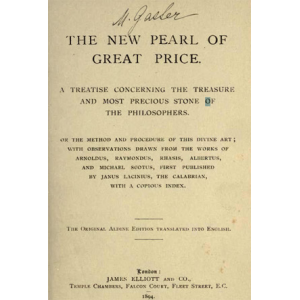
The New Pearl Of Great Price

The New Pearl Of Great Price Cover

Book: The New Pearl Of Great Price by Janus Lacinius Therapus

A treatise concerning the treasure and most precious stone of the philosophers. Or the method and procedure of this divine art ; with observations drawn from the works of Arnoldus, Raymondus, Rhasis, Albertus, and Michael Scotus (1894)

THIS work casts out cruel disease from the human body, disease produced by malignant humours ; and thus you are preserved. It will teach you how to regain the beautiful flower of youth, and how to secure a green and placid old age. All this may be yours, by the favour of the gods. Poverty will be triumphantly put to flight ; your treasure-house will be filled ; you will be able to succour the needy,
and to render the sacrifice of praise to great Jupiter.

TWO features of special interest attach to the " Pearl of Great Price," as written by Bonus of Ferrara, and edited by Janus Lacinius. In the first place, it is one of the earliest works printed on alchemy, and the original is a very beautiful specimen of typography. Concerning the latter point, it is only necessary to say that it was issued from the press of Aldus, appearing in 1546, with the privilege of Pope Paul III. and the Senate of Venice for the space of ten years. This edition is, of course, exceedingly rare, and is highly prized by collectors. In the second place, it is a very clear, methodical, and well-reasoned treatise, comparing favourably in these respects with the bulk of alchemical literature. A reader who is unacquainted with alchemy will probably not appreciate these points,
but any one who, like the present editor, has had occasion to become widely familiar with Hermetic authors, will do honour to the lucidity of Bonus.

Concerning" the adept himself, no biographical materials whatsoever are forthcoming, nor, as in most other cases, is there even a legend to fall back on. He is supposed to have been a native of Lombardy, and to have performed his alchemical labours at Pola, a maritime town of Istria, about 1330. He is sometimes described as Bonus of Ferraria,* and on this and other grounds Tiraboschi't identifies him with the "monk Ferarius".

This work attacks Lenglet du Fresnoy, the historian of alchemy, as an inexact writer, but Tiraboschi had no acquaintance whatsoever with alchemy, and does not seem to have read the Authors whom he endeavours to identify. Imaginative persons might, perhaps, be more inclined to question the equivocal name of Janus, the Calabrian Minorite Friar, and to suspect that his master Bonus was possibly his alter ego.


Download Janus Lacinius Therapus's eBook: The New Pearl Of Great Price

Free eBooks (Can Be Downloaded):

Isaac Bonewits - The Enemies Of Our Enemies
Aleister Crowley - The World Of Tarot
Ralph Blum - The New Book Of Runes
Anonymous - The Magical Library Of Harry Price
Janus Lacinius Therapus - The New Pearl Of Great Price.pdf

Sunday, October 3, 2010

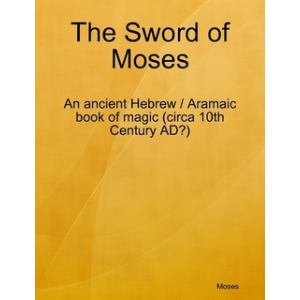
The Sword Of Moses An Ancient Hebrew Aramaic Book Of Magic

The Sword Of Moses An Ancient Hebrew Aramaic Book Of Magic Cover

Book: The Sword Of Moses An Ancient Hebrew Aramaic Book Of Magic by Moses Gaster

Sword of Moses (originaly SEPHER REZIAL HEMELAK - The Book of the Angel Rezial) - RARE 19th century edition was printed in Yozefof in 1873, it is a tall hardback with a GORGEOUS recent Fine binding, leather spine (rich Harmatan goat) on marbled boards, THE TEXT IS COMPLETELY IN HEBREW , with lovely decorative border on title page, there are a few tiny wormholes, also four pages are trimmed at bottom (which does not affect the text at all), otherwise an unusually Nice copy, extremely attractive, tight recent binding, one full page plate plus several diagrams of ancient Hebrew talismans.

This is the famous magical Hebrew grimoire text, sometime called The Sefer Razial or Raziel, and according to Hebrew legend, the Sepher Raziel was presented to Adam in the Garden of Eden, given by the hand of God and delivered by the angel Rezial. The myth suggests that this is the first book ever written, and of direct divine provenance. A diverse compendium of ancient Hebrew magical lore, this book was quite possibly the original source for later, traditional literature on angelic hierarchy, astrology, Qabalah and Gematria. Moses Gaster mentions this in his introduction to the Sword of Moses (1896) suggesting that the Sepher Rezial could be a primary source for many magic and qabalistic books of the Middle Ages. Sepher Rezial Hemelach is a compilation of five books, being The Book of the Vestment, The Book of the Great Rezial, The Holy Names, The Book of the Mysteries (Sepher HaRazim), and The Book of the Signs of the Zodiac. It includes extensive explanatory text on the holy names of God, the divisions of Heaven and Hell, the names and hierarchy of the angels and spirits, as well as symbolic intepretations of both the Book of Genesis and Sepher Yetzirah. It also includes material on astronomy, astrology, Gematria and various magical talismans, most notably those used for protection during childbirth.

Of interest to students of the occult, kabbalah ( qabala - qabalah ) and ritual magic, also the works of Arthur Edward Waite, Eliphas Levi and Aleister Crowley.

Download Moses Gaster's eBook: The Sword Of Moses An Ancient Hebrew Aramaic Book Of Magic

Free eBooks (Can Be Downloaded):

William Butler Yeats - The Secret Rose And Rosa Alchemica
Eliphas Levi - The Doctrine Of Transcendental Magic
Lincoln Order Of Neuromancers - Apikorsus An Essay On The Diverse Practices Of Chaos Magick
Lisa Mcsherry - The Alchemy Of Abundance Practical Money Magic
Moses Gaster - The Sword Of Moses An Ancient Hebrew Aramaic Book Of Magic

Saturday, October 2, 2010

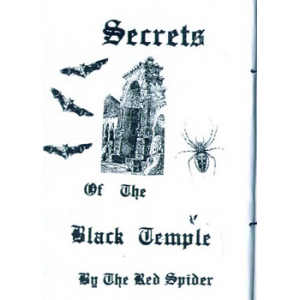
Secrets Of The Black Temple

Secrets Of The Black Temple Cover

Book: Secrets Of The Black Temple by Basil Crouch

Warning this book can be dangerous. Persons in ill health or suffering any mental illness should not have access to this book. Be warned this is a not fiction book it can lead into dark waters if the instructions are not followed. I cannot be help responsible for any damage or ill health through reading this book. You alone are responsible for your actions (Basil E. Crouch)

Download Basil Crouch's eBook: Secrets Of The Black Temple

Free eBooks (Can Be Downloaded):

Opus Majus - The Book Of The Black Serpent
Walter Gibson - Witchcraft A History Of The Black Art
Carroll Runyon - The Secret Of The Dark Mirror
Basil Crouch - Secrets Of The Black Temple

Drawing Down The Moon Witches Druids Goddess Worshippers And Other Pagans In America

Drawing Down The Moon Witches Druids Goddess Worshippers And Other Pagans In America Cover

Book: Drawing Down The Moon Witches Druids Goddess Worshippers And Other Pagans In America by Margot Adler

Popular demand for this clear-sighted compendium of information about the rebirth of Pagan religions hasn't waned since its initial publication in 1979. Distinguished by the journalism of National Public Radio columnist Margot Adler, Drawing Down the Moon explains this diverse and burgeoning religion's philosophies and activities while dispelling stereotypes that have long been associated with it. Most people don't realize that pagan simply refers to pre-Christian polytheistic nature religions, such as the various Native American creeds, Japanese Shinto, Celtic Druid, and Western European Wicca. Originally, the word pagan meant "country dweller" and was a derogatory term in Rome in the third century A.D., not unlike calling someone a hick today. If you find yourself feeling queasy when you hear the words witch or pagan, a healthy dose of reeducation via Drawing Down the Moon could be the cure.

I read this book when it was first published and recommned it to anyone who wants to become more enlightened about the topic. I have a social science background, and thus a general understanding of the various world views of traditional societies who are in my opinion closer to old Mother Earth than most of us "moderns" who spend far too much time caught up in our technology. Margot Adler (granddaughter of the famous psychologist) went exploring (ethnographic field work) and this book is the result.

She does not promote any of the world views she describes, she plays the good ethnographer and records what she finds. She participates on several occasions, and thus becomes the "participant observer" recorder. I didn't know much about the revival of "paganism" and had never heard of Wicca before I read Adler's book. I learned that in spite of the professed enlightenment of our modern age, many fear the practices described. Why? Basically, the practice of Wicca seems to be a female oriented way of life--focusing on nature, life, a spiritual path. I for one am continuing to read about Wicca and explore what others are doing.

I figure some of the so-called witches etc. are not what they purport to be, just as some of the agressive so-called Christians driving with bumper stickers that advertise their "faith" are not what they purport to be. I recommend Adler's book if you are interested in comparative religion, are looking for a new way of living or just curious about a somewhat maligned and often persecuted group of mostly women.

Buy Margot Adler's book: Drawing Down The Moon Witches Druids Goddess Worshippers And Other Pagans In America

Free eBooks (Can Be Downloaded):

Mw Macdowall - Asgard And The Gods The Tales And Traditions Of Our Northern Ancestors Ver 2
Leo Joachim Frachtenberg - Allusions To Witchcraft And Other Primitve Beliefs In The Zoroastrian Literature
Robin Artisson - Dance Of The Witches Opening The Devil Eye
Gerina Dunwich - A Witchs Guide To Ghost And The Supernatural
Damon Leff - A Pagan Witches Touchstone Witchcraft And Witch Hunts In South Africa

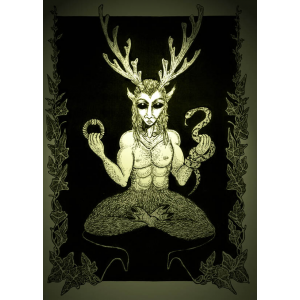
Invocation Of The Horned God

Invocation Of The Horned God Cover By the flame that burneth bright
O Horned One!

We call thy name into the night
O Horned One!

Thee we invoke by the moon led sea
By the standing stone and the twisted tree
Thee we invoke where gather thine own
By the nameless shrine forgotten and lone

Come where the round of the dance is trod
Horn and hoof of the goat-foot God
By moonlit meadow on dusky hill
When the haunted wood is hushed and still

Come to the charm of the chanted prayer
As the moon bewitches the midnight air
Evoke thy powers, that potent bide
In shining stream and secret tide

In fiery flame by starlight pale
In shadowy host that ride the gale
And by the fern-brakes fairy-haunted
Of forests wild and wood enchanted

Come! O Come!
To the heartbeats drum!

Come to us who gather below
When the broad white moon is climbing slow
Through the stars to the heavens height
We hear thy hoofs on the wind of night
As black tree branches shake and sigh
By joy and terror we know thee nigh

We speak the spell thy power unlocks
At Solstice, Sabbat, and Equinox

Word of virtue the veil to rend
From primal dawn to the wide world's end
Since time began---
The blessing of Pan!

Blessed be all in hearth and hold
Blessed in all worth more than gold
Blessed be in strength and love
Blessed be wher'er we rove

Vision fade not from our eyes
Of the pagan paradise
Past the gates of death and birth
Our inheritance of the earth

From our soul the song of spring
Fade not in our wandering

Our life with all life is one,
By blackest night or noonday sun
Eldest of gods, on thee we call
Blessing be on thy creatures all

by Doreen Valiente

Free eBooks (Can Be Downloaded):

John Ronald Tolkien - Introduction To The Elder Edda
Aleister Crowley - The Invocation Of Thoth
James Eschelman - Invocation Of Horus

Thursday, September 30, 2010

The Sacred Magic Of Abramelin The Mage Book 3

The Sacred Magic Of Abramelin The Mage Book 3 Cover

Book: The Sacred Magic Of Abramelin The Mage Book 3 by Abramelin The Mage

Volume III of The Book of the Sacred Magic of Abramelin the Mage.

The Book of Abramelin tells the story of an Egyptian mage named Abramelin, or Abra-Melin, who taught a system of magic to Abraham of Worms, a German Jew presumed to have lived from c.1362 - c.1458. The system of magic from this book regained popularity in the 19th and 20th centuries due to the efforts of Mathers' translation, The Book of the Sacred Magic of Abramelin the Mage, its import within the Hermetic Order of the Golden Dawn, and later within the mystical system of Thelema (created in 1904 by Aleister Crowley).

Unfortunately, Mathers used the least-reliable manuscript copy as the basis for his translation, and it contains many errors and omissions. The later English translation by Georg Dehn and Steven Guth, based on the earliest and most complete sources, is more scholarly and comprehensive. Dehn attributed authorship of The Book of Abramelin to Rabbi Yaakov Moelin (Hebrew ca. 1365–1427), a German Jewish Talmudist.

Structure of the book

The grimoire is framed as a sort of epistolary novel or autobiography in which Abraham of Worms describes his journey from Germany to Egypt and reveals Abramelin's magical and Kabbalistic secrets to his son Lamech. Internally the text dates itself to the year 1458.

The story involves Abraham of Worms passing his magical and Kabbalistic secrets on to his son, and tells how he acquired his knowledge. Abraham recounts how he found Abramelin The Mage living in the desert outside an Egyptian town, Arachi or Araki, which borders the Nile. Abramelin's home sat atop a small hill surrounded by trees. He was an Egyptian mage and taught a powerful form of Kabbalistic magic to Abraham. He was a "venerable aged man", and very courteous and kind. He discussed nothing but "the Fear of God", leading a well-regulated life, and the evils of the "acquisition of riches and goods."

Abramelin extracted a promise from Abraham that he would give up his "false dogmas" and live "in the Way and Law of the Lord." He then gave Abraham two manuscript books to copy for himself, asking for ten gold florins, which he took with the intention of distributing to seventy-two poor persons in Arachi. Upon his return fifteen days later, after having disposed of the payment money, Abramelin extracted an oath from Abraham to "serve and fear" the Lord, and to "live and die in His most Holy Law." After this, Abramelin gave Abraham the "Divine Science" and "True Magic" embedded within the two manuscripts, which he was to follow and give to only those whom he knew well.

Origin of the manuscript

The book exists in the form of six manuscripts and an early printed edition. The provenance of the text has not been definitively identified. The earliest manuscripts are two versions that date from about 1608, are written in German and are now found in Wolfenbuttel Another two manuscripts are in Dresden, and date from about 1700 and 1750 respectively.

The first printed version, also in German, dates to 1725 and was printed in Cologne by Peter Hammer. A partial copy in Hebrew is found in the Bodleian Library in Oxford, and dates from around 1740. A manuscript copy existed in French in the Bibliotheque de l'Arsenal in Paris, an institution founded in 1797. The French copy has since disappeared, but is available on microfilm.

All German copies of the text consist of four books: an autobiographical account of the travels of Abraham of Worms to Egypt, a book of assorted materials from the corpus of the practical Kabbalah (including some which is duplicated in the German-Jewish grimoire called "The Sixth and 7th Books of Moses") and the two books of magic given by Abramelin to Abraham. The well-known English translation by S.L. MacGregor Mathers from the French Manuscript in Paris contains only three of the four books. The Hebrew version in Oxford is limited to Book One, without reference to the further books.

Of all the extant sources, the German manuscripts in Wolfenbuttel and Dresden are taken by scholars to be the authoritative texts. According to respected Kabbalah scholar Gershom Scholem, the Hebrew version in Oxford was translated into Hebrew from German. An analysis of the spelling and language usage in the French manuscript indicates that it dates to the 18th century, and that it was also likely copied from a German original. Although the author quotes from the Jewish Book of Psalms, the version given is not from the Hebrew; rather, it is from the Latin Vulgate, a translation of the Bible employed by Roman Catholics at that time.

The German esoteric scholar Georg Dehn has argued that the author of The Book of Abramelin was Rabbi Yaakov Moelin (Hebrew 1365–1427), a German Jewish Talmudist and posek (authority on Jewish law). (ref Georg Dehn, The Book of Abramelin: A New Translation, transl. by Steven Guth, Ibis Publishing, 2006)

Magic word squares

The practical magic of Abramelin (found in both Book III of the French text, and Book IV of the German original) centers around a set of talismans composed of magic word squares. These are similar to traditional magic squares, though the latter are usually composed of numbers, while Abramelin's squares contain letters. Commonly word squares are used as puzzles or as teaching aids for students. In the context of Abramelin, the focus becomes mystical—so that each square should contain words or names that relate to the magical goal of the square. A parallel is found in the famous Sator Arepo Tenet Opera Rotas word square, an altered version of which is also found among Abramelin's squares.

For example, a square entitled "To walk under water for as long as you want" contains the word MAIAM, the Hebrew and Arabic word for "water". A square for recovering treasures of jewelry begins with the word TIPHARAH (a variant of Tiferet), which can mean "golden ring" in Hebrew and is also the name of the sphere of "Beauty" on the Kabbalistic Tree of Life.

Download Abramelin The Mage's eBook: The Sacred Magic Of Abramelin The Mage Book 3

Free eBooks (Can Be Downloaded):

Aleister Crowley - The Sixth Chakra Of The Human Body
Manly Palmer Hall - The Secret Teachings Of All Ages
Solomonic Grimoires - The Magic Of Armadel
Abramelin The Mage - The Sacred Magic Of Abramelin The Mage Book 2
Abramelin The Mage - The Sacred Magic Of Abramelin The Mage Book 3

Wednesday, September 29, 2010

The Magic Of Armadel

The Magic Of Armadel Cover

Book: The Magic Of Armadel by Solomonic Grimoires

The grimoire of Armadel translated from the original French and Latin of a manuscript in the Biblotheque l'Arsenal in Paris. This is classed as a Christian Grimoire and contains many important seals and sigils of the various demons and planetary spirits. First translated by S.L. McGregor Mathers in the late 1890’s. The Grimoire of Armadel remained unpublished until 1980.

What follows is an unabridged introduction taken directly from the version of the Grimoire by Frator Alastor:

“…….When Mathers made his translation he notice that the title page was the last page of the Grimoire, so he moved to the front but keep the rest of the chapters in the same order. He also notice that this Grimoire began speaking about the magick circle like if it where something that the reader should already know. Now it is my believe that the whole Grimoire was written backward, this is to say that you should read the last page first (the title page) then the last chapter and so on. If you read it this way you will see that make a lot of sense. In Mathers version the first chapter is a reference to the magick circle and the License to depart, it make no sense to begin a Grimoire that way since the license to depart is the last think that a magician read. Also if you fallow the Latin titles in Mathers version the text begin with the Sanhedrin, Jesus and go on to the creation of Adam and the demons and the angels etc. This order is completely the opposite of that one on the bible this is god first, then the angels, the demons, Adam, Jesus, the Crucifixion and the Sanhedrin. So neither to say I had inverted the orders of the chapters in Mathers version under the believing that this is the way that the magic was intended to be read.”

Download Solomonic Grimoires's eBook: The Magic Of Armadel

Free eBooks (Can Be Downloaded):

William Blake - The Marriage Of Heaven And Hell
John Musick - The Witch Of Salem
Reynold Nicholson - The Mystics Of Islam
Aubrey Bell - The Magic Of Spain
Solomonic Grimoires - The Magic Of Armadel

Tuesday, September 28, 2010

The Ultimate Book Of Spells

The Ultimate Book Of Spells Cover

Book: The Ultimate Book Of Spells by Pamela Ball

The Ultimate book of spells - A Complete Guide to Using Magic to Improve Your Life and the World Around You (2007) Arcturus Publishing ISBN 978-1-84193-577-5

This book is essential reference for anyone wishing to take control of their lives and become confident in the art of spell making...The book includes over 250 spells and techniques, covering every aspect of life and spiritual development. Whether it is creating opportunities for love, doubling your money or protecting your teenage daughter, there is a spell for everyone...With sections on the folkloric history of magic, astrology, divination and mysticism, the book provides the reader with a complete background to the art of magic. The complex social and cultural influence of spells is revealed, as well as their power to enrich and transform modern lives.

The desire to change and improve that which we have has been around for many thousands of years, if not since man first walked the earth. Magic and spell working have always been a part of that, and indeed still are today. Anyone who practises any form of magic, including spell working, needs to be grounded. This means having h feet firmly planted in reality and also having a basic knowledge of what
magic is and is not, what spells can and can’t do and what – with practice – you can do with the tools, information and knowledge you have. This book sets out to give you that information in as succinct a manner as possible.

Download Pamela Ball's eBook: The Ultimate Book Of Spells

Free eBooks (Can Be Downloaded):

Ancient Grimoires - The 6th And 7th Book Of Moses
Anonymous - Book Of Spells
Ancient Grimoires - The 8th Book Of Moses
Michael Johnstone - The Ultimate Encyclopedia Of Spells
Pamela Ball - The Ultimate Book Of Spells.pdf

The Pungo Witch

The Pungo Witch Cover The Pungo Witch, as she has come to be called, or in real life, Grace Sherwood, was accused of bewitching a neighbor's crop in 1698. Allegations of other 'witchy' things escalated over time in the Princess Anne County government. Her accusers decided to test her by 'ducking,' or, trial by water, her innocence or guilt determined by whether she floated or drowned. Drowning, by the way, was the GOOD outcome.

On July 10th, 1706 at ten o'clock, Grace Sherwood was tied by her thumbs, cross-bound and dropped into the western branch of the Lynnhaven River near what is now known as Witchduck Point in Virginia. Unfortunately for Sherwood, she floated. Guilty of being a duck? No, guilty of being a witch. She was imprisoned, and eventually released, but Sherwood lived the rest of her life quietly unvindicated, and died in 1740.

I guess they taught her a lesson, huh? Grace Sherwood was a midwife who would often wear men's clothing while working her own homestead. She went to court a dozen times to either defend herself or sue her neighbors for slander, yet never turned her back on a woman in need of her skills. She never married. Thus one can assume that then, as now, a woman who takes care of herself, a confident, competent woman, is suspect at best, ducked at worst, but always, apparently, in need of being taught to mind her place.

In 2006, she was pardoned by the Governor of Virginia, Timothy M Kaine--300 years after her ordeal. The wheels of justice sure do run slow, sometimes, but at least they turn.

Free eBooks (Can Be Downloaded):

Anonymous - The Laws For Witches
Margaret Alice Murray - The God Of The Witches
Alfred Elton Van Vogt - The Witch

Maxine Sanders Queen Of The Witches

Maxine Sanders Queen Of The Witches Cover Maxine Sanders is the famous Alexandrian High Priestess from England . I strongly identify with her, for I believe she was born with the Witchblood. As a teenager in the 1960’s, she defied the stereotype of the hag witch with the youth, beauty, and charisma of the Enchantress. Partnered with Alex Sanders, she was instrumental in bringing the old religion to public consciousness and the eventual quasi-acceptability we have today. Her lifetime of dedication to the Mysteries as healer, teacher, Initiator, and muse in the face social antagonism, media sensationalism, public adulation and envy, makes for one of the truly remarkable life stories of our time.

Free eBooks (Can Be Downloaded):

Bernard King - Meanings Of The Runes
Thomas Potts - Discovery Of Witches
George Lincoln Burr - Narratives Of The Witchcraft Cases
Michael Magee - Robin Hood And The Witches
Margaret Alice Murray - The God Of The Witches

Monday, September 27, 2010

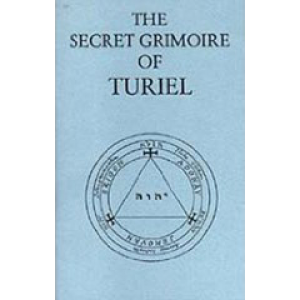
The Secret Grimoire Of Turiel

The Secret Grimoire Of Turiel Cover

Book: The Secret Grimoire Of Turiel by Medieval Grimoires

Turiel in the Book of Enoch

Turiel in later translations was the 18th Watcher of the 20 leaders of the 200 fallen angels that are mentioned in an ancient work called the Book of Enoch. The name is believed to originate from tuwr, el (God) meaning "rock of God". The translation taken from Michael Knibbs work on the Ethiopic Book of Enoch is "Mountain of God" or "Rock of God".

Grimoire of Turiel

There is a grimoire called "The Secret Grimoire of Turiel" in which the magician is given instructions on how to contact Turiel. It was believed to have been written in about 1518, but may have been copied from something older. It came to light in 1927 after being sold to Marius Malchus in Spain by a defrocked priest and was then translated into English from the original Latin. However, since Turiel is only previously mentioned in the Book of Enoch, it is unlikely that Turiel would have been known in the west before the rediscovery of the Book of Enoch in the early 17th century. No version previous of 1927 has been brought to the public.

Download Medieval Grimoires's eBook: The Secret Grimoire Of Turiel

Free eBooks (Can Be Downloaded):

Anonymous - The Secret Book Of Artephius
Yacki Raizizun - The Secret Of Dreams
Parker Torrence - The Craft Grimoire Of Eclectic Magic
Austin Osman Spare - The Zoetic Grimoire Of Zos
Medieval Grimoires - The Secret Grimoire Of Turiel

Sunday, September 26, 2010

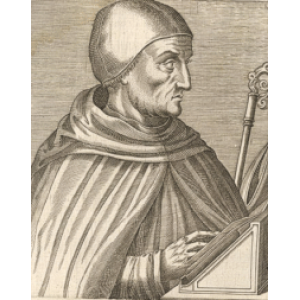
Albertus Magnus Biography

Albertus Magnus Biography Cover Albertus Magnus (1193-1206? - 1280) also known as “Albert the Great” was a German scholar of theology, philosophy, natural science, medicine, alchemy, astrology, chemistry and physics. He was also an alleged magician who believed in the benefits of botany, claiming that various plants, rocks and amethysts improved clairvoyance. He was known as “Doctor Universalis” (“Universal Doctor”) because of the breadth of his knowledge, and was especially noted for introducing Greek and Arabic science and philosophy to the medieval world. He was the most prolific writer of his century and was the only scholar of his time to be called “the Great”, a title that was used even before his death.

Albertus Magnus was born Albert de Groot, in Lauingen, Bavaria, the eldest son of the Count of Bollstadt, a military lord in the service of Emperor Frederick II. Later contemporaries such as Roger Bacon (1214-1294) applied the latinised name of “Albertus Magnus” out of respect for his immense reputation as a scholar and philosopher. Nothing about his primary or preparatory education is known but it is thought he was privately tutored at home before being sent to Bologna University in Italy for his formal education. He then moved to Padua University where he studied the liberal arts and teachings of the Greek philosopher Aristotle.

While there in 1223, he was recruited by the Blessed Jordan of Saxony, the second Master General of the recently formed Dominican Order of Friar Preachers (founded by St Dominic in 1214), who was doing the rounds of major universities in Europe recruiting the best young scholars into the Dominican Order. The Order at that time was less than ten years old, and had only been granted ecclesiastical approval in 1216. Magnus was ordained in a Dominican convent house in Cologne, Germany, from where he quickly advanced through the ranks of the Order.

After leaving Padua, Magnus taught theology at several convent houses throughout Germany including: Regensburg, Freiburg, Strasbourg, Hildesheim and lastly at the convent house in Cologne, were he reinterpreted Peter Lombard’s “Book of the Sentences” (Magister Sententiarum), the theological textbook used in most of the medieval universities. He then moved on to the University of Paris were he became Master of Theology in 1245.

His most famous pupil at the University of Paris was Thomas Aquinas, who later in 1248 joined him at the new Studium Generale in Cologne, in which Magnus was appointed Regent and were Aquinas became his second professor and Magister Studentium (Master of Students). Magnus went on to become an influential Church administrator, teacher and preacher, and travelled throughout Western Europe on behalf of the Dominican Order.

In 1254 Magnus was made provincial of the Dominican Order in Germany, and in 1256 journeyed to Rome to defend the Mendicant Orders against an attack by William of St. Amour, who sought to have the Dominican’s right to alms removed. Magnus succeeded in having his book treatise “De novissimis temporum periculis” condemned by Pope Alexander IV on the 05th October 1256. During his short stay in Rome, he also filled the position of Master of the Sacred Palace, from were he preached on the Gospel of St. John and the Canonical Epistles.

A year later in 1257, Magnus resigned the office of Provincial in Germany to devote himself to his studies and teaching, although he remained a leading force in the Order. At a General meeting of the Dominicans held in Valenciennes, France in 1258, with Thomas Aquinas and Peter of Tarentasia (later Pope Innocent V), he drew up rules for the direction of studies and determined the future system of graduation to be used throughout the Order.

In 1260 Magnus was called by the Pope Alexander IV to serve as the Bishop of Regensburg, a position he resigned from in 1262, in order return to his convent in Cologne, there once again to concentrate on his scholarly interests. However from 1263 to 1264 he was made a legate of Pope Urban IV, and sent to preach the crusades throughout Germany and Bohemia, where subsequently he lectured at Wurzburg and at Strasbourg.

On his journeys around Europe, Magnus showed an intense interest in natural phenomena, and was consumed by the scientific writings of Aristotle. He examined his works, commented on them, and occasionally contradicted them based on the evidence of his own observations. In his laboratory in Cologne he carried out his own experiments in chemistry, mineralogy and physics, and built up a collection of plants, insects and chemical compounds. Of his experiments he is said to have discovered the metallic element of arsenic, caustic potash, and was the first person to determine the chemical composition of cinnabar, minium and white lead.

As a theologian and philosopher, Magnus was outstanding among his contemporaries but not as innovative as his star pupil Thomas Aquinas. Magnus attempted to bring Aristotelian doctrines together with Christian teachings, and in his Summa Theologiae (1270) he maintained that human reason could not contradict revelation, but defended the philosopher’s right to investigate divine mysteries.

In 1274 Magnus was called by Pope Gregory X to attend the ecumenical Council of Lyon, where he had to defend the orthodoxy of his former pupil Thomas Aquinas and the Aristotelian doctrines that both he and Aquinas held to be true. While there he received the sad news that Aquinas had died on his way to the same Council. The news was a heavy blow to Magnus who declared, “that a shining light of the Church had been extinguished”. In 1277 when it was announced that critics wished to condemn and writings of Aquinas, believing that his teachings were too favourable to unbelieving philosophers, Magnus again travelled to Paris to defend his good name.

Magnus suffered serious health problems in 1278 and later died in Cologne on the 15th of November 1280. He was buried in a crypt tomb at the Dominican Church of St. Andreas in Cologne, while his relics were held at Cologne Cathedral. Much later in 1622 he was beatified, and later still declared a Saint by Pope Pius XI in 1931, at which time he was also acclaimed an official Doctor of the Church. In 1941 Pope Pius XII made him the Patron Saint of Natural Sciences.

In the centuries after his death, many myths and stories were told about Magnus the alchemist and magician. On the subject of alchemy and chemistry, he had written mant treaties, including: Alchemy; Metals and Materials; the Secrets of Chemistry; the Origin of Metals; the Origins of Compounds, and Concordance, which is a collection of Observations on the philospher's stone. Other alchemical and chemistry topics were collected under the name of Theatrum Chemicum.

Magnus believed that stones had occult properties, as he related in his work De mineralibus. However there is little actual evidence that he personally performed alchemical experiments. Most of the modern myths are the result of later works, such as the alchemical work known as the Secreta Alberti or the Experimenta Alberti, which were falsely attributed to Magnus by their authors in order to increase their prestige through association. According to one myth, Magnus is said to have discovered the Philosopher’s Stone and passed it on to his pupil Thomas Aquinas. While Magnus made observations about the stone in his writings, he does not mention ever discovering or owning it, although he did record that he witnessed the creation of gold by “transmutation”.

Magnus was also deeply interested in astrology, as were most academics in his day. In the high Middle Ages and well into the early modern period, few intellectuals questioned the basic theories of astrology i.e. that humans lived within a web of celestial influences that affect their bodies, and motivates them to behave in certain ways. They believed that astrology could be used to predict the probable future of a human being. Magnus made this a central component of his philosophical system, arguing that an understanding of celestial influences could help us to live our lives more in accord with Christian precepts. His astrological beliefs can be found in a work he authored around 1260, now known as the Speculum astronomiae. However, details of these beliefs can be found in almost everything he wrote, from his early Summa de bono to his last work the Summa theologiae.

The works of Albertus Magnus represents the entire body of European knowledge, as was extent during his time, not only in theology but also in philosophy and the natural sciences. His importance to the history of medieval academia consists in his bringing Aristotelian doctrines to the fore against the reactionary tendencies of his contemporaries. But it was by his writings on the natural sciences that he exercised his greatest influence. Albertus Magnus must be regarded as unique in his time for having made accessible and available the Aristotelian knowledge of nature and for having enriched it by his own observations. A pre-eminent place in the history of science was accorded to him when because of his achievements, he was canonised and made the Patron Saint of Natural Sciences.

Free eBooks (Can Be Downloaded):

Aleister Crowley - Liber 132 Liber Apotheosis
Anonymous - The Lawes Against Witches
Aleister Crowley - Liber 011 Nu With Commentary
Aleister Crowley - Eight Lectures On Yoga
Aleister Crowley - Liber 666 The Master Therion A Biographical Note

Monday, July 26, 2010

Witch Hunts Today

Witch Hunts Today Cover Few people are aware that witch-hunts still claim thousands of lives every year, especially in the countries of sub-Saharan Africa, and above all in South Africa.

Witch-hunts in South Africa have become "a national scourge," according to Phumele Ntombele-Nzimande of the country's Commission on Gender Equality. (Quoted in Gilbert Lewthwaite, "South Africans go on witch hunts," Baltimore Sun, September 27, 1998.) The phenomenon is centered in the country's poverty-stricken Northern Province, where "legislators counted 204 witchcraft-related killings [from 1985-95] ... Police counted 312 for the same period. Everybody agreed both numbers were gross underestimates." (Neely Tucker, "Season of the Witch Haunts Africa," The Toronto Star, August 1, 1999.) In 1996 The Observer (UK) reported that "the precise statistics are not known, but the deaths from witch-burning episodes number in the hundreds each year and the trend appears to be on the rise." (David Beresford, "Ancient superstitions, fear of witches cast spell on new nation," reprinted in The Ottawa Citizen, June 18, 1996.)

As with its European predecessor, witch-hunting in South Africa is closely tied not only to prevailing superstitions, but to socio-economic pressures, natural disasters, and personal jealousies. In the Northern Province, "among the poorly educated rural residents, traditional healers and clairvoyants claiming supernatural powers hold broad sway. And hunger, poverty, and unemployment can create jealousies that can quickly turn to anger and vengeance." (Lewthwaite, "South Africans go on witch hunts.") Likewise, Peter Alexander reports that "In a region of intense poverty and little education, villagers are quick to blame any adverse act of fate on black magic." These traditional tendencies have been exacerbated by a recent hysteria (extending to Kenya and Zimbabwe) over the very real phenomenon of "ritual killings related to witchcraft," which "include the removal of organs and limbs from the victims -- the genitals, hands or the head, all of which are believed to bring good luck." (Alexander, "'Witches' get protection from superstitious mobs," The Daily Telegraph, May 26, 1997.) Such ritual murders often bring "retribution" against innocents accused of witchcraft.

The intensity of the persecution and vigilantism in South Africa has reached such levels that no fewer than ten villages have been established in the Northern Province, populated exclusively by accused "witches" whose lives are at risk in their home communities. One such settlement, Helena, counted among its residents 62-year-old Esther Rasesemola, who "was accused in 1990 of being a witch after lightning struck her village":

A group of people visited the Inkanga [village witch-doctor] to see who was responsible. When they returned, it was my brother-in-law who told the rest of the village that I was responsible. He owed me money and I think he did it to get rid of me because he did not want to pay the money back. People in the village became convinced I was a witch. They came to my house at night and burnt it down and took all my belongings. Then they put me in a truck and drove me to a deserted place and dropped me off with my husband and my three children. They told me never to come back to the village or they would kill me. My husband died two years after we were expelled. My children have gone away and now I have nothing. I don't believe in witchcraft. It is just superstitious belief. (Quoted in Alexander, "'Witches' get protection.")

Gilbert Lewthwaite of the Baltimore Sun described the case of Violet Dangale, a 42-year-old woman who "was driven from her home 30 months ago by relatives and neighbours who accused her of being a witch growing rich from the work of zombies, as the 'living dead' are known." Now she was "penniless and in fear for her life," living in Tshilamba, another of the refuges for accused witches. Her "main accuser was her uncle. He first accused her father of using zombies to enrich himself. Then he turned on her, suggesting that she enjoyed her share of the family's wealth through witchcraft. ... As the accusations and threats grew stronger, the Dangale family fled their homes in Dzimauli." "They said I was a witch," Dangale told Lewthwaite. "I don't know anything about witchcraft. I don't believe in zombies. Since I was born, I never saw a zombie." (Lewthwaite, "South Africans go on witch hunts.")

Both of these women were luckier than 65-year-old Linah Seabi, "a sorghum beer brewer ... [who] was charged with killing an elderly woman with a poisonous potion. More than 200 villagers stormed Seabi's house in late May [1991], beat her and burned her to death with straw thatch from the roof of her house." (Nina Shapiro, "Wave of witch hunts sweeps South African countryside," The Toronto Star, September 19, 1991.) In December 1998, "Francina Sebatsana, 75, and Desia Mamafa, 55 ... were burned to death on pyres of wood in the village of Wydhoek," in the Northern Province, for alleged witchcraft. "Eleven men, ages 21 to 50" were charged with her murder. (Lewthwaite, "South Africans go on witch hunts.")

The gendering of the European witch-hunts appears to be closely duplicated in the South African case. As the above accounts suggest, "traditionally, it is women who are accused of witchcraft" (Alexander, "'Witches' get police protection"). Especially vulnerable are "defenceless elderly women, against whom the actions are taken without resistance," according to Northern Province Premier Ngoako Ramatlhodi. "That women most often are the victims of witch hunts stems from attitudes toward gender," writes Nina Shapiro of The Toronto Star:

"In our culture, men go out in the afternoon, women remain in the home," said Russell Molefe, a local journalist. People believe women sit at home concocting potions, he said. Older women are suspected, according to Lebowa police lieutenant Mohlabi Tlomatsana, simply because they are alive. "People will think 'Why has she not died? Probably because she is a witch.'" (Shapiro, "Wave of witch hunts.")

However, as in the European case-study, "these days almost a third of victims of men" (Alexander, "'Witches' get police protection.") Nonetheless, approximately 30 percent of accused witches are male -- reflecting men's prominence as nangas, or traditional healers. Anton La Guardia describes the case of "Credo Mutwa, southern Africa's best-known practising healer ... [who] said he had been accosted by a mob and stabbed several times. He lay bleeding on the ground and waited helplessly to die as his assailants poured petrol and prepared to set it alight. Mr. Mutwa ... said he was saved by the same superstition which was about to claim his life. 'A young man shouted, "His ghost will haunt you." They vanished, leaving me like a fish on dry land.'" (La Guardia, "South Africa's non-political witch-hunts," The Daily Telegraph, September 9, 1998.)

As in all these campaigns, it is difficult to assign particular responsibility for fuelling the anti-witch hysteria. Although they may themselves be accused of witchcraft, it is also generally the nangas who are called upon to point out "suspicious" persons who can be accused as witches: according to one South African police sergeant, "Generally, if people believe there is a witch in their village, they will consult the [witch-doctor]. He or she will then 'sniff out' the witch. The person who is accused will then be killed or ordered to leave the village." (Alexander, "'Witches' get police protection.") Village males usually carry out the murders and other acts of terrorism. But as in the European case-study, patterns of gossip and rumour are central to the process -- and to shielding the perpetrators from justice. South African police inspector Matome Mamabolo reports: "If someone is accused of murdering a witch, the community tends to support them by supplying money for an advocate when the case comes to court. There is a solidarity there -- after all, that person is accused of ridding the village of a witch." (Quoted in Alexander, "'Witches' get police protection.")

Much the same pattern is evident in Tanzania, Zimbabwe, and Kenya, although the gender of the victims may be more even. In August 1999, Paul Harris of the Sunday Telegraph reported that

Lynch mobs have killed hundreds of Tanzanians whom they accuse of witchcraft as black magic hysteria sweeps East Africa. Most of the usually elderly victims have been beaten or burnt to death by gangs of youths. Some old women have been singled out simply because they have red eyes -- regarded as a sign of sorcery by their assailants. The condition is actually caused by years of toiling in smoky kitchens cooking family meals. ... Police say 357 suspected witches have been killed in the past 18 months, but the Ministry of Home Affairs believes that the true figure is much higher. A departmental survey said as many as 5,000 people were lynched between 1994 and 1998. (Paul Harris, "Hundreds burnt to death in Tanzanian witch-hunt," Sunday Telegraph, August 22, 1999.)

In Zimbabwe, as in neighbouring South Africa, the witch-hunts also seem closely related to "the black market demand for human body parts, which are used in making evil potions." The upsurge in such practices, the ritual murders they require, and the vengefulness that results against accused "witches," are all linked to the country's precipitous economic decline. "It's obvious the cause is economic," says Gordon Chavanduka, head of the Zimbabwe National Traditional Healers Association (which counts 50,000 members). "The worse the economy gets, the more political tension there is in society, the more frustrated and frightened people get. They turn to witchcraft to gain riches or to hurt their enemies." (Neely Tucker, "Season of the witch haunts Africa," The Toronto Star, August 1, 1999.)

In the Kenyan case, as was also true in a handful of European countries, the witch-hunts appear predominantly to target males. A British sociologist, J.F.M. Middleton, records the conviction of the Lugbara tribe of Kenya that

a witch is a man [emphasis added] who perverts a mystical power of kinship for his own selfish ends and is therefore an evil person. Witches in general are given both physical and moral attributes: a witch has greyish skin, red eyes, a physical deformity; he may travel about upside down; he is bad tempered, secretive, petty and jealous; he is thought to practice incest and cannibalism. The distinction between witchcraft, a mystical activity, and sorcery, the use of material objects, was widespread in eastern Africa, Dr. Middleton said. When, as in Lugbara, the basic principles of organization were unilineal descent and seniority by generation it would be expected that men were believed to practise witchcraft, whereas women should have the less important role of sorcerer. ("How to recognize witches," The Times [UK], September 5, 1997.)

In Kenya in 1993, killings among the Gusii tribe were occurring at the rate of one a week. "In most cases ... village mobs several hundred strong locked the victims inside thatch-roof houses and set them on fire. ... According to tribal elders, the Gusii have always executed people found to be witches. Sanslaus Anunda, a 99-year-old tribal elder, said that during his youth, villagers had a foolproof method for determining guilt. The most respected men in the community would call a meeting. Next, they would smear local herbs on the hands of the suspect and that of a second, innocent man [emphasis added]. Both men would be ordered to dip their hands into a pot of boiling water, then return in five days. If the suspect was a witch, burns would appear on his hands. However, Anunda insists, the innocent man's hands would remain unscarred." (Tammerlin Drummong, "Kenya: Dozens die in witch hunts," The Ottawa Citizen, August 28, 1993.)

A trend of predominantly male victimization may also be evident in West Africa, where a bizarre wave of accusations of "penis-snatching" has come to light. The Reuters news agency reported in 1996 that "eight men in Accra, Ghana, were accused of using witchcraft to snatch penises. Their motivation was allegedly to return the sexual organs in return for cash. Mobs attacked them ... two died and six were seriously injured. The police examined all the alleged victims and found their genitals intact. ... [But] the 'victims' believed that sorcerers only had to touch them to make the genitals shrink or disappear completely." ("'Witches' steal penises in Ghana," Reuters dispatch, January 17, 1996.) D. Trull reported in 1997 that "the killings of alleged 'penis snatchers'" had been reported "along the west coast from Cameroon to Nigeria." (See Trull, "Witches Protection Program".)

Books You Might Enjoy:

Phil Hine - Aspects Of Evocation
Aleister Crowley - The Sixth Chakra Of The Human Body
Richard Johnson - The Zodiac Stellar Stories
Gerald Gardner - Witchcraft Today

Saturday, July 24, 2010

Who Was Responsible For Great Witches Hunt

Who Was Responsible For Great Witches Hunt Cover The medieval witch-hunts have long been depicted as part of a "war against women" conducted exclusively or overwhelmingly by men, especially those in positions of central authority. Deborah Willis notes that "more polemical" feminist accounts "are likely to portray the witch as a heroic protofeminist resisting patriarchal oppression and a wholly innocent victim of a male-authored reign of terror designed to keep women in their place." (Willis, Malevolent Nurture, p. 12.)

In fact, the stigmatizing, victimizing, and murdering of accused "witches" is more accurately seen as a collaborative enterprise between men and women at the local level. "The historical record suggests that both men and women found it easiest to fix these fantasies [of witchcraft], and turn them into horrible reality, when they were attached to women. It is really crucial to understand that misogyny in this sense was not reserved to men alone, but could be just as intense among women." Most of the accusations originated in "conflicts [that] normally opposed one woman to another, with men liable to become involved only at a later stage as ancillaries to the original dispute." Briggs adds that "most informal accusations were made by women against other women, ... [and only] leaked slowly across to the men who controlled the political structures of local society." At the trial level, his research on the French province of Lorraine found that

women did testify in large numbers against other women, making up 43 per cent of witnesses in these cases on average, and predominating in 30 per cent of them. ... A more sophisticated count for the English Home Circuit by Clive Holmes shows that the proportion of women witnesses rose from around 38 per cent in the last years of Queen Elizabeth to 53 per cent after the Restoration. ... It appears that women were active in building up reputations by gossip, deploying counter-magic and accusing suspects; crystallization into formal prosecution, however, needed the intervention of men, preferably of fairly high status in the community." (Briggs, Witches & Neighbours, pp. 264-65, 270, 273, 282.)

Deborah Willis's study of "Witch-Hunting and Maternal Power in Early Modern England" similarly finds it "clear ... that women were actively involved in making witchcraft accusations against their female neighbours":

[Alan] Macfarlane finds that as many women as men informed against witches in the 291 Essex cases he studied; about 55 percent of those who believed they had been bewitched were female. The number of witchcraft quarrels that began between women may actually have been higher; in some cases, it appears that the husband as "head of household" came forward to make statements on behalf of his wife, although the central quarrel had taken place between her and another woman. ... It may, then, be misleading to equate "informants" with "accusers": the person who gave a statement to authorities was not necessarily the person directly quarreling with the witch. Other studies support a figure in the range of 60 percent. In Peter Rushton's examination of slander cases in the Durham church courts, women took action against other women who had labeled them witches in 61 percent of the cases. ... J.A. Sharpe also notes the prevalence of women as accusers in seventeenth-century Yorkshire cases, concluding that "on a village level witchcraft seems to have been something peculiarly enmeshed in women's quarrels." To a considerable extent, then, village-level witch-hunting was women's work. (Willis, Malevolent Nurture, pp. 35-36.)

These comments and data serve as a reminder that gendercide against women may be initiated and perpetrated, substantially or predominantly, by "other women," just as gendercide against men is carried out overwhelmingly by "other men." The case of female infanticide can also be cited in this regard. Patriarchal power, however, was ubiquitous at all later stages of witchcraft proceedings. Men were exclusively the prosecutors, judges, jailers, and executioners -- of women and men alike -- in Europe's emerging modern legal system.

Books You Might Enjoy:

Thomas Moore - Candle Magick For Love
Richard Weiss - Recipes For Immortality
Marian Green - A Witch Alone
Thomas Muldoon - Numerology For The 21st Century
Janet Farrar - A Witches Bible The Complete Witches Handbook

Thursday, July 22, 2010

The Witch Hunts Of Early Modern Europe

The Witch Hunts Of Early Modern Europe Cover For three centuries of early modern European history, diverse societies were consumed by a panic over alleged witches in their midst. Witch-hunts, especially in Central Europe, resulted in the trial, torture, and execution of tens of thousands of victims, about three-quarters of whom were women. Arguably, neither before nor since have adult European women been selectively targeted for such largescale atrocities.

The witch-hunts of early modern Europe took place against a backdrop of rapid social, economic, and religious transformation. As we will see in the modern-day case-studies below, such generalized stress -- including the prevalence of epidemics and natural disasters -- is nearly always central to outbreaks of mass hysteria of this type. Jenny Gibbons' analysis ties the witch-hunts to other "panics" in early modern Europe:

Traditional [tolerant] attitudes towards witchcraft began to change in the 14th century, at the very end of the Middle Ages. ... Early 14th century central Europe was seized by a series of rumor-panics. Some malign conspiracy (Jews and lepers, Moslems, or Jews and witches) was attempting to destroy the Christian kingdoms through magick and poison. After the terrible devastation caused by the Black Death [bubonic plague] (1347-1349), these rumors increased in intensity and focused primarily on witches and "plague-spreaders." Witchcraft cases increased slowly but steadily from the 14th-15th century. The first mass trials appeared in the 15th century. At the beginning of the 16th century, as the first shock-waves from the Reformation hit, the number of witch trials actually dropped. Then, around 1550, the persecution skyrocketed. What we think of as "the Burning Times" -- the crazes, panics, and mass hysteria -- largely occurred in one century, from 1550-1650. In the 17th century, the Great Hunt passed nearly as suddenly as it had arisen. Trials dropped sharply after 1650 and disappeared completely by the end of the 18th century. (Gibbons, "Recent Developments in the Study of the Great European Witch Hunt".)

Gibbons' allusion to the Reformation reminds us that the clash between institutional Catholicism and emergent Protestantism contributed to the collapse of a stable world-view, which eventually led to panic and hyper-suspiciousness on the part of Catholic and Protestant authorities alike. Writes Nachman Ben-Yehuda, "This helps us understand why only the most rapidly developing countries, where the Catholic church was weakest, experienced a virulent witch craze (i.e., Germany, France, Switzerland). Where the Catholic church was strong (Spain, Italy, Portugal) hardly any witch craze occurred ... the Reformation was definitely the first time that the church had to cope with a large-scale threat to its very existence and legitimacy." But Ben-Yehuda adds that "Protestants persecuted witches with almost the same zeal as the Catholics ... Protestants and Catholics alike felt threatened." It is notable that the witch-hunts lost most of their momentum with the end of the Thirty Years War (Peace of Westphalia, 1648), which "gave official recognition and legitimacy to religious pluralism." (Ben-Yehuda, "The European Witch Craze of the 14th to 17th Centuries: A Sociologist's Perspective," American Journal of Sociology, 86: 1 [July 1980], pp. 15, 23.)

Books You Might Enjoy:

John Moore - A Modern Master Extract
Will Herberg - The Writings Of Martin Buber
Nathan Johnston - The Devil And Demonism In Early Modern England
Margaret Alice Murray - The Witch Cult In Western Europe
Diane Purkiss - The Witch In History Early Modern And Twentieth Century Representations

Tuesday, July 20, 2010

The Real Witch

The Real Witch Cover A complete account of the ingredients of the witch-idea or even of the genuine witch-cult would fill a volume like this. We should have to go back to the very dawn of religion or, if the theory of Sir J.G. Frazer is correct, before its dawn. Frazer holds that magic preceded religion. I contend that magic and the belief in spirits developed separately. But they are blended in the early idea of the witch: a man or woman who receives magical powers by a league with evil spirits.

Something corresponding to the witch is found, and is dreaded and abhorred, in every stage of human evolution. The spirits of the dead were very soon regarded as in very large part malignant and malevolent, and certain persons were held to act in conjunction with them and practice "black magic"; to raise destructive storms, to blight crops or cattle, to cause disease, sterility, or death. Sometimes this persisted quite apart from belief in spirits. The Romans were not much more definite than the Babylonians in their beliefs about a future life, yet they believed very emphatically in magic and its evil powers. The magician was exposed to a sentence of death in Roman law and was often executed. The ground of the law was, of course, purely secular. The practicer of black magic was dangerous to the community.

The Babylonians and Assyrians (and Persians) believed that myriads of evil spirits or devils hovered about the face of the earth and caused all the evils of humanity; and that there was a special class of these malignant beings who moved about at night, inspired bad dreams, and even sucked the blood of sleepers. This belief in legions of devils passed through the Jews, into Christianity, and the particular belief in night-prowlers and blood-suckers or entrail-suckers (vampires, harpies, etc.) obtained currency amongst the Greeks and Romans. The Greek and Latin word strix, which properly means the screech-owl (so naturally associated with the legend), was applied to these dreaded night- birds.

The Fathers of the Church, particularly St. Augustine, the most influential of them all, denounced magic as "pagan" and as a collusion with the devils. The synods of Elvira (306), Ancyra (314), and Laodicea (375), and the sermons of St. Chrysostom and the other great preachers, show that the new Christians brought with them the magical practices as well as the vices of the pagan world. It does not seem to have been enough to denounce these as pagan, so St. Augustine worked out a more deadly theory: the diviner or magician, in whose powers he firmly believed, was in league with the devil. And the Bible was quite clear about such people. It (Leviticus xx, 27 and Exodus xxii, 18) defined a witch as one who "hath a familiar spirit" and condemned him or her to death. Moreover, the Latin and Catholic Bible translates verse 5 of Psalm xcvi (Psalm xcv in the Catholic Bible): "The gods of the heathen are devils." paganism and devilism coincided.

The change was lamentable and is responsible for the ghastly tragedy of later years. The Roman persecution of magicians was based entirely on the belief that they had abnormal powers and the progress of enlightenment might have undermined this belief. But if magic meant collusion with the devil, belief in it was sure to be magnified very considerably under a religion which taught that the world swarmed with devils. It was precisely the elaboration of this devil-doctrine by the great theologians of the Middle Ages which caused the appalling witch-massacres of the fifteenth, sixteenth, and seventeenth centuries. What surprises one at first is that there was comparatively little persecution of witches before the thirteenth century. It was this wonderful thirteenth century, of which modern Catholics are so proud, that inaugurated the massacres on a large scale. A famous philosopher has called it the most stupid century in the whole of the Middle Ages, and certainly it was the most tyrannical, most superstitious, and most sanguinary.

As far as magic is concerned, the Church never wavered, and the practice of its children never relaxed. The situation is analogous to that of the virtue of chastity. The law was clear: the practice almost universally ignored it. On the other hand, there was no consistent attitude in the Church in regard to the striga (as the strix was now called), the blood-sucking nocturnal creature. The Salic Law in south Germany sentenced the atriga to death. The Lombard Law treated the idea as a superstition. Under Charlemagne a synod held at Paderborn in 785 enacted (canon 6): "Whosoever, deceived by the devil, believes, as the pagans did, that any person is a witch and can devour men, and therefore burns that person, and gives her flesh to others to eat, shall be put to death." individual churchmen were just as much at variance. Some believed in the striga: others did not.

Characteristically, what the Church was concerned about most was magic of an erotic nature. In 860 the great archbishop of Rheims, Hincmar, held a solemn inquiry into this, as the king's concubine was supposed to have used such magic on the queen, and he concluded that it was genuine deviltry. On the whole, there were few executions of witches until the eleventh century, when we begin to find isolated executions more frequently in the chronicles.

I am, however, more concerned with the other aspects of witchcraft: the suggestion of an organization contained in the belief that witches flew in the air at night in droves or to an appointed gathering place. It is usually said that there was no organization of witches until the thirteenth century, which would be quite inconsistent with the view that witchcraft was the ancient pagan religion of Europe. The historical truth is not so simple, and it is interesting.

At the end of the tenth century Abbot Regino made a large collection of Church laws and canons, and one of these is concerned with witches. Where and when this canon was passed we do not know. Some scholars trace it to the Synod of Ancyra, in 314, which is impossible, for the Roman world was then almost entirely pagan. It seems to come from some synod of the sixth century. It says:

And we must not overlook this, that certain wicked women, who have turned aside to Satan, seduced by the illusions and phantasms of the demons, believe and profess that during the night they ride with Diana the goddess of the pagans [another version says, or with Herodias] and an innumerable crowd of women on certain beasts, and pass over great spaces of the earth during the night, obeying her commands as their mistress, and on certain nights are summoned to her service. Would that these had perished in their perfidy and had not dragged many with them to destruction! For an innumerable multitude, deceived by this false opinion, believe that these things are true and so depart from the faith and fall into the error of the pagans, believing that there is some divinity apart from the one God, (Migne edition.)

The abbot goes on to say that all this is the work of the devil who assumes various forms to tempt silly women. The law is reproduced again a few years later in the collection of Bishop Burkhard of Worms (Decreta, bk. ix, chap. 5), who adds the vampire- idea: that women claim that they can, even while they lie in bed with their husbands, fly out in the air and suck the heart and entrails out of other men who are abed.

A life of Pope Damasus (of the fourth century) pretends that as early as 367 a Roman synod took cognizance of these women who rode on beasts at night with Herodias. This life is probably spurious, but it is clear that by the sixth century (to which the canon seems to belong) there was something very like organized witchcraft in Europe. We will not press the words "innumerable multitude," but clearly numbers of women met by night to honor Diana, the goddess of the moon and of fertility.

This does not surprise us. Europe never voluntarily accepted Christianity. Paganism was driven into dark corners, but age by age the Church had to thunder against it. The women in particular clung to their Diana, if not to the still older mother-earth goddess. Sterility was a curse in those days, however convenient it may seem to moderns. Everything that could counteract it and beat the blood- magic, the aid of a goddess, or even the mutual inspiration of a human orgy -- was treasured. The cold advice of Christianity to pray to Mary, was found less effective in practice and less congenial than the nocturnal adventure, But it had to be conducted with secrecy and cunning, and it seemed as if the women must fly through the air to the point of assembly.

Where I venture to differ from Miss Murray is when she supposes that these more or less organized gatherings persisted and reappeared as the witches of the fifteenth and sixteenth centuries. The Dianists disappear, and for centuries the Church deals only with individual magicians, male or female. But a new element was meantime entering European life, and the reader will find that it throws a fascinating light upon witchcraft. It is usual to say that Thomas Aquinas with his absurd demonology, and the Inquisition with its terrible scent for heresy, created witchcraft. Let us try another line.

The true religious history of Europe has never yet been written. Possibly the full truth will never be known, as there has been so much suppression and distortion of facts; but we do know that the accepted version is false. Christianity was imposed by force upon a reluctant world. The current idea of a "conversion" of the Roman world to it is not more false than the almost universal belief that it was meekly accepted, if not profoundly cherished, until modern times. Although our forefathers were robbed of their schools and detained for ages in the densest ignorance, it is to their credit that age after age they, in immense multitudes, rebelled against the corrupt priestcraft and the absurd legend of the Christian religion. It is only by the bloody use of force on a colossal scale that the Church maintained its dominion for so many centuries.

Witchcraft was one expression of the constant effort of the race to rid itself of the religion imposed on it. One of the chief rival religions to Christianity in the fourth century had been Manichaeism, and the writings of St. Augustine, who was at first a Manichaean, but later one of the worst slanderers of the religion, show us how heroically its adherents fought for their creed even long after imperial decrees had declared, under pain of confiscation and death, that Christianity was to be the sole religion of the empire.

I need say of it here only that it was an ascetic religion, and that it was based essentially on the ancient Persian belief in two supreme principles, one of light and goodness, the other of darkness and evil. Manichaeism was crushed by the aid of the imperial troops but Manichaean ideas were destined still to play a great part in Europe. And one aspect of the religion deserves special notice. It has been, I suppose, the custom of religious bodies from time immemorial to slander and vilify rival bodies. The Romans themselves put the darkest interpretations on the secret gatherings of the Christians; they were said to indulge in sensual orgies, to worship a god with an ass's head and to kill babies for sacramental purposes. So in time the Christians vilified the Manichees; though St. Jerome candidly admits that they were men and women of far stricter virtue than the Christians themselves. Augustine, however, was chiefly instrumental in defaming them.

In writing his life, I discovered a carefully overlooked passage in which, posing as the first Inquisitor, he made a public examination of two Manichees. The first was a girl of twelve, and from the lips of this child the pious elderly bishop drew the confession, by leading questions, that the Manichees made their sacrament of human semen and flour. The second victim was a sacred virgin of the sect, and Augustine at once charged her with what he had put into the mouth of the little girl. To make the sacrament, he said, she had lain nude on the ground, a little heap of flour beside her, and the priests had ... She protested that she was a virgin, but Augustine's midwives examined her and declared that she was not. Then, Augustine says, she confessed the whole "abominable crime"; in other words, she escaped the drastic punishment of her heresy by letting the bishop have his way and feigning conversion. Later we hear of similar examinations on Manichaean women and confessions of intercourse with "the devil" (probably meaning his representative, the Manichaean priest).

Here, I am convinced, is the origin of one of the ingredients of the early myth of the witch; though in the fully developed witch-cult there was unquestionably a large amount of "intercourse with the devil." However that may be, the Manichaean ideas were merely thrust out of sight, and they broke out again from time to time. One of the most famous heretics of the Greek Church, Paul of Samosata, was the son of a Manichaean mother and his heresy combined the Manichaean principle of two supreme powers with an early form of Protestantism or evangelical Christianity. The Greek Church and Empire -- which, let us remember, had never been tainted by barbarian invasions -- were now, in the eighth century, appallingly corrupt, and this purer religion, as it was, spread widely, especially among the Armenians. Emperor after emperor tried to suppress it. The Empress Theodora put to death no less than one hundred thousand members of the sect; or, in a few years, made fifty times as many martyrs as the pagans had in three centuries. Finally, in the tenth century, no less than two hundred thousand members of the sect were transplanted from Armenia to Thrace, to form a living bulwark against the encroachments of the Bulgars.

But within a short time the worthy Paulicians had spread their gospel peacefully among the Bulgars, and Europe was confronted with a new heresy, the Bogomiles. You have probably never heard of the Bogomiles, but you will surely have heard of those famous heretics of the south of France, the Albigensians, who were drowned by the greatest of the Popes, Innocent III, in their own blood. They (and the Waldensians, the Cathari, the Patarenes, and other obscure bodies of the time) were inspired by the Bogomiles and had the same tincture of Manichaean ideas. The orthodox Catholics of France called them bougres (Bulgars) and it was thus that the innocent name of a people became the worst swear-word of French and English tongues. They were reproached with having a pope in Bulgaria. In short, from the tenth century onward this revolt against orthodox Christianity and its corrupt priests and monks spread over Europe like a prairie fire.

The reader will already have perceived that here we have the clue to the appearance of witchcraft as a secret and organized cult. The Dianists of the sixth and seventh centuries had gone, and until the twelfth century we find only a few isolated executions of witches for practicing black magic. In the twelfth century these become more frequent. In the thirteenth century the swords of the troops and the fires of the Inquisition suppress heresy; and from that time on witchcraft is recognized by the Church as a secret heresy and a widespread organization.

The Paulicians, Bogomiles, Albigensians, etc., were, as usual, slandered by the orthodox. Psellus, one of the leading Greek orthodox writers of the tenth century, wrote a book "On the Operations of the Devils," in which he included almost as many fables as in his lives of the martyrs. The heretics, he says, used to meet at night by candle light and invoke the devils. When these appeared in the shape of animals, the lights were extinguished and the worshipers indulged in an orgy of sexuality with the devils and with each other. This amiable story passed all over Europe and was applied to the heretics everywhere. It will be enough to quote a letter of Pope Gregory IX to show the connection with witchcraft. In 1233 Gregory wrote to the bishops of Germany, urging them to seek out and persecute the heretics. The letter (given in the Latin in the "Annales" of Ravnaldus, year 1233, p. 89) is one of those weird compositions which bring a smile to the lips when one hears Catholics claim some special divine interest in their church and its popes, but it is too long to be quoted here in full.

The Pope says that amongst these heretics "when a neophyte is received there appears to him a kind of frog," though some say it is a toad. Some kiss it shamelessly on the buttocks, others on the mouth, drawing the tongue and spittle of the animal into their mouths. Sometimes this toad is "as big as a goose or a duck." The neophyte next encounters a "man of extraordinary paleness, with deep black eyes, and so thin that his skin seems to be stretched over his bones." The neophyte kisses him and finds that he is "as cold as ice." The worshipers then sit to table, and a large black cat comes out of a statue, and all of them in the order of their dignity, kiss its buttocks. After a time the lights are extinguished and there is the usual orgy of sexual intercourse. If, the Pope gravely explains, there are more men than women, or women than men, they resort to sodomy. The candles are relit, and they sit again at table, when from a dark corner of the room comes a man "shining like the sun from the loins upward, but rough as a cat below." To this devil the neophyte is presented, and the faithful also give consecrated hosts which they have stolen from the churches where they have communicated.

This is almost exactly an account of a witch meeting, and the Pope adds another significant detail. These heretics, he says, declare that God is a tyrant, and that he unjustly condemned Lucifer to hell. Lucifer is the real creator of the world and prince of men, and in the end he will regain his place.

In point of fact, the Paulicians and Bogomiles and their kin had quaintly mixed the old Persian belief with some of the speculations of the Gnostics. The ancient Persians had believed that the evil principle had created matter which was evil. To Christians the evil principle was Lucifer, and the new heretics contended that Lucifer was one of the two sons of God, unjustly cast off by an overbearing father. He became their "prince" and "lord," and (unlike the Persians) they believed that he would ultimately triumph. This belief either led to or was due to -- the details are necessarily obscure, as we know the tenets only from bitter enemies -- another departure from Manichaeism. The Manichaeans had been very ascetic, deeming the flesh (as part of the creation of the evil principle) an evil thing; and it is clear that the Albigensians and other European heretics also led strict lives. But the glorification of Lucifer meant that matter and the flesh could scarcely be regarded as evil, and a reaction into orgies was inevitable. The witches, at least, had such orgies.

Here we have almost the whole of the ingredients of the witch- cult before our eyes. John of Salisbury, bishop of Chartres in the twelfth century, and others refused to believe in the striga. Pope Silvester II (Gerbert) was himself accused of magic. Moorish influence was beginning to teach Europe the elements of wisdom. And, curiously enough, it was the crown of this new development, the Scholastic movement, which completed the evolution of the witch and let loose the murderous forces of the Church.

Books You Might Enjoy:

John Dee - The Calls Of Enoch
Phil Hine - Oven Ready Chaos
Marian Green - A Witch Alone
Carl Mccolman - The Well Read Witch

Popular Posts