Showing posts with label money magic. Show all posts

Tuesday, November 16, 2010

I Am A Witch Or The Reincarnation Of One

I Am A Witch Or The Reincarnation Of One Cover Psychic talents have been linked to hereditary traits, but having those gifts doesn't make you a witch. Anyone can write their own spells, it's your belief that makes the magic, not even the oldest dusty tome will instantly grant wishes, it's your belief that creates it.

You can be both a Wiccan and a witch, these two words are not the same.

One of the biggest sore points among Wiccans is the improper usage of the terms "Wiccan" and "Witch". Too many people use the terms interchangeably, presuming that they both mean the same thing. They do not.

Wiccan
Wicca is just one of many faiths that embrace Magic. Wicca is a religion, and someone who follows that religion is called a Wiccan. Sometimes it can be difficult to accurately define Wicca, and not all Wiccans will define themselves the same way. Observing the 8 Wiccan Sabbats, honoring the Gods and/or Goddesses, creating sacred space for rituals, to name a few. Many traditional Wiccans also feel that belonging to a coven is also a requirement and that those who practice their religion as a solitary, should not refer to themselves as Wiccan. Personally, I'm still not sure on that point. Typical Wiccans also practice magick, and therefore are also witches. You cannot be a "natural Wiccan" any more than you could be a "natural Christian".

Witch
The practice of witchcraft is not associated with any religion, therefore you can be a witch and yet also be a member of any number of religions (or none). Using the natural energies within yourself, along with the energies of herbs, stones or other elements to make changes
around you is considered witchcraft. Though the skills and gifts that are part of witchcraft can be inherited from parents or grandparents, you aren't automatically a witch just because your grandmother may have been one. The use of magick takes practice, experience and learning.
On a side note, a male witch is called a witch, not a warlock.

Pagan
While I'm explaining terminology, I thought I would throw in "Pagan" as well. Paganism refers to a variety of non-Christian/Jewish/ Islamic religions that are usually polytheistic and are often nature-based. Wicca is only one Pagan religion, but there are others such as Santeria,
Asatru, or Shamanism. Many people do not necessarily identify with a specific religion, and just use the broad term "Pagan" to define their spiritual path. Pagan religions are distinct and separate from each other, and it should not be assumed that they are just different names for
the same faith.

The short answer is magic is a lot of work and it takes a long time to become a proficient Witch. If you are interested in this area, submit a followup question and I'll be happy to provide a list of books, websites and ways to meet other Witches.

If this was just a question, I bid you good night.

Blessings!

Books in PDF format to read:

Scott Cunningham - Wicca A Guide For The Solitary Practitioner
Aleister Crowley - Liber 008 The Ritual Proper For The Invocation Of Augoeides
Aleister Crowley - Sephiroth Ha Dborim The Emanations Of Words

Sunday, October 3, 2010

The Witches Chant

The Witches Chant Cover Darksome night and shining moon,
Hearken to the witches’ rune.
East then South, West then North,
Hear! Come! I call thee forth!

By all the powers of land and sea,
Be obedient unto me.
Wand and Pentacle and Sword,
Hearken ye unto my word.

Cords and Censer, Scourge and Knife,
Waken all ye into life.
Powers of the witch’s Blade,
Come ye as the charge is made.

Queen of Heaven, Queen of Hell,
Send your aid unto the spell.
Horned Hunter of the night,
Work my will by magic rite.

By all the powers of land and sea,
As I do say, “So mote it be.”
By all the might of moon and sun,
As I do will, it shall be done.

By Lady Sheba – 1974

Free eBooks (Can Be Downloaded):

Tarostar - The Witchs Spellcraft Revised
George Lyman Kittredge - Notes On Witchcraft
Alfred Elton Van Vogt - The Witch

Biddy Early Biography

Biddy Early Biography Cover Biddy Early was a famous Irish seer and healer, a cunning woman of the nineteenth century, often identified as Biddy 'The Healer', 'The Wise Woman' or 'The Witch'. Much of what is known about her has been passed down from oral tradition and blended into myth and folklore, as such, there is much “poetic licence” used to recount her life. However, in real life she does seem to have had some genuine powers of healing and clairvoyance, for she was widely consulted for her cures and council. Many believed she was of the sidhe (fairies).

Born Bridget Ellen Connors in lower Faha near Kilanena in 1798, Biddy was the daughter of a small land farmer, John Thomas Connors and his wife Ellen Early. Biddy is described as being small in statue and pretty, a woman who kept her good looks throughout her life. While married four times, she always used her mother's maiden name, believing that her gifts were inherited through the female line. Her mother taught her all about herbs and how to make potions, just as her own mother had taught her.

At the age of 16 when her parents died, Biddy was evicted from their home and forced to work as a serving girl in the nearby towns of Feakle and Ennis. In 1817 she met and married widower Pat Mally, a middle-aged man from Gurteenreagh, who died a short time later. After the death of her first husband, she married his son, her “stepson”, John Mally with whom she had a son called Paddy. Her son Paddy died when he was just 8 years old, of the fever (typhus), a common sickness in those times. After which Biddy started to use her healing powers, giving out herbal cures tied-up in small sachets, and liquid potions in small bottles with strict instructions for how they should be used.

Biddy’s powers of clairvoyance are credited to a mysterious dark bottle. How this “magic” bottle came into her possession, has since become part of her myth and legend. Some believe her late husband Pat Mally gave it to her before he died, or her son before he died; others believe it came to her from the “sidhe” (fairies). There are some stories that say she was away with the sidhe, and went to live among them for a time as a child. As a little girl it was said she could see and talk to the sidhe in their own language, which was different from Gaelic and that they taught her how to use her gifts.

She was instructed that by looking into the bottle with one eye and keeping the other eye open, she would be able to see what ailed people and view the future. In exchange for this ability, she was never to charge money for her services, or she would lose the power. She could accept gifts, but was to give away whatever was left over from her own needs. She must never allow others to look into the bottle, or else they would either die or go mad. By using the bottle, Biddy always knew when a person was about to visit her, and whether they had gone to a doctor or a priest first. If they had, then she usually refused to treat them unless she was in a good mood.

In 1840, her second husband died of a liver ailment, most likely due to an excess consumption of alcohol. Biddy quickly married again, her third husband was Tom Flannery from Carrowroe in County Clare. She and Tom moved into a cottage on Dromore Hill in Kilbarron, overlooking Kilbarron Lake that locally became known as Biddy Early's Lake. By this time Biddy’s reputation as a healer and seer had spread, for it was here that she created her most powerful cures, and hundreds of people came to seek her out. It is said the road to her house was always full of those traveling to see her.

Biddy also brought relief to animals, and treated them with great care. In her time, the death of an animal could bring particular hardship to people living in a mainly rural farming community. Animals were relyed upon for everyday living, and to lose one could lead to eviction if farming chores were not compelted. Many of the stories about Biddy include tales of her healing a family’s most important horse or cow. She also helped many people restore their wells, often the only source of clean water, to solve problems that women ran into while churning butter. Water and butter were also vital to a peasant’s everyday life.

During the nineteenth century, superstitious belief in fairies and all things apparently supernatural was very strong, and when something happened that appeared to be miraculous, without the aid of the church, it was commonly and easily attributed to witchcraft and the devil. As such the local church viewed Biddy with suspicion, and all the local clergy were totally opposed to her. As her fame spread they even tried to warn off people who went to visit her. One story of the churches opposition occurred in 1865. While visiting friends in Ennis, Biddy was charged with Witchcraft under the 1586 statute, however the case was dismissed due to a lack of sufficient evidence. Many of the local people stood their ground against the clergy, maintaining she did nothing but good works.

In 1868, her third husband Tom died, but Biddy now seventy years old, still only looked fifty, and a year later married her fourth husband Thomas Meaney. However he too got sick and died within the year. Many believed her husbands all died from alcohol abuse, as there was so much whiskey and other strong liquors brought to her in payment. Her husbands did not need to work as she herself provided everything through her healing work. After her last husband died, Biddy’s own health slowly deteriorated, she died in April 1874 with a rosary around her neck and her mysterious dark bottle wrapped in a red shawl beside her.

Before her death and despite their differences, Biddy had befriended one of the local priests and asked him not to let her bottle fall into the wrong hands when she died. According to her wishes, the priest took the bottle and hurled it into Kilbarron Lake. Since then, such was the belief in Biddy’s legend, many attempts to trawl the lake in search of the bottle have been made, but to this day it has never been found.

Free eBooks (Can Be Downloaded):

Michael Prescott - Darklore
Anonymous - The Legal Basis For Wicca
Janus Lacinius Therapus - The New Pearl Of Great Price.pdf
Saturday, October 2, 2010

Sefer Ha Zohar Idra Zuta Qadusha Lesser Holy Assembly

Sefer Ha Zohar Idra Zuta Qadusha Lesser Holy Assembly Cover

Book: Sefer Ha Zohar Idra Zuta Qadusha Lesser Holy Assembly by Rabbi Shimon Bar Yochai

Idra Zuta Qadusha (Lesser Holy Assembly), or simply Idra Zuta - the next layer of the core of the five-volume mystical exegesis Sefer HaZohar.

The Sefer HaZohar (Book of Splendor, often referred to simply as "the Zohar") is a five-volume mystical exegesis written in Rashi Aramaic on the five books of the Torah. Like the Sefer Yetzirah, the date and original author of the Zohar are subjects for academic debate. Many qabalistic scholars, such as Gershom Scholem, believe the Zohar to be a new work produced by Moses De Leon, circa 1250 CE in Spain.Scholem, Gershom. Kabbalah, Keter Publishing, Jerusalem, 1974. Others believe that it was dictated by its pivotal figure Rabbi Shimeon Ben Yochai to his son Rabbi Abba in the first century CE, while they and their group of rabbis hid in caves for thirteen years in Piquin, Israel to avoid Roman persecution. Hence, there are also those who would take the intermediary position that De Leon redacted and published a work that had a much earlier time of origin.

The Sefer HaZohar is central to Kabbala that has influenced all mystical movements within Judaism. Many Kabbalists invest it with a sanctity normally accorded only to the Torah and the Talmud. Written mostly in Aramaic, it is believed to be mainly the work of Moses de Leon. The main part of the Zohar provides a mystical and symbolic interpretation of biblical texts, especially the Torah, the book of Ruth, and the Song of Solomon. Other sections deal with the mystery of creation, the problem of evil, and the cosmic significance of prayer and good deeds.

The text of the Zohar is presented as a series of dialogues among a group of rabbis. These rabbis were the embodiments of the various Sefiroth (spheres) on the Tree of Life (see Diagram). Hence, the "flavor" of the respective Sefirah (sphere) colors each rabbi's remarks and questions. Like the Sefer Yetzirah, the Zohar has its own distinct set of names for the Sefiroth, most of which come from the Sefer HaShmoth, and are later echoed in the Torah and Ketuvim (Writings). Those names may be described as various qualities of the Divine, such as Wisdom, Beauty, Glory, and Mercy. The Zoharic names for the Sefiroth are the most commonly known and used among all types of Qabalists.

The body of the five volumes of the Zohar emanates from a core of three extraordinary texts. The innermost layer and heart of the Zohar is a small text called the Sifra Detzniyutha (Book of THAT Which is Concealed). This book contains the single greatest exposition on the negatively existent Mysterious Unknown (called Ayn, and also "The NOT") among all written works of the Mystical Qabalah. The next layer of the core of the Zohar is a text called Idra Rabba Qadusha (Greater Holy Assembly), or simply Idra Rabba; and the third layer of the core is called Idra Zuta Qadusha (Lesser Holy Assembly), or simply Idra Zuta. The Idra Rabba and Idra Zuta expand greatly upon the anthropomorphic allusions introduced in the Sifra Detzniyutha. The "Greater Holy Assembly" is the entire Tree of ten Sefiroth. The "Lesser Holy Assembly" is the upper seven Sefiroth only.

Download Rabbi Shimon Bar Yochai's eBook: Sefer Ha Zohar Idra Zuta Qadusha Lesser Holy Assembly

Free eBooks (Can Be Downloaded):

Solomonic Grimoires - Lemegeton I The Lesser Key Of Solomon Goetia
Aleister Crowley - Liber 017 Fake Liber Iao Or The Book Of Holy Kisses
Rabbi Shimon Bar Yochai - Sefer Ha Zohar Sifra Detzniyutha Book Of That Which Is Concealed
Rabbi Shimon Bar Yochai - Sefer Ha Zohar Idra Rabba Qadusha Greater Holy Assembly
Rabbi Shimon Bar Yochai - Sefer Ha Zohar Idra Zuta Qadusha Lesser Holy Assembly

Thursday, September 30, 2010

The Red Book Of Appin

The Red Book Of Appin Cover

Book: The Red Book Of Appin by Medieval Grimoires

Translated by Scarabaeus, but the date of the original manuscript is unknown. The Grimoire, primarily a dark Grimoire, is in two parts. The first part concerns the requirements to become an adept who follows a wizard (evil spirit) who initiates the adept into the secrets of the book. The second part of the book introduces Superior Demons and evil spirits together with their seals and invocations.

“Some say that The Red Book had been dictated by Vlad Tepes himself to some monk Kirill. If it is so or not, we cannot say, but the devil-worshipping of the great romanian general is an unquestionable fact, which no serious black adept can deny. It is well known that this document, enwrapped in blood-red leather of some unknown creature (according to rumors , that was one of lower demons, invoked by Vlad specially for this purpose), was kept by the english merchant Joseph Appin (from this comes the title of the book), who died in 1689 and bequeathed to bury it together with him.

Having accomplished their father`s behest, two of his sons afterwards digged his grave out in order to get the access to the source of terrible transcendent knowledge, but found no book there. It is possible that the book had been stolen by some offspiring of Vlad, and since then it was imparted from father to son until the year 1869, when it got into the hands of the Hungarian secret community , which afterwards turned to one of branches of the Great Black Lodge under the abbreviation A.C.C. The copy had been imparted to the Pontiphic of the Lodge Johan Kellenheim in 1901 and translated to polish and German.

The further destinity of the original is unknown. It`s written in the purest version of the enochian language, in comparison with which the language of John Dee is just a pitiable senseless murmuring, and not with enochian symbols but with latin letters, which confirms the version of writing it by the monk, unfamiliar with the Heavenly Language.” If you play with these rituals, you will get burned severely. Before attempting any form of magick, know the theory. Information is Power, please handle it with care.

Download Medieval Grimoires's eBook: The Red Book Of Appin

Free eBooks (Can Be Downloaded):

Aleister Crowley - The Book Of Lies
Ralph Blum - The New Book Of Runes
Anonymous - The Secret Book Of Artephius
Michael Ford - The Book Of Cain
Medieval Grimoires - The Red Book Of Appin

Of Occult Philosophy Or Of Magical Ceremonies The Book Iv

Of Occult Philosophy Or Of Magical Ceremonies The Book Iv Cover

Book: Of Occult Philosophy Or Of Magical Ceremonies The Book Iv by Henry Cornelius Agrippa

Of Occult philosophy Or Of Magical Ceremonies The Book IV of The Three Book of Occult Philosphy by Henry Cornelius Agrippa

The Three Book of Occult Philosphy purports to be the work of Henry Agrippa, the 16th century author of "Three Books of Occult Philosophy". But the 4th Book was obviously not written by Agrippa and bears no resemblance to his style of writing. Although it can be traced back to the 16th century as it is mentioned by Agrippa's student, Johann Weyer in his "De Praestigiis Daemonum", the work remains of uncertain provencance.

In part a partial summary of some of Agrippa's writings, this facsimile of the English translation by the 17th century Cambridge scholar Robert Turner, comprises spurious essays on Geomancy and Magick under the name of Agrippa, The Heptameron of Peter of Abano, and books on Astrology and Demonolgy, concluding with the Arbatel, a largely Judeo-Christian outlook on the dangers of magic.

It is a very quick and easy read, despite the portions dealing with Geomancy and Astrology that even those serious about such subjects would find largely frustrating and incomprehensible.

The work largely remains of pure historical interest with not much of serious substance to an undertanding of Magic and Occult Philiosphy.

This volume is a facsimile of Robert Turner's English translation (1654); the original volume first appeared (in Latin) in Marburg around 1554. The original volume included a large number of short texts of varying interest, but Robert Turner's (1654) (for unclear reasons) decided only to translate a few of them. This edition includes 6 short texts: Of Geomancy (H.C. Agrippa); Of Occult philosophy the Three Book (pseudo-Agrippa); Heptameron or Magical Elements (pseudo-Peter de Abano); Isagoge: An Introductory Discourse on the Nature of ... Spirits... (Georg Pictorius Villinganus); Of Astronomical Geomancy (Gerard of Cremona); and the Anonymous Arbatel of Magic. Only the Geomancy is actually by Agrippa, and it doesn't fit well with the other texts. The Three Book is, as another reviewer noted, certainly spurious; it purports to be Agrippa's "secret key" to the Occult Philosophy, of which he spoke in a letter to a friend. The Heptameron and the Arbatel are grimoires of some interest for those interested in black magic, as indeed is the Three Book itself; the Isagoge is a rather dull dialogue about spirits; and the Astronomical Geomancy is more or less impenetrable but perhaps interesting in a peculiar way. There have been a number of reprints of this volume, some now surprisingly valuable despite their modernity; all, however, have trimmed out one or more of the already few texts. As such, this is probably the best edition available. It is, like all Kessinger products, a cheaply-bound xerox facsimile of the original 17th-century text, but it's readable and includes everything. If you collect grimoires or magical texts, this is a very famous one, and you ought to have it; copies of the various Latin printings turn up with some regularity, and those with access to Latin would do better with those, although they are of course quite expensive. If you're looking for works by Agrippa, the Geomancy is all you'll find here, but it's interesting in a number of respects. If you want to know about Agrippa's ceremonial magic, however, you need to read book 3 of the Occult Philosophy, available in a nice Llewellyn edition.

Download Henry Cornelius Agrippa's eBook: Of Occult Philosophy Or Of Magical Ceremonies The Book Iv

Free eBooks (Can Be Downloaded):

Henry Cornelius Agrippa - Occult Philosophy And Magick Book Iii
Henry Cornelius Agrippa - Occult Philosophy And Magick Book Ii
Henry Cornelius Agrippa - Occult Philosophy And Magick Book I
Henry Cornelius Agrippa - Occult Philosophy And Magick Book Iv
Henry Cornelius Agrippa - Of Occult Philosophy Or Of Magical Ceremonies The Book Iv

Tuesday, September 28, 2010

The 8th Book Of Moses

The 8th Book Of Moses Cover

Book: The 8th Book Of Moses by Ancient Grimoires

The Eighth Book of Moses, a magical treatise that otherwise has nothing to do with Moses and which is found in Greek Magical Papyrus (PGM) xiii in two versions. The end of this papyrus also mentions the "Hidden Book of Moses Concerning the Great Name," which may be another lost Moses work.

Download Ancient Grimoires's eBook: The 8th Book Of Moses

Free eBooks (Can Be Downloaded):

Solomonic Grimoires - The Book Of Secrets
Ancient Grimoires - The 6th And 7th Book Of Moses
Ancient Grimoires - The 8th Book Of Moses

Sunday, September 26, 2010

Alex Sanders Biography

Alex Sanders Biography Cover Alex Sanders – the “King of the Witches” as he became known - was responsible for founding the Alexandrian Tradition of Wicca, now one of the main traditions of the Wicca/Witchcraft movement. But his reign was fraught with criticism and controversy.

Alex Sanders was born Orrel Alexander Carter on the 06th June 1926 in a house on Moon St, Birkenhead. He was the eldest of six children to parents Hannah and Harold Carter. His father Harold Carter was a music hall entertainer who suffered from alcoholism, and soon after the birth of Alex, moved the family to Grape St in Manchester, there he unofficially changed the family name to Sanders. Alex was unaware of his official surname until he applied for a passport later in life, at which time he officailly changed his name to Sanders by deed poll.

As a young boy Sanders suffered with tuberculosis and would regularly visit with his grandmother in Wales, where he could benefit from the Welsh fresh air. At the age of seven, he is believed to have happened upon his grandmother “Mary Biddy” performing some sort of pagan ritual. Taken by surprise she immediately swore young Sanders to secrecy, and initiated him on the spot claiming, “Now, you are one of us”. Thus he became her student and started on the path of the Old Religion.

Sanders was a natural psychic who learned all he could from his grandmother. He claimed that she gave him her “Book of Shadows” to copy and taught him all the rites and magic of the witches including clairvoyance by scrying in inky water and using his grandmother's crystal. Sanders also claimed that following the Blitz during WWII and just a few months before her death at age 74, his grandmother conferred upon him the second and third grade initiations involving ritual sex. After her death he tried to contact other witches, and though failing continued with his studies while working for a time as a healer in Spiritualist Churches under the pseudonym of Paul Dallas.

In the early 60’s, Sanders is reported to have sought entrance to some Gardnerian covens (see Gerald Gardner), including that run by "Patricia and Arnold Crowther", who refused to accept him. Not to be put off so easily, he somehow managed to obtain a copy of the Gardnerian Book of Shadows. This he copied (badly from all accounts) and embellished it with a few of his own amendments. He then used this as the bases to found his own coven, claiming it to be a copy of his grandmother’s Book of Shadows.

Sanders was a born showman who avidly courted publicity. In September of 1962 he even succeeded in convincing the Manchester Evening News to run a front-page article about Wicca. As a result he soon attracted a large following. During this period Sanders and his coven worked from his home at 24 Egerton Road North, Chorlton-cum-Hardy, Manchester. One of his initiates was "Maxine Morris", a Roman Catholic 20 years his junior. After her initiation, they handfasted and she became his High Priestess. They were married in a civil ceremony in 1968 and moved into a basement flat near Nottinghill Gate, London. Later that same year, Maxine bore him a daughter they called "Maya".

From their new home the Sanders’ ran his London coven and taught training classes, he claimed to have initiated more than 1,623 witches working in 100 covens around the country, all-practicing what had become known as the Alexandrian Tradition. At one meeting, a gathering of sixteen of his covens, Sanders was bestowed with the title of “King of the Witches”. Sanders frequently appeared in ritual photos as robed or wearing only a loincloth while Witches surrounding him were naked. His explanation for this was that the old “Witch laws” required that the Elder of a coven should be easily identifiable from the other coven members.

In 1968-69, Sanders with Maxine appeared in and gave technical advice on a film called “Legend of the Witches”. During the press preview of the film, they met with and were introduced to "Stewart Farrar", then a reporter for the Reveille. Stewart would later be initiated by Maxine, and move on to become famous himself as a witch and author.

Without doubt Alex Sanders was a controversial and flamboyant man, who without scruples plagiarized the work of others to embellish he own. Whither he did so with malice, remains a question? Personally I don’t think so. More I assume through innocuous indifference, and mainly for the benefit of his students, even though it resulted in criticism from many in the craft. He was also without doubt a very skilled witch, and powerful magician, whose contribution to the newly evolving movement, brought witchcraft back into the public arena and changed the face of Wicca. He helped to influence many newcomers entering the craft and Alexandrian Wicca remains today one of the largest traditions of the craft.

Free eBooks (Can Be Downloaded):

Aleister Crowley - Alice An Adultery
Albert Pike - Morals And Dogma
Aleister Crowley - Alexandra

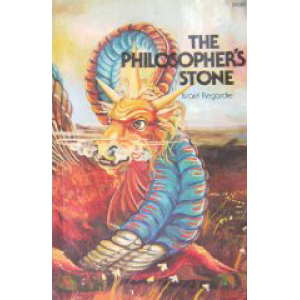
The Philosophers Stone

The Philosophers Stone Cover

Book: The Philosophers Stone by Israel Regardie

My book has been praised as a good meaningful book by some reviewers and by many readers, to judge from the mail I have received during the past thirty years. It is patently an open sesame to one level of interpretation. The Occult Review, now defunct, published a critical review by Archibald Cockren who took me rather severely to task for asserting that alchemical texts should be interpreted solely in terms of psychological and mystical terms. He himself, I subsequently discovered, had written a book Alchemy Rediscovered and Restored. Of course I immediately procured a copy. Since I was peeved by his review, I did not feel that his book had very much to offer—so I dismissed both offhand. I was about to write the editor of The Occult Review a scorching letter, but reason intervened so that fortunately it never got written.

The opportunity is rarely given to an author in his lifetime “to eat crow” and to enjoy it. This lot, it pleases me to say, is mine—after thirty years. Not that I would significantly change much of what I wrote then. I admitted that I had not “proceeded to the praxis” but I felt then and still do that a mystical and psychological interpretation of some alchemical texts was legitimate. There is unequivocally this aspect of the subject. Certainly Jacob Boehme and Henry Khunrath, for example, cannot be interpreted except in these terms.

The Philosophers Stone with these preliminary comments, should answer a wide-felt need which has called forth this new edition. I hope, being in print once more, it will bring new light and knowledge and values to present-day students who may be still groping in the dark areas of the occult towards alchemy, where a guiding hand needs to be extended.
So, to close this Introduction, I must use the ancient Rosicrucian greeting, and the close of a Golden Dawn ritual:
May what we have partaken here sustain us in our search for the Quintessence; the Stone of the Philosophers, True Wisdom and perfect Happiness, the Summum Bonum.


Download Israel Regardie's eBook: The Philosophers Stone

Free eBooks (Can Be Downloaded):

Yogi Ramacharaka - Yogi Philosophy
Louis Claude De Saint Martin - Theosophic Correspondence
Andrew Lang - The Witch And Other Stories
John Mitchell - The Philosophy Of Witchcraft
Israel Regardie - The Philosophers Stone

Tuesday, August 17, 2010

The Mysterious Pentagram

The Mysterious Pentagram Cover The Pentagram means different things to different people. Some may argue as to what it represents, but I will tell you the real meanings of it. The Pentagram right side up represents God ruling over the world of matter. The 5 points represent the 5 places that Christ was wounded. This is why Devils are afraid of it! It also represents the Microcosmic man with his arms stretched out.

Let us not forget that it also represents the elements Spirit, Water, Air, Earth, and Fire as shown below.
This is used by most people in Witchcraft.

Now there is also the upside-down Pentagram. It represents Satan or the world of matter ruling over God. It is the same as denouncing God. To wear it is to attract evil around you. It will not bring good spirits around you. Normally it is only worn by Satanists or devil worshipers. So if you wish to attract good spirits around you... wear it right side up!

Many mainstream religion believers think that they are both evil and represent the Devil. But that is because they are so... ignorant and blind to the fact that there is a difference. It shows their lack of study on the true facts of history. I wear the right side up Pentagram and I personally have had many people come up to me and ask me if I am a Devil worshiper! This really pisses me off! But I explain the reality to them.

Free eBooks (Can Be Downloaded):

Reynold Nicholson - The Mystics Of Islam
Greg Wotton - A Mystery Of The Pentalpha
Captain William Morgan - The Mysteries Of Freemasonry
Franz Cumont - The Mysteries Of Mithra

Friday, August 13, 2010

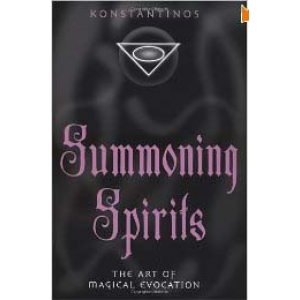
Summoning Spirits The Art Of Magical Evocation

Summoning Spirits The Art Of Magical Evocation Cover

Book: Summoning Spirits The Art Of Magical Evocation by Konstantinos

If you are interested in summoning up elementals,Planetary spirits, Angels and Goetic beings this is the book to get. Though I do a diffrent ceremony for goetic spirits. I do use the methods in this book for the other beings. The auther gives very good and solid information on the Elementals, Angels, Planetary spirits and Goetic beings. But dont be decieved sometimes evoking these beings are not very easy at all. Be prepared for successes as well as failures. This is a great book to get on the subject of evoking these forces. Now you can learn how to evoke and communicate with 50 spirit entities and make use of their abilities, when you get Summoning Spirits by Konstantinos.

Evoking spirits is one of the Most Powerful magical techniques you can use-but, until now, most of the material available on evocation has been virtually unusable because it was written by those with little practical evocation experience. Summoning Spirits was written by a practicing magician who has successfully performed many evocations. With his guidance and clear directions, performing evocations will be easy and safe for anyone.

- Learn to safely evoke powerful spirits to aid you with any task
- Create sigils charged with the energy of spirits to magnify the effects of your evocations
- Make an etheric egregore, a manufactured spirit that will perform the task of your choice
- Perform easy exercises to train your magical abilities and to develop clairvoyance and clairaudience
- Construct, prepare, and use special magical tools to aid your evocations

Summoning Spirits is a complete manual for evoking entities to effect positive changes in your life. Learn how the spirits that dwell on the other planes can be evoked to the astral and physical planes to help you obtain mystical abilities, locate hidden "treasure," and even command a spirit "army" to protect your home while you're away.

Summoning Spirits describes the specific attributes and abilities of 50 entities that you can evoke to uncover valuable knowledge, and who will help you succeed in nearly any task, magical or mundane.

Whether you need help to face life's challenges or to work a minor miracle, you will find the art of Magical Evocation a tremendously potent tool for change. Included are information and theory, as well as full instructions for all the rituals you will need to prepare for and then evoke spirits. No other book makes this ancient magical technique as easy to understand and use, as does this one. That's why you must get Summoning Spirits.

"Summoning Spirits" is the one of best books I have read so far in regards to the ancient and powerful art of magickal evocation. Although I have only just recently purchased this book, I have found it to be very informative, educational and interesting. As an individual aspiring to master this ancient magickal art, and science, I had found Konstantinos's advice and guidance quite beneficial about only working with benevolent spirits such as Angelic, Planetary and Elementary entities. However, I will be looking forward to summoning the Goetic entities as well, as I believe that a magician should have a 'magickal and spiritual balance' between both benevolent and malevolent entities, in addition to mastering them. All in all, a great book for a magician wishing to practice magickal evocation. In addition, I am especially looking forward to evoking the divine and beautiful Archangels and striving to unite and become 'one' with Divinity, which Konstantinos mentions is the 'true' defintion and purpose of magick. A truly magickal and spiritually inspiring book. I know that I will always enjoy and value keeping it as part of my personal magickal library to cherish, reflect upon, and treasure the ancient magickal wisdom and power within it.

Buy Konstantinos's book: Summoning Spirits The Art Of Magical Evocation

Free eBooks (Can Be Downloaded):

Jarl Fossum - Seth In The Magical Texts
Phil Hine - Aspects Of Evocation
John Dee - The Practice Of Enochian Evocation
Malcolm Mcgrath - Practical Magickal Evocation
Konstantinos - Summoning Spirits The Art Of Magical Evocation

Thursday, July 29, 2010

How And Why I Became A Witch

How And Why I Became A Witch Cover I created this lens to allow others to peek into the life of a typical American witch, what we do, what we are and basic beliefs. I certainly do not speak for other witches, their beliefs or opinions. We are all individuals just like anyone else. I am trying to explain (not defend) witchcraft, some facts about real witches, discuss "wanna-be witches," black and white magick, and more. I also feature recommended products, tools, music, links of interest and other information. To learn how to perform your own spells, whether you're a witch or not (it doesn't matter) visit this guide to spellcrafting for witches or non-witches.
I am a solitary witch. I am not Wiccan, per se. I have a few different beliefs but many are similar to Wicca. I really don't label myself into any particular denomination but the closest to any would be Traditional. It has taken me several years to truly believe I am most likely a Natural Witch. This doesn't make me bad or good, it just makes me who I am. This is who I was born to be.

Please feel free to question, comment or share your own stories in the comment section. Recommend your own witch, pagan or spiritual links there, too. I'd love to hear from you, witch or non-witch!

Books You Might Enjoy:

Michael Magee - Robin Hood And The Witches
Anton Szandor Lavey - The Satanic Rituals
Howard Phillips Lovecraft - Cults Of Cthulhu
Ann Moura - Green Witchcraft

Monday, July 26, 2010

Witch Hunting Panic And Torture

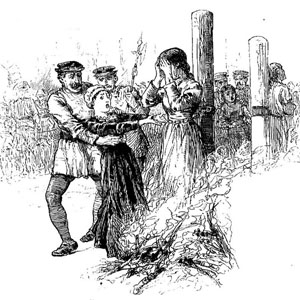
Witch Hunting Panic And Torture Cover Witch-hunting could be endemic or epidemic. Its dynamics varied. Small panics (fewer than 20 victims) tended to occur in villages worried about maleficium. Their victims were often poor, obnoxious persons whose removal the rest of the community applauded.

If small panics fed on long-smoldering fears about neighbors, large ones exploded without warning, killing people of all classes and conditions and rupturing social bonds. The worst examples of this were in Germany, where unlimited use of torture (in defiance of imperial law) produced an ever-expanding wave of denunciations. To object was to court death.

Large witch-panics started with the usual obscure suspects and worked up the social scale to prosperous citizens, reputable matrons, high-ranking clerics, town officials, and even judges. The longer a panic lasted, the higher was the proportion of male and wealthy victims.

According to the Dutch Jesuit Cornelius van Loos, confiscations from suspected witches in large panics could "coin gold and silver from human blood," Youngsters were legally old enough to burn as soon as they could distinguish "gold from an apple." Children as young as nine were burned in Wurzburg, including the bishop's nephew, and boys ages three and four were imprisoned as Satan's catamites.

Some of the German trials were marred by collusion, bribes, and rape. Unspeakable tortures were routine -- 17 different kinds were authorized by "the Saxon lawgiver," Benedikt Carpzov, during the 17th century. Confessing "without torture" in Germany meant without torture that drew blood. Nearly all who underwent this broke, even the blameless.

Yet witches sometimes did turn themselves in and confess spontaneously, the equivalent of today's "suicide by police." The same melancholy, frustration, and despair that they claimed had driven them into the devil's arms brought them willingly to the stake. They had apparently come to believe the wish-fulfillment fantasies of pleasure and revenge enacted in the theaters of their minds. Nevertheless, they still hoped to save their souls through pain.

A few brave men spoke up for justice. In 1563, Johann Weyer, a Protestant court physician, drew attention to the cruelty of the trials and the mental incompetence of many of the accused. English country gentleman Reginald Scot mocked witchcraft as popish nonsense in 1584. In 1631, the Jesuit Friedrich von Spec, confessor to witches burned at Mainz, proclaimed them innocent victims. Van Loos, witness to the horrors of witchcraft trials at Trier, had his manuscript confiscated in 1592 before it could be published and was himself imprisoned and banished.

Ironically, a Spanish inquisitor named Alonso Salazar y Frias mounted the most dramatic challenge to witch-hunting. In 1609, a panic among French Basques in the western Pyrenees on the Bay of Biscay spilled over into the Navarra region in Spain, where six accused witches went to the stake. But Salazar, who had been a judge in that trial, became skeptical as the panic widened to engulf 1,800 suspects, 1,500 of them children. Basque witches' confessions included such incredible details as familiars in the form of costumed toads that child-witches herded with little crooks during sabbats.

Salazar cross-checked testimony, had supposed magic substances tested, and applied logic to conclude that the alleged witches were simply an artifact of witch-hunting. "There were neither witches nor bewitched until they were talked and written about," he reported in 1610. With stubborn practice, Salazar wrested a decision from his superiors that freed the accused in 1614. The Spanish Inquisition never executed another witch; nor did it permit secular authorities to do so after an outbreak in Catalonia that saw more than 300 witches hanged between 1616 and 1619. What could have erupted into Europe's worst witch-panic was extinguished by one man.


Books You Might Enjoy:

Max Heindel - Teachings Of An Initiate
Richard Johnson - The Zodiac Stellar Stories
Stephen William Hawking - Space And Time Warps

Sunday, July 25, 2010

Witch Hunts And Persecution In America

Witch Hunts And Persecution In America Cover As most Americans know, witch hunts also affected the American colonies. The Salem witch trials pursued the Massachusetts Puritans have entered American consciousness as being much more then just the killing of witches. They, like the trials of Europe, have become a symbol. In our case, the witch trials have become a symbol of what can go wrong when mobs of ignorant people go crazy, especially when egged on by just as ignorant and/or power hungry leaders.

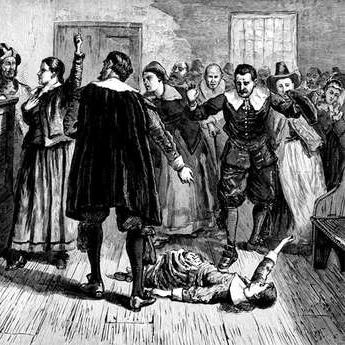
The Salem story began in 1692 when a few girls, who had become friendly with a slave woman named Tituba, began acting very strangely -- hysterical screaming, falling into convulsions, barking like dogs, etc. Soon other girls began acting in a similar manner and of course they all must have been possessed by demons. Three woman, including Tituba, were promptly accused of witchcraft. The result was much like the European experience, with a chain-reaction of confessions, denouncements, and more arrests.

In an effort to help combat the witch menace, courts relaxed traditional rules of evidence and procedure -- after all, witches are a terrible menace and must be stopped. In place of the normal rules and methods, the courts used what was common among Inquisitors in Europe -- scouring the womens' bodies for marks, numb spots, etc. Also accepted were "spectral sources" of evidence -- if someone had a vision of a woman being a witch, that was good enough for the judges.

The people who were mostly killed were not those who submitted quickly and obediently to authorities. Only those who were defiant or hostile were put to death. If you admitted being a witch and repented, you had a very good chance of living. If you denied being a witch and insisted that you had rights which must be acknowledged, you were on a quick path to execution. Your chances were also bad if you were a woman -- especially if you were an older, deviant, troublesome or somehow disorderly woman.

In the end, nineteen people were executed, two died in prison and one man was pressed to death under rocks. This is a better record than what we see in Europe, but that isn't saying very much. The religious and political authorities clearly used the witch trials to impose their own ideas of order and righteousness upon the local populace. As in Europe, violence was a tool used by religion and religious people to enforce uniformity and conformity in the face of dissent and social disorder.

Books You Might Enjoy:

Mira Ray - Minerals And Gems In Indian Alchemy
Anonymous - Protection Of Space
Gabor Klaniczay - Witchcraft Mythologies And Persecutions

Friday, July 23, 2010

Hubble Bubble Pardoned From Trouble

Hubble Bubble Pardoned From Trouble Cover It's Halloween and, consequently, one of my favorite days of the year. There are some things that have become inexorably linked to this holiday: candy, costumes, watching It's the Great Pumpkin Charlie Brown and, of course, witches.

Modern culture has really taken the witch in interesting places. From the evil Wicked Witch of the West in the original Wizard of Oz to the Not-Really-Wicked-But-Misunderstood Witch of the West Elphaba in the book and play Wicked, it is clear that witches can take on any number of personas. Today, witches can be good, bad, cutesy, goofy, and cunning. But not so long ago, the term "witch" was not taken so lightly.

Here at the Museum of Jewish Heritage, we often talk about scapegoating. If one looks at the history of the witch, this term comes to the fore pretty quickly. In Europe, between approximately 1480 and 1700, between 40,000 and 100,000 women and men were put to death on the charge of witchcraft. Accusations often arose as a result of an unexplained natural phenomenon--such as a failed crop or sick livestock-- or simply out of the malicious desire to seek revenge on another person.

Today, campaigners will petition Justice Secretary Jack Straw to posthumously pardon the 2,400 women and men wrongfully put to death for witchcraft in England and Scotland before the Witchcraft Act put an end to the practice in 1735. (Read full article here.) These campaigners follow the example of Swiss groups who successfully urged the government to pardon Anna Goeldi, the last woman in Europe on record to be put to death for witchcraft in 1782. While such pardons are, of course, entirely symbolic, I think this gesture is an important one. Not only does it officially clear the names of innocent victims, but makes a stand against scapegoating and lets everyone know that this injustice has no place in today's society.

Books You Might Enjoy:

John White - Toward Homo Noeticus
Ea Wallis Budge - Egyptian Ideas Of The Future Life
Aleister Crowley - Songs For Italy

Thursday, July 22, 2010

What Is A Kitchen Witch

What Is A Kitchen Witch Cover What is Kitchen Witchery?:

There's a growing movement within modern paganism known as kitchen witchery. The kitchen is, after all, the heart and hearth of many modern households. When you have a gathering in your home, where do most of your guests hang out? Why, the kitchen, of course! Also, thanks to a declining economy, many more people are making meals from scratch and the kitchen has once again become a place where people spend hours, rather than minutes. So it's no surprise that kitchen witchery has seen a rise in popularity.
Meal Prep as Magic:

When you take the time to put meals together from the basic ingredients, you have a magical opportunity at hand. You can infuse every dish with intent and will. A meal can stop being something you dump out of a can, and start being a ritual in and of itself. When you take time to prepare something with your own hands, that lends it sacredness, and will make you want to spend time savoring it with your family, rather than just snarfing it down on your way out the door to soccer practice. By changing the way you view food, its preparation and its consumption, you can craft some practical magic at its simplest level.

Books You Might Enjoy:

Tarostar - The Witchs Spellcraft Revised
Aj Drew - A Wiccan Bible
Michael Harrison - The Roots Of Witchcraft

The Witch Hunts Of Early Modern Europe

The Witch Hunts Of Early Modern Europe Cover For three centuries of early modern European history, diverse societies were consumed by a panic over alleged witches in their midst. Witch-hunts, especially in Central Europe, resulted in the trial, torture, and execution of tens of thousands of victims, about three-quarters of whom were women. Arguably, neither before nor since have adult European women been selectively targeted for such largescale atrocities.

The witch-hunts of early modern Europe took place against a backdrop of rapid social, economic, and religious transformation. As we will see in the modern-day case-studies below, such generalized stress -- including the prevalence of epidemics and natural disasters -- is nearly always central to outbreaks of mass hysteria of this type. Jenny Gibbons' analysis ties the witch-hunts to other "panics" in early modern Europe:

Traditional [tolerant] attitudes towards witchcraft began to change in the 14th century, at the very end of the Middle Ages. ... Early 14th century central Europe was seized by a series of rumor-panics. Some malign conspiracy (Jews and lepers, Moslems, or Jews and witches) was attempting to destroy the Christian kingdoms through magick and poison. After the terrible devastation caused by the Black Death [bubonic plague] (1347-1349), these rumors increased in intensity and focused primarily on witches and "plague-spreaders." Witchcraft cases increased slowly but steadily from the 14th-15th century. The first mass trials appeared in the 15th century. At the beginning of the 16th century, as the first shock-waves from the Reformation hit, the number of witch trials actually dropped. Then, around 1550, the persecution skyrocketed. What we think of as "the Burning Times" -- the crazes, panics, and mass hysteria -- largely occurred in one century, from 1550-1650. In the 17th century, the Great Hunt passed nearly as suddenly as it had arisen. Trials dropped sharply after 1650 and disappeared completely by the end of the 18th century. (Gibbons, "Recent Developments in the Study of the Great European Witch Hunt".)

Gibbons' allusion to the Reformation reminds us that the clash between institutional Catholicism and emergent Protestantism contributed to the collapse of a stable world-view, which eventually led to panic and hyper-suspiciousness on the part of Catholic and Protestant authorities alike. Writes Nachman Ben-Yehuda, "This helps us understand why only the most rapidly developing countries, where the Catholic church was weakest, experienced a virulent witch craze (i.e., Germany, France, Switzerland). Where the Catholic church was strong (Spain, Italy, Portugal) hardly any witch craze occurred ... the Reformation was definitely the first time that the church had to cope with a large-scale threat to its very existence and legitimacy." But Ben-Yehuda adds that "Protestants persecuted witches with almost the same zeal as the Catholics ... Protestants and Catholics alike felt threatened." It is notable that the witch-hunts lost most of their momentum with the end of the Thirty Years War (Peace of Westphalia, 1648), which "gave official recognition and legitimacy to religious pluralism." (Ben-Yehuda, "The European Witch Craze of the 14th to 17th Centuries: A Sociologist's Perspective," American Journal of Sociology, 86: 1 [July 1980], pp. 15, 23.)

Books You Might Enjoy:

John Moore - A Modern Master Extract
Will Herberg - The Writings Of Martin Buber
Nathan Johnston - The Devil And Demonism In Early Modern England
Margaret Alice Murray - The Witch Cult In Western Europe
Diane Purkiss - The Witch In History Early Modern And Twentieth Century Representations

Wednesday, July 21, 2010

The Witch Hunter Baedeker

The Witch Hunter Baedeker Cover Meanwhile, witch-hunters' manuals multiplied, most notably the infamous Malleus Maleficarum (Hammer of Witches), published in 1486. Its authors, Jacob Sprenger and Heinrich Kraemer, were experienced Dominican inquisitors who had burned 48 witches in one diocese alone and had obtained a papal bull approving their mission. Reversing the old principle of the Canon Episcopi, Sprenger and Kraemer proclaimed that not believing in the reality of witches was heresy. Witches regularly did physical as well as spiritual harm to others, they wrote, and allegiance to the devil defined witchcraft. Sprenger and Kraemer exhorted secular authorities to fight witches by any means necessary.

Malleus Maleficarum (notice the feminine possessive of "witches") was a vicious misogynist tract. It depicted women as the sexual playmates of Satan, declaring: "All witchcraft comes from carnal lust, which is in women insatiable." Ironically, Sprenger also had a deep devotion to Mary. He helped to shape the modern rosary and founded the first rosary confraternity.

Malleus Maleficarum did not cover its ground completely, failing to discuss the actual pact that witches made with the devil, the sabbat, familiars (imps in animal form who aided witches), and night-flying. But those elements did not always appear in witchcraft cases. By itself, the Malleus started no new witch-panics, but it was freely used by later witchcraft writers, Protestant and Catholic alike. The Spanish inquisitors were nearly alone in scoffing at its lack of sophistication.

The demonologists who absorbed the Malleus were highly cultured men, such as the Protestant Jean Bodin, "the Aristotle of the 16th century," and his contemporary, the Jesuit classicist Martin del Rio. Those theoreticians pounded home the principle of the crimen exceptum: Because witchcraft was so vile an offense, accused witches had no legal rights. "Not one witch in a million would be accused or punished," Bodin boasted, "if the procedure were governed by ordinary rules." Anyone who defended accused witches or denied their crimes deserved the same punishment as witches, Bodin wrote.

Socially elite persecutors, demonologists, and judges relentlessly hunted witches with the zeal of modern revolutionaries pursuing a political utopia. No cost was too great, because witch-hunting served the greater good of Christendom, in their view. They believed that witchcraft inverted society's key values, disturbed godly order, challenged the divine right of kings -- the ancient doctrine that rulers derive their right to rule from God -- and diminished the majesty of God. It was thought that witch-hunting saved souls and averted the wrath of God by purging society of evil as the End Times loomed.

Commoners, by contrast, simply wanted relief from the evildoers of folklore who, they believed, were harming them, their children, their cattle, and their crops. It was grassroots complaints that started most witch-hunts. If authorities were too slow to act, peasants were capable of lynching suspected neighbors.

Although maleficium -- physical harm -- loomed much larger than diabolism in common people's accusations against suspected witches, their folk beliefs cross-fertilized the learned ones of Bodin and others in complex ways. Through sermons, gossip, trial accounts, and luridly illustrated "witch-books" (especially popular in Germany), everyone learned what witches did and how to detect them.


Books You Might Enjoy:

Aleister Crowley - The Sixth Chakra Of The Human Body
Louise Huebner - Witchcraft For All
Aleister Crowley - The Winged Beetle
Tarostar - The Witchs Spellcraft Revised
Margaret Alice Murray - The Witch Cult In Western Europe

Sunday, July 18, 2010

Male Witches

Male Witches Cover Robin Briggs calculates that 20 to 25 percent of Europeans executed for witchcraft between the 14th and 17th centuries were male. Regional variations are again notable. France was "a fascinating exception to the wider pattern, for over much of the country witchcraft seems to have had no obvious link with gender at all. Of nearly 1,300 witches whose cases went to the parlement of Paris on appeal, just over half were men. ... The great majority of the men accused were poor peasants and artisans, a fairly representative sample of the ordinary population." Briggs adds:

There are some extreme cases in peripheral regions of Europe, with men accounting for 90 percent of the accused in Iceland, 60 percent in Estonia and nearly 50 per cent in Finland. On the other hand, there are regions where 90 per cent or more of known witches were women; these include Hungary, Denmark and England. The fact that many recent writers on the subject have relied on English and north American evidence has probably encouraged an error of perspective here, with the overwhelming predominance of female suspects in these areas (also characterized by low rates of persecution) being assumed to be typical. Nor is it the case that the courts treated male suspects more favourably; the conviction rates are usually much the same for both sexes. (Briggs, Witches & Neighbours: The Social and Cultural Context of European Witchcraft, pp. 260-61.)

Books You Might Enjoy:

Aleister Crowley - White Stains
Carl Mccolman - The Well Read Witch
Margaret Alice Murray - God Of The Whitches
Aristotle - On The Soul
Marian Green - A Witch Alone

Saturday, July 17, 2010

How To Make A Witchs Ladder

How To Make A Witchs Ladder Cover A witch's ladder is one of those nifty things we sometimes hear about but rarely see. Its purpose is similar to that of a rosary - it's basically a tool for meditation and ritual, in which different colors are used as symbols for one's intent. It's also used as a counting tool, because in some spell workings there is a need to repeat the working a particular number of times. You can use the ladder to keep track of your count, running the feathers or beads along as you do so. Traditionally, the witch's ladder is made with red, white and black yarn, and then nine different colored feathers woven in.

Here's How:

1. Realistically speaking, it makes more sense to use yarn colors that have a significance to you and your working. Also, finding nine differently colored feathers can be tricky if you're looking for them out in the wild -- you can't just go plucking feathers from local endangered species -- and that means a trip to the craft store and some oddly tinted feathers. I'd recommend using either found feathers of any color, or something else entirely -- beads, buttons (see our discussion on the magical uses of buttons), bits of wood, shells, or other items you have around your home.

2. To make your basic witch's ladder, you'll need:
* Yarn or cord in three different colors
* Nine items that are similar in property but in different colors (nine beads, nine shells, nine buttons, etc)

Cut the yarn so that you have three different pieces in a workable length - usually a yard or so is good. Although you can use the traditional red, white and black, there's no hard and fast rule that says you must. Tie the ends of the three pieces of yarn together in a knot.

3. Begin braiding the yarn together, tying the feathers or beads into the yarn, and securing each in place with a sturdy knot. Some people like to chant or count as they braid and add the feathers. If you wish, you can say something like this variation on the traditional chant:

By knot of one, the spell's begun.
By knot of two, the magic comes true.
By knot of three, so it shall be.
By knot of four, this power is stored.
By knot of five, my will shall drive.
By knot of six, the spell I fix.
By knot of seven, the future I leaven.
By knot of eight, my will be fate.
By knot of nine, what is done is mine.

4. As the feathers are tied into knots, focus your intent and goal. As you tie the final and ninth knot, all your energy should be directed into the cords, the knots and the feathers. The energy is literally stored within the knots of the witch's ladder. When you've completed the string and added all nine feathers or beads, you can either knot the end and hang the ladder up, or you can tie the two ends together forming a circle.

If you'd like your ladder to be more like a rosary string, I'd highly recommend picking up a copy of pagan Prayer Beads by John Michael Greer and Clare Vaughn.

What You Need:

* Yarn or cord in three different colors
* 9 Feathers or other items to braid into your ladder

Books You Might Enjoy:

June Johns - King Of The Witches The World Of Alex Sanders
Heinrich Kramer - The Malleus Maleficarum Or The Witch Hammer
Tarostar - The Witchs Spellcraft Revised
Paul Huson - Mastering Witchcraft
Marian Green - A Witch Alone

Popular Posts