Showing posts with label cool magic. Show all posts

Thursday, October 21, 2010

Comselha An Enochian Macrocosmic Ritual

Comselha An Enochian Macrocosmic Ritual Cover

Book: Comselha An Enochian Macrocosmic Ritual by Benjamin Rowe
The purpose of this ritual exercise is to invoke the transcendental power of the Enochian god, to transform it in turn through all the macrocosmic powers within the Elemental Tablets, and to organize them into a balanced form. At the same time, these powers are conditioned so that they express a particular view of the creation of which they are a part. As the final step, these energies are directed so that they energize the magician himself.

The magickal records covering the results of the first use of this exercise are available separately.

I have received several complaints about my published rituals recently. Some complain that they are too elaborate, others that they are too simple, and some question whether they really qualify as magickal rituals in the traditional sense.

The complaints of over-elaborateness stem from the fact that it is impossible to perform any significant part of the works in a single session. This is perfectly correct, and is done deliberately. My experience has been that the rewards given to the magician by the "angels" of the Enochian system are very precisely gauged to the amount of care and effort the magician puts into the work. Works that are planned, rehearsed, and carried out over a period of weeks or months are much more likely to produce significant initiations than any number of single-session efforts. The present work was designed to be performed in stages, with the expectation that each stage will be performed until the powers invoked achieve a self-sustaining presence in the magician’s temple before he passes on to the next stage. It can be expected that the rewards will be commensurate with the effort involved.

Complaints of excessive simplicity derive from lack of the pompous verbiage typically found in formal rituals, and the dearth of advice concerning symbols, implements, and materiel that would help to fire the imagination of the magician. There is a decidedly bare-bones feel to the descriptions. This is perhaps an expression of my own character as a magician; I find that complex pomp and ceremony put me off rather than enhancing the work. I have complete faith that every magician’s imagination and intuition will provide him with enhancements appropriate to his or her own character and style, and so see no need to provide more than the minimum schema necessary to accomplish the work successfully.

The differences between these rituals and more traditional forms derives from the nature of Enochian magick. In most systems, the primary difficulty is in producing a flow of the desired power. The major portions of the rituals are dedicated to simply getting the power to appear. Once it does appear, its direction to the desired end is a relatively simple matter.

In contrast, the Angelic Calls and Names provide a means by which even a beginning magician can easily call up a strong flow of force. But the forces involved are much more ambiguous than in other systems. Each appears to have many different natures depending on the level and orientation from which they are viewed; their manifestations seem to be potentially infinite. The primary work of a ritual must accordingly be to focus, direct, and condition them, through the use of the imagination, so that they manifest in a clear and manageable way. This work conforms to that necessity.

Additionally, the specific form used makes this work something resembling an inverse path-working exercise, going top-down rather than bottom-upwards. And as Frater Azoth has pointed out, there are resemblances to the mandala-workings and chakra-visualizations used in Tibetan Buddhism. They are certainly very similar in intent, though the similarity of form was unintentional.

Download Benjamin Rowe's eBook: Comselha An Enochian Macrocosmic Ritual

Books in PDF format to read:

Josh Norton - Charging An Enochian Tablet
Benjamin Rowe - Comselha An Enochian Macrocosmic Ritual
Wicca For Beginners Fundamentals Of Philosophy And Practice

Wicca For Beginners Fundamentals Of Philosophy And Practice Cover

Book: Wicca For Beginners Fundamentals Of Philosophy And Practice by Thea Sabin

In her first book-length work, Sabin presents a first-rate, fresh and thorough addition to the burgeoning field of earth-based Spiritual Practice volumes. Sometimes using examples that young people can relate to (SATs, dying grandmothers), she opens the door to this path for people of all ages who want concrete beginnings to "work actively and spiritually to develop as a person." Sabin covers well the familiar territory of the calendar, circle, pentagram, tools, etc., but she shines distinctively in several areas. The first is in Wiccan history, written in a light, informative style that magically mines depth, breadth and brevity. Another is in the emphasis on personal will and ethical practices that transcend reliance on external paraphernalia. She also deftly shows how the various tools and spells can be put into use, but always encourages practitioners to utilize their own experiences, environment and spiritual intelligence to shape their practice. Especially helpful are the criteria to assess groups and potential teachers, and the volume is capped by a fine bibliography. Sabin advocates consistent study, practice and evolved learning. Gently admonishing her reader not to become a "one-book wonder," Sabin has nearly voided her own advice with this important first effort that is perfect for novice Wiccans.

As a teacher of Wicca for many years, I'm always looking for better materials to use for training. I am grateful to Ms. Sabin for providing what will undoubtedly be the introductory book I will recommend for the foreseeable future. She presents the basics without pushing any given path or tradition, often presenting varying Interpretations and viewpoints in a non-judgemental manner. This is a solid foundation for seekers to use as a springboard to whatever flavor of Wicca they choose to explore. I appreciate that she addresses ethics within Wicca, which many authors seem to avoid, or present in a highly simplistic manner. The book is clearly meant for beginners, hence the title, and is possibly the best overall introduction I have yet seen.

I bought this book to learn more about the Wiccan Religion as my girlfriend is wiccan and I had no prior (correct) knowledge of the religion. This book offers an excellent intro to the history, philosophy and basic practices of the religion as the title suggest. Its also doesn't read like a textbook so its fun and to read. In general I would reccomend this book to anyone just starting out who wants to learn more about the religion.

Buy Thea Sabin's book: Wicca For Beginners Fundamentals Of Philosophy And Practice

Free eBooks (Can Be Downloaded):

Henry Cornelius Agrippa - Occult Philosophy And Magick Book I
Johannes Kepler - Concerning The More Certain Fundamentals Of Astrology
Anonymous - Wicca Beliefs And Practices

Sunday, October 3, 2010

The Great Rite Invocation

The Great Rite Invocation Cover Assist me to erect the ancient altar
At which in days past all worshipped
The great altar of all things
For in times of old, woman was the altar
Thus was the altar made and placed
And the sacred place was the point within the center of the circle
As we have of old been taught
That the point within the center is the origin of all things
Therefore should we adore it
Therefore whom we adore we also invoke
O circle of stars

Whereof our Father is but the younger brother
Marvel beyond imagination, soul of infinite space
Before whom time is ashamed
The mind bewildered, and the understanding dark
Not unto thee may we attain unless thine image be love
Therefore by seed and root, and stem and bud
And leaf and flower and fruit, do we invoke thee
O Queen of Space, O Jewel of Light
Continuous One of the Heavens

Let it be ever thus
That man speak not of thee as One, but as None
And let them not speak of thee at all
Since thou art continuous
For thou art the point within the Circle, which we adore
The point of life without which we would not be
And in this way truly are erected the holy pillars
In beauty and in strength were they erected
To the wonder and glory of all men

Altar of mysteries manifold, the sacred circle’s secret point
Thus do I sign thee as old, with kisses of my lips anoint
Open for me the secret way, the pathway of intelligence
Beyond the gates of night and day, beyond the bounds of time and sense
Beyond the mysteries aright, the five true points of fellowship
Here where the Lance and Grail unite
And feet, and knees, and breast, and lip

Stewart and Janet Farrar – 1984.

Free eBooks (Can Be Downloaded):

Aleister Crowley - Invocation
Friedrich Adler - The Witchcraft Trial In Moscow
Michael Sharp - The Great Awakening
Aleister Crowley - The Supreme Ritual The Invocation Of Horus
John Dee - The Practice Of Enochian Evocation

Saturday, October 2, 2010

Sefer Ha Zohar Idra Zuta Qadusha Lesser Holy Assembly

Sefer Ha Zohar Idra Zuta Qadusha Lesser Holy Assembly Cover

Book: Sefer Ha Zohar Idra Zuta Qadusha Lesser Holy Assembly by Rabbi Shimon Bar Yochai

Idra Zuta Qadusha (Lesser Holy Assembly), or simply Idra Zuta - the next layer of the core of the five-volume mystical exegesis Sefer HaZohar.

The Sefer HaZohar (Book of Splendor, often referred to simply as "the Zohar") is a five-volume mystical exegesis written in Rashi Aramaic on the five books of the Torah. Like the Sefer Yetzirah, the date and original author of the Zohar are subjects for academic debate. Many qabalistic scholars, such as Gershom Scholem, believe the Zohar to be a new work produced by Moses De Leon, circa 1250 CE in Spain.Scholem, Gershom. Kabbalah, Keter Publishing, Jerusalem, 1974. Others believe that it was dictated by its pivotal figure Rabbi Shimeon Ben Yochai to his son Rabbi Abba in the first century CE, while they and their group of rabbis hid in caves for thirteen years in Piquin, Israel to avoid Roman persecution. Hence, there are also those who would take the intermediary position that De Leon redacted and published a work that had a much earlier time of origin.

The Sefer HaZohar is central to Kabbala that has influenced all mystical movements within Judaism. Many Kabbalists invest it with a sanctity normally accorded only to the Torah and the Talmud. Written mostly in Aramaic, it is believed to be mainly the work of Moses de Leon. The main part of the Zohar provides a mystical and symbolic interpretation of biblical texts, especially the Torah, the book of Ruth, and the Song of Solomon. Other sections deal with the mystery of creation, the problem of evil, and the cosmic significance of prayer and good deeds.

The text of the Zohar is presented as a series of dialogues among a group of rabbis. These rabbis were the embodiments of the various Sefiroth (spheres) on the Tree of Life (see Diagram). Hence, the "flavor" of the respective Sefirah (sphere) colors each rabbi's remarks and questions. Like the Sefer Yetzirah, the Zohar has its own distinct set of names for the Sefiroth, most of which come from the Sefer HaShmoth, and are later echoed in the Torah and Ketuvim (Writings). Those names may be described as various qualities of the Divine, such as Wisdom, Beauty, Glory, and Mercy. The Zoharic names for the Sefiroth are the most commonly known and used among all types of Qabalists.

The body of the five volumes of the Zohar emanates from a core of three extraordinary texts. The innermost layer and heart of the Zohar is a small text called the Sifra Detzniyutha (Book of THAT Which is Concealed). This book contains the single greatest exposition on the negatively existent Mysterious Unknown (called Ayn, and also "The NOT") among all written works of the Mystical Qabalah. The next layer of the core of the Zohar is a text called Idra Rabba Qadusha (Greater Holy Assembly), or simply Idra Rabba; and the third layer of the core is called Idra Zuta Qadusha (Lesser Holy Assembly), or simply Idra Zuta. The Idra Rabba and Idra Zuta expand greatly upon the anthropomorphic allusions introduced in the Sifra Detzniyutha. The "Greater Holy Assembly" is the entire Tree of ten Sefiroth. The "Lesser Holy Assembly" is the upper seven Sefiroth only.

Download Rabbi Shimon Bar Yochai's eBook: Sefer Ha Zohar Idra Zuta Qadusha Lesser Holy Assembly

Free eBooks (Can Be Downloaded):

Solomonic Grimoires - Lemegeton I The Lesser Key Of Solomon Goetia
Aleister Crowley - Liber 017 Fake Liber Iao Or The Book Of Holy Kisses
Rabbi Shimon Bar Yochai - Sefer Ha Zohar Sifra Detzniyutha Book Of That Which Is Concealed
Rabbi Shimon Bar Yochai - Sefer Ha Zohar Idra Rabba Qadusha Greater Holy Assembly
Rabbi Shimon Bar Yochai - Sefer Ha Zohar Idra Zuta Qadusha Lesser Holy Assembly

Thursday, September 30, 2010

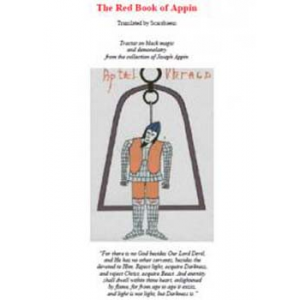
The Red Book Of Appin

The Red Book Of Appin Cover

Book: The Red Book Of Appin by Medieval Grimoires

Translated by Scarabaeus, but the date of the original manuscript is unknown. The Grimoire, primarily a dark Grimoire, is in two parts. The first part concerns the requirements to become an adept who follows a wizard (evil spirit) who initiates the adept into the secrets of the book. The second part of the book introduces Superior Demons and evil spirits together with their seals and invocations.

“Some say that The Red Book had been dictated by Vlad Tepes himself to some monk Kirill. If it is so or not, we cannot say, but the devil-worshipping of the great romanian general is an unquestionable fact, which no serious black adept can deny. It is well known that this document, enwrapped in blood-red leather of some unknown creature (according to rumors , that was one of lower demons, invoked by Vlad specially for this purpose), was kept by the english merchant Joseph Appin (from this comes the title of the book), who died in 1689 and bequeathed to bury it together with him.

Having accomplished their father`s behest, two of his sons afterwards digged his grave out in order to get the access to the source of terrible transcendent knowledge, but found no book there. It is possible that the book had been stolen by some offspiring of Vlad, and since then it was imparted from father to son until the year 1869, when it got into the hands of the Hungarian secret community , which afterwards turned to one of branches of the Great Black Lodge under the abbreviation A.C.C. The copy had been imparted to the Pontiphic of the Lodge Johan Kellenheim in 1901 and translated to polish and German.

The further destinity of the original is unknown. It`s written in the purest version of the enochian language, in comparison with which the language of John Dee is just a pitiable senseless murmuring, and not with enochian symbols but with latin letters, which confirms the version of writing it by the monk, unfamiliar with the Heavenly Language.” If you play with these rituals, you will get burned severely. Before attempting any form of magick, know the theory. Information is Power, please handle it with care.

Download Medieval Grimoires's eBook: The Red Book Of Appin

Free eBooks (Can Be Downloaded):

Aleister Crowley - The Book Of Lies
Ralph Blum - The New Book Of Runes
Anonymous - The Secret Book Of Artephius
Michael Ford - The Book Of Cain
Medieval Grimoires - The Red Book Of Appin

The Devil Notebook

The Devil Notebook Cover

Book: The Devil Notebook by Anton Szandor Lavey

Anton Szandor LaVey was a man full of biting wit, iconoclastic insight and, above all, a most astute and adroit observer of human folly and misinterpretation, himself being subjected to the latter more than anyone in recent memory.

In this book, published after two decades of inactivity (to the world of print), LaVey sheds light on many interesting topics, bringing his usual dose of sardonic humor to the printed page.

A particular essay comes to mind when I think of this book- it's called "Hatha Toilet Seat Meditaion," and if it doesn't solicit laughter from you, nothing will. For those of you who are familiar with it, I'm certain you're grinning right now. For those who aren't, read the book and find out why.

Other essays focus on some pretty forbiding topics, and the level of candor expressed by LaVey never lets us forget that while the media may have portrayed him as several things- none of which were especially flattering- we will continue to respect him for the insight he shared with us, remembering the first time we read the "Satanic Bible," a book that for many of us described the thoughts we'd always thought, but never knew anyone else did.

In general The Devil Notebook is very useful and practical black magic book that does explain (with some deals hidden) the ways of satanic practices. The author knows the material, and its well laid out with clear - but as I say some missing - instructions. However, the book does deliver much material. I read an interesting but rare satanic gem called the Question of Lucifer, about how far Lucifer has penetrated into the upper ranks of power and elite. It was fascinating, and very, very scary, depending on if you are on the White or black magic side. That book unknowingly exposed some satanic secrets and left a lot open for us to see, more than the author expected - if you are willing to read it. Be warned!

Download Anton Szandor Lavey's eBook: The Devil Notebook

Free eBooks (Can Be Downloaded):

Mark Mirabello - The Odin Brotherhood
Rabbi Michael Laitman - The Open Book
Anton Szandor Lavey - The Devil Notebook

The Sacred Magic Of Abramelin The Mage Book 3

The Sacred Magic Of Abramelin The Mage Book 3 Cover

Book: The Sacred Magic Of Abramelin The Mage Book 3 by Abramelin The Mage

Volume III of The Book of the Sacred Magic of Abramelin the Mage.

The Book of Abramelin tells the story of an Egyptian mage named Abramelin, or Abra-Melin, who taught a system of magic to Abraham of Worms, a German Jew presumed to have lived from c.1362 - c.1458. The system of magic from this book regained popularity in the 19th and 20th centuries due to the efforts of Mathers' translation, The Book of the Sacred Magic of Abramelin the Mage, its import within the Hermetic Order of the Golden Dawn, and later within the mystical system of Thelema (created in 1904 by Aleister Crowley).

Unfortunately, Mathers used the least-reliable manuscript copy as the basis for his translation, and it contains many errors and omissions. The later English translation by Georg Dehn and Steven Guth, based on the earliest and most complete sources, is more scholarly and comprehensive. Dehn attributed authorship of The Book of Abramelin to Rabbi Yaakov Moelin (Hebrew ca. 1365–1427), a German Jewish Talmudist.

Structure of the book

The grimoire is framed as a sort of epistolary novel or autobiography in which Abraham of Worms describes his journey from Germany to Egypt and reveals Abramelin's magical and Kabbalistic secrets to his son Lamech. Internally the text dates itself to the year 1458.

The story involves Abraham of Worms passing his magical and Kabbalistic secrets on to his son, and tells how he acquired his knowledge. Abraham recounts how he found Abramelin The Mage living in the desert outside an Egyptian town, Arachi or Araki, which borders the Nile. Abramelin's home sat atop a small hill surrounded by trees. He was an Egyptian mage and taught a powerful form of Kabbalistic magic to Abraham. He was a "venerable aged man", and very courteous and kind. He discussed nothing but "the Fear of God", leading a well-regulated life, and the evils of the "acquisition of riches and goods."

Abramelin extracted a promise from Abraham that he would give up his "false dogmas" and live "in the Way and Law of the Lord." He then gave Abraham two manuscript books to copy for himself, asking for ten gold florins, which he took with the intention of distributing to seventy-two poor persons in Arachi. Upon his return fifteen days later, after having disposed of the payment money, Abramelin extracted an oath from Abraham to "serve and fear" the Lord, and to "live and die in His most Holy Law." After this, Abramelin gave Abraham the "Divine Science" and "True Magic" embedded within the two manuscripts, which he was to follow and give to only those whom he knew well.

Origin of the manuscript

The book exists in the form of six manuscripts and an early printed edition. The provenance of the text has not been definitively identified. The earliest manuscripts are two versions that date from about 1608, are written in German and are now found in Wolfenbuttel Another two manuscripts are in Dresden, and date from about 1700 and 1750 respectively.

The first printed version, also in German, dates to 1725 and was printed in Cologne by Peter Hammer. A partial copy in Hebrew is found in the Bodleian Library in Oxford, and dates from around 1740. A manuscript copy existed in French in the Bibliotheque de l'Arsenal in Paris, an institution founded in 1797. The French copy has since disappeared, but is available on microfilm.

All German copies of the text consist of four books: an autobiographical account of the travels of Abraham of Worms to Egypt, a book of assorted materials from the corpus of the practical Kabbalah (including some which is duplicated in the German-Jewish grimoire called "The Sixth and 7th Books of Moses") and the two books of magic given by Abramelin to Abraham. The well-known English translation by S.L. MacGregor Mathers from the French Manuscript in Paris contains only three of the four books. The Hebrew version in Oxford is limited to Book One, without reference to the further books.

Of all the extant sources, the German manuscripts in Wolfenbuttel and Dresden are taken by scholars to be the authoritative texts. According to respected Kabbalah scholar Gershom Scholem, the Hebrew version in Oxford was translated into Hebrew from German. An analysis of the spelling and language usage in the French manuscript indicates that it dates to the 18th century, and that it was also likely copied from a German original. Although the author quotes from the Jewish Book of Psalms, the version given is not from the Hebrew; rather, it is from the Latin Vulgate, a translation of the Bible employed by Roman Catholics at that time.

The German esoteric scholar Georg Dehn has argued that the author of The Book of Abramelin was Rabbi Yaakov Moelin (Hebrew 1365–1427), a German Jewish Talmudist and posek (authority on Jewish law). (ref Georg Dehn, The Book of Abramelin: A New Translation, transl. by Steven Guth, Ibis Publishing, 2006)

Magic word squares

The practical magic of Abramelin (found in both Book III of the French text, and Book IV of the German original) centers around a set of talismans composed of magic word squares. These are similar to traditional magic squares, though the latter are usually composed of numbers, while Abramelin's squares contain letters. Commonly word squares are used as puzzles or as teaching aids for students. In the context of Abramelin, the focus becomes mystical—so that each square should contain words or names that relate to the magical goal of the square. A parallel is found in the famous Sator Arepo Tenet Opera Rotas word square, an altered version of which is also found among Abramelin's squares.

For example, a square entitled "To walk under water for as long as you want" contains the word MAIAM, the Hebrew and Arabic word for "water". A square for recovering treasures of jewelry begins with the word TIPHARAH (a variant of Tiferet), which can mean "golden ring" in Hebrew and is also the name of the sphere of "Beauty" on the Kabbalistic Tree of Life.

Download Abramelin The Mage's eBook: The Sacred Magic Of Abramelin The Mage Book 3

Free eBooks (Can Be Downloaded):

Aleister Crowley - The Sixth Chakra Of The Human Body
Manly Palmer Hall - The Secret Teachings Of All Ages
Solomonic Grimoires - The Magic Of Armadel
Abramelin The Mage - The Sacred Magic Of Abramelin The Mage Book 2
Abramelin The Mage - The Sacred Magic Of Abramelin The Mage Book 3

Wednesday, September 29, 2010

Astronomical Geomancy

Astronomical Geomancy Cover

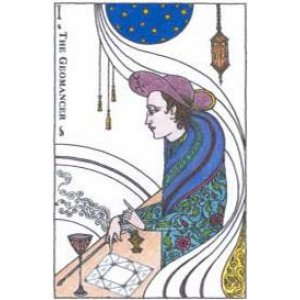
Book: Astronomical Geomancy by Gerald Cremonensis

Astrological geomancy is an ancient method of divination. The word geomancy means earth divination and is believed to have come from the use of sand to generate the geomantic figures, the basis of prediction in geomancy. This also accounts for its Arabic name, ilm al-raml, literally the science or wisdom of the sand.

In the modern era the ancient art of divinatory geomancy has been confused with Chinese feng shui which is not a method of divination, but a science of spatial arrangement, architecture and landscaping. Divinatory geomancy has also had its name appropriated by the modern New Age study of ley lines and earth "energies" which are also not techniques of divination.
Contemporary practitioners of the traditional Western art of geomancy have taken to referring to it as divinatory or astrological geomancy to differentiate it from these more modern uses of the term. Astrological geomancy is a particularly appropriate term as much of the divinatory methodology used in geomancy comes from traditional astrology.

The origins of geomancy are shrouded in mystery, but the first manuscripts describing the practice appear in the 9th century AD in the advanced Islamic civilization of the Middle East. From there it spread to Europe in the 11th and 12th centuries as part of the reception of many arts and sciences, including the occult arts of astrology, alchemy and magic by the rapidly civilizing West. Known in Arabic as ilm al-raml, literally the science or wisdom of the sand, geomancy became quite popular as a divinatory technique because of its ease of learning and use. Here is an interesting article in pdf form by the Dutch academic Wim van Binsbergen on the Astrological Origin of Islamic Geomancy. Because of its close connection to astrology, geomancy has been called "the Daughter of Astrology" and known as terrestial astrology.

Download Gerald Cremonensis's eBook: Astronomical Geomancy

Free eBooks (Can Be Downloaded):

Anonymous - Gerald Cremonensis On Astrological Geomancy
Henry Cornelius Agrippa - Of Geomancy
Nick Farrell - Notes On Geomancy
Gerald Cremonensis - Astronomical Geomancy

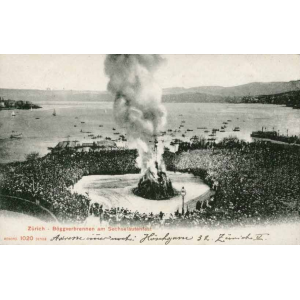
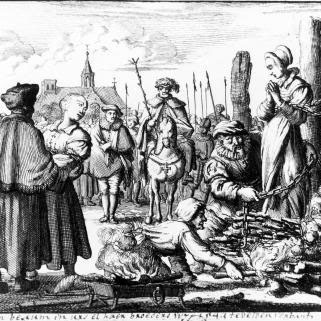
Historical Summary Of The European Witch Hunts

Historical  Summary Of The European Witch Hunts Cover The European witch Craze started roughly during conclusion of the 15th century and peaked during the first half of the seventeenth century. The belief that women were sinful and had the power of the devil within them developed out of the Middle Ages. The Reformation further promoted the idea of a satanic kingdom of evil on earth with which to justify persecutions. Theologians sought to prove that accused witches represented the devil.

The first and most significant written cumulative concept of witchcraft available to a large audience was the Malleus Maleficarum written by Sprenger and Kraemer. It was first published in 1486 and reprinted fourteen times before 1520. The document made an important contribution to the widespread witch hunt. Most people accused of witchcraft were rural, poor, and single women. The hunts are often seen as a massive effort to keep women in their place. Women were seen as evil, and unclean people whose weakness could summon the devil for sexual intercourse.

The Malleus Maleficarum document ignited a widespread hunt for the so-called witches described in it. During the hunt, witches were accused of "impractical" and "traceless" crimes such as intercourse with the devil, unregistered babies from hidden pregnancies who were supposedly eaten or sacrificed, and even natural disasters. However there is no record of any solid evidence for any of these accused crimes.

Often these hunts were instigated by hysterical children, or nuns who accused relatives, and neighbors of these outrageous crimes. Witnesses were often bribed or threatened in order to prosecute the accused. The accused would then be tortured until they confessed. The methods of torture were very cruel and painful, and almost all who were put through the various devices would confess. In some cases the accused would die of torture, and very few survived the ordeal without confessing. However, the accused was set free if they survived the torture without a confession. After the forced confession, the trial took place. These trials were run by genuine believers of witchcraft. The aim of the trial was to exterminate the witches as conspirators with the devil. When the accused was declared guilty, they were usually executed.

Although, there are many estimates as to how many actual people were killed during these hunts, most estimates show the number well below the one-million mark. The actual number of documented executions, is generally considered to be under one hundred thousand. Of all that were executed, only a minority were men, and of those men, many are those who tried to protect accused women from the hunters.

Free eBooks (Can Be Downloaded):

Sharynne Nicmacha - The Star Of Life A Historical And Spiritual History Of The Pentagram
Martin Van Buren Perley - A Short History Of The Salem Village Witchcraft Trials
Tuesday Lobsang Rampa - Wisdom Of The Ancients
Michael Bailey - Historical Dictionary Of Witchcraft
Charles Kirkpatrick Sharpe - A Historical Account Of The Belief In Witchcraft In Scotland

Tuesday, September 28, 2010

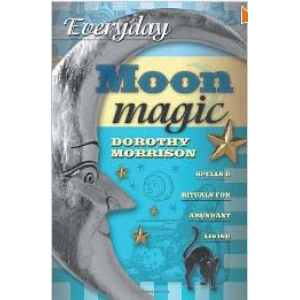
Everyday Moon Magic Spells And Rituals For Abundant Living

Everyday Moon Magic Spells And Rituals For Abundant Living Cover

Book: Everyday Moon Magic Spells And Rituals For Abundant Living by Dorothy Morrison

I've read a couple other Moon books, but this one is by far the best. Why? Because Ms. Morrison (much like another of my favorite authors, Patricia Telesco) has a certain and very special way of making things simple, accessable and right to the point without talking down to the reader, getting lost in Craft mumbo-jumbo or making things harder than they really need to be as I've seen so many times by other authors. There are no lectures, power trips or mind-numbing lists of hard-to-find ingredients here; no lofty words or flowery rituals. In fact, you probably already have many of the ingredients she mentions. This book is practical, useful, wonderfully organized and chock full of Moon facts, spells, rituals and other worthy and interesting tidbits that can indeed be used every day. I found it a fast read, which is good -this way I can get right into things :) If you've been disappointed, bored or overwhelmed by other Moon Magic books, give this one a try. Simply put, this book is a pleasure to read, use and own; it's one I'm sure I'll refer to often. I'm keeing this right next to my much-loved copy of Everyday Magic and will likely be following up with her companion book, Everyday Sun Magic.

That magical, mystical, glorious Moon-invite Her power into your life every day, from fixing your computer to blessing your pets. You'll learn how each Moon phase affects your spellwork, including the seldom-discussed energies of the true Blue Moon, the Black Moon, the void-of-course moon, and the lunar eclipse. Follow the Moon as She traverses each sign of the zodiac, and discover how each astrological phase affects magic, mundane events, and gardening-and how your personal Moon sign affects your magical work. Includes more than 140 modernized spells, chants, and rituals, along with Esbat celebrations for the Full Moon.

Dorothy Morrison has put together in this book a wonderful primer that is chock full of moon lore, moon mystery and moon magic. And because of all the bits of information collected here, even the experienced practitioner will read through this book and come away scratching their head saying "I didn't know that!"

Ms. Morrison includes in this book some of the history of moon lore and moon cycles. Included are bits of 'old sayings' and superstitions as well as names of the monthly moons and what they mean. She reviews the moon phases and effects. Ms. Morrison also discusses astrological terms referencing the moon and what they actually mean. For those who are not familiar or don't remember or are not sure, this section alone is worth the price of the book. Then she takes it a step further by explaining how these references apply in relationship to our magic and our lives. Times and cycles for ritual, magic and spells are also discussed and examined. Empowering moon rituals filled with positive affirmations for the building of personal self esteem, which Ms. Morrison is so good at writing, are here for you to incorporate into your own ritual material. And, of course, no book by Dorothy Morrison would be complete without a whole section of her wonderful spells.

As usual, Dorothy takes all this and puts it into a book that shows you, step by step, how to work this into your everyday life, making it a practical as well as informative book. There is so much more here that I've not included in this review because it would take pages to write about. Needless to say, Ms. Morrison has been thorough in her research. There is a table of contents to help you find what you are looking for as well as a bibliography. Add to that her easy to read format and no nonsense approach to teaching, and you have a winner here.


This is a book that should be considered when you are in the store looking for something practical, informative and just plain good to read and add to your library.

Originally from Texas, Dorothy Morrison now lives the magical life in Maine with her family. Dorothy is a member of the Pagan Poets Society and a charter member of M.A.G.I.C., a magical writers and artists organization. Dorothy is a Wiccan High Priestess of the Georgian Tradition, and has been an avid practitioner of the ancient arts for more than twenty years. She founded the Coven of the Crystal Garden in 1986, and spent many years teaching the Craft of Wicca to students both in the United States and in Australia. A former state championship archer and bow hunter, Dorothys current interests include Tarot work, magical herbalism, stonework, and computer networking.Dorothys work has been published in many journals and magazines, including Circle Network News, SageWoman, and Crone Chronicles. She is the author of the acclaimed Everyday Magic, Magical Needlework, In Praise of the Crone, Yule, Bud, Blossom & Leaf: The Magical Herb Gardeners Handbook, The Craft, and The Craft Companion, among other works..

Buy Dorothy Morrison's book: Everyday Moon Magic Spells And Rituals For Abundant Living

Free eBooks (Can Be Downloaded):

Lady Sabrina - Exploring Wicca The Beliefs Rites And Rituals Of The Wiccan Religion
Benjamin Rowe - A Modified Hexagram Ritual For Enochian Workings
Richard Alan Miller - The Magical And Ritual Use Of Herbs
Talismagick - Love Spells And Rituals For Love And Relationships

Maxine Sanders Queen Of The Witches

Maxine Sanders Queen Of The Witches Cover Maxine Sanders is the famous Alexandrian High Priestess from England . I strongly identify with her, for I believe she was born with the Witchblood. As a teenager in the 1960’s, she defied the stereotype of the hag witch with the youth, beauty, and charisma of the Enchantress. Partnered with Alex Sanders, she was instrumental in bringing the old religion to public consciousness and the eventual quasi-acceptability we have today. Her lifetime of dedication to the Mysteries as healer, teacher, Initiator, and muse in the face social antagonism, media sensationalism, public adulation and envy, makes for one of the truly remarkable life stories of our time.

Free eBooks (Can Be Downloaded):

Bernard King - Meanings Of The Runes
Thomas Potts - Discovery Of Witches
George Lincoln Burr - Narratives Of The Witchcraft Cases
Michael Magee - Robin Hood And The Witches
Margaret Alice Murray - The God Of The Witches

Monday, September 27, 2010

Moon Eclipses

Moon Eclipses Cover A lunar eclipse occurs whenever the moon passes through some portion of the Earth’s shadow. This can only occur when the Sun, Earth and Moon are aligned exactly, or very closely, with the Earth in the middle. As such there is always a Full Moon on the night of a lunar eclipse. Every year there are at least two partial lunar eclipses, while total eclipses are much less common. The type and length of an eclipse depends upon the moon’s location relative to its orbit of the earth. As of writing this article the most recent total eclipse occurred on the 21st February 2008. The next eclipse, allbeit a partial one, will occur on the 16th August 2008. The next total eclipse is due on the 21st December 2010. Unlike a solar eclipse, which can only be seen from a number of small areas around the world, a lunar eclipse can be seen from anywhere on the night side of the Earth.

Free eBooks (Can Be Downloaded):

Charlotte Fell Smith - John Dee
Charles Baize - Pagan Scriptures
Nicolas Schreck - Demons Of The Flesh

Sunday, September 26, 2010

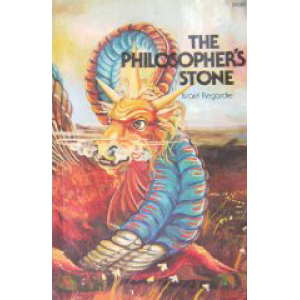
The Philosophers Stone

The Philosophers Stone Cover

Book: The Philosophers Stone by Israel Regardie

My book has been praised as a good meaningful book by some reviewers and by many readers, to judge from the mail I have received during the past thirty years. It is patently an open sesame to one level of interpretation. The Occult Review, now defunct, published a critical review by Archibald Cockren who took me rather severely to task for asserting that alchemical texts should be interpreted solely in terms of psychological and mystical terms. He himself, I subsequently discovered, had written a book Alchemy Rediscovered and Restored. Of course I immediately procured a copy. Since I was peeved by his review, I did not feel that his book had very much to offer—so I dismissed both offhand. I was about to write the editor of The Occult Review a scorching letter, but reason intervened so that fortunately it never got written.

The opportunity is rarely given to an author in his lifetime “to eat crow” and to enjoy it. This lot, it pleases me to say, is mine—after thirty years. Not that I would significantly change much of what I wrote then. I admitted that I had not “proceeded to the praxis” but I felt then and still do that a mystical and psychological interpretation of some alchemical texts was legitimate. There is unequivocally this aspect of the subject. Certainly Jacob Boehme and Henry Khunrath, for example, cannot be interpreted except in these terms.

The Philosophers Stone with these preliminary comments, should answer a wide-felt need which has called forth this new edition. I hope, being in print once more, it will bring new light and knowledge and values to present-day students who may be still groping in the dark areas of the occult towards alchemy, where a guiding hand needs to be extended.
So, to close this Introduction, I must use the ancient Rosicrucian greeting, and the close of a Golden Dawn ritual:
May what we have partaken here sustain us in our search for the Quintessence; the Stone of the Philosophers, True Wisdom and perfect Happiness, the Summum Bonum.


Download Israel Regardie's eBook: The Philosophers Stone

Free eBooks (Can Be Downloaded):

Yogi Ramacharaka - Yogi Philosophy
Louis Claude De Saint Martin - Theosophic Correspondence
Andrew Lang - The Witch And Other Stories
John Mitchell - The Philosophy Of Witchcraft
Israel Regardie - The Philosophers Stone

Thursday, July 29, 2010

Your Magical Name

Your Magical Name Cover Why a Magical Name?:
Ah, the magical name. So many people find wicca and decide right off the bat that they’re going to name themselves Lady Such-and-Such or Lord Whatsis. Go to a pagan event and you’ll meet more fifteen-year-old Lady Morganas than you can shake a stick at. And it’s virtually guaranteed that within about three months, Lady Morgana will decide her magical name, sometimes called a craft name, is really supposed to be Starfluffle or Moongypsy, and she’ll change it.

In fact, she’ll probably change it two to three times a year.

The Name-of-the-Month Club:
This odd phenomenon, known as the Name-of-the-Month Syndrome, happens most often because the person in question hasn’t taken the time to research and learn, which is crucial to finding the right magical name.

A magical name is unique to the practitioner, and there are several ways to find yours. When you find the right name, you’ll keep it for a long time. In some traditions, it‘s customary to wait until you‘ve studied a year and a day before claiming your magical name. Some Pagans have two magical names -- one which they use in public and one which is known only to the gods and members of the person’s coven.

Think Long-Range:
One method by which people sometimes find their magical name is to simply choose something they like. A problem with this method is that what we like on one day, we may find silly a year down the road. If you’re going to choose a name based on whether it sounds cool or not, stop and think about it. What is it about the name that appeals to you? Ten years from now, are still going to feel comfortable saying, “Hi, I‘m Fairypuddle,” when you meet a new person?

Names with Meaning:
Choose a name not only for its sound, but its attributes as well. For example, someone wishing to convey strength in their name might include “oak“ or “iron“ as part of their moniker. A person who is highly creative might select a name that reflects their art or craft. You may want to choose a name based rooted in folklore or mythology. Many people include the name of an animal that resonates with them. A cautionary note here: in the Pagan community, certain animals pop up all the time. You’ll meet two dozen Ravens and just as many Cats, but it’s unlikely you’ll encounter anyone calling himself Wombat or Penguin.

Names to Avoid:
Another bit of advice -- generally, the titles Lord and Lady are reserved for people who are elders or have a significant amount of leadership experience under their belt. To name oneself Lady So-and-So without any credentials is considered presumptuous by many Pagans. Likewise, in many traditions it’s seen as hubris to give oneself the name of a deity. You may want to choose a name that indicates your dedication to a god or goddess, but don’t co-opt their names. It’s just rude. If you're a dedicant to Apollo, don't call yourself Master Apollo, call yourself something like Apollonius instead.

Using Your Birth Number:
Another popular method of finding a magical name is to choose one that corresponds with your birth number. To find your birth number, begin by adding the digits of your birth date.

If your birthday was September 1, 1966, you would start with the numbers 911966 = 9 + 1 + 1 + 9 + 6 + 6 = 32.

Now take those two numbers (3 and 2), and bring it down to a single digit: 3 + 2 = 5. That number -- in this case, 5 -- is your birth number.

Use the grid below to find a name that corresponds to the number 5, by calculating the sum of the corresponding letters.

1 = A, J, S

2 = B, K, T

3 = C, L, U

4 = D, M, V

5 = E, N, W

6 = F, O, X

7 = G, P, Y

8 = H, Q, Z

9 = I, R

Let’s say you’ve decide you like the name Willow. Using the letters in “Willow” you would take the numbers 5 + 9 + 3 + 3 + 6 + 5 = 32. From there, 3 + 2 = 5. If the name you like doesn’t match your birth numbers, try some creative or alternate spellings to see what happens.

A Gift from the Gods:
In some cases, you may be fortunate enough to have your new name bestowed upon you by a god or goddess. In these instances, you may encounter someone in a dream or a vision who tells you, “Your name is Such-and-such.” While you may choose to add to it or come up with a variation on it later, if this happens to you, accept the name as the gift that it is.

Whatever method you end up using, think carefully before you finalize your new name. While it’s okay to change your name later on as you evolve spiritually, changing your name every few weeks or every time you see a new episode of “Charmed” is probably not the best course of action. Find the name that is right for you -- and when it IS the right one, you will know.


Books You Might Enjoy:

Anonymous - Meditation Of The Four Magickal Weapons
Jarl Fossum - Seth In The Magical Texts
Anonymous - The Mystical Qabbalah
Kenneth Grant - Magical Revival
Aninymous - The Angelical Alphabet

Friday, July 23, 2010

Who Burned The Witches

Who Burned The Witches Cover The 30,000 to 50,000 casualties of the European witch-hunts were not distributed uniformally through time or space, even within particular jurisdictions. Three-quarters of Europe saw not a single trial. witch persecution spread outward from its first center in alpine Italy in the early 15th century, guttering out in Poland, where witchcraft laws were finally repealed in 1788. The center had generally stopped trying witches before the peripheries even started.

The Spanish Road stretching from Italy to the Netherlands was also a "witch-road." The Catholic-ruled Spanish Netherlands (today's Belgium) saw far worse persecutions than the Protestant-ruled United Provinces of the Netherlands, which had stopped burning convicted witches by 1600. There were early panics in the German cities of Brandenburg and Mecklenburg, as well as in Lorraine, France, and parts of Switzerland and Scotland. The Rhineland and Southwest Germany suffered severe outbreaks, with German ecclesiastical territories hit hardest. Three-quarters of all witchcraft trials took place in the Catholic-ruled territories of the Holy Roman Empire. But Catholic Portugal, Castile and Spanish-ruled Italy, and the Orthodox lands of Eastern Europe saw virtually none. The panic in Salem, Massachusetts, was as bad as anything in England, but there seem to have been no executions in the Latin colonies of the New World.

The regional tolls demonstrated the patchwork pattern of witch-hunting. The town of Baden, Germany, for example, burned 200 witches from 1627 to 1630, more than all the convicted witches who perished in Sweden. The tiny town of Ellwangen, Germany, burned 393 witches from 1611 to 1618, more than Spain and Portugal combined ever executed. The Catholic prince-bishop of Wurzburg, Germany, burned 600 witches from 1628 to 1631, more witches than ever died in Protestant Sweden, Norway, Finland, and Iceland combined. The Swiss canton of Vaud executed about 1,800 witches from 1611 to 1660, compared with Scotland's toll of between 1,300 and 1,500 and England's toll of 500. The claim of some Catholic apologists that Elizabeth I executed 800 witches a year is gross slander. In Southwest Germany alone, 3,229 people were executed for witchcraft between 1562 and 1684 -- more than were executed for any reason by the Spanish, Portuguese, and Roman Inquisitions between 1500 and 1800. (All three of these Inquisitions burned fewer than a dozen witches in total.)

The most-dreaded lay witch-hunter was Nicholas Remy, attorney general of Lorraine, who boasted of sending 900 persons to the stake in a single decade (1581-1591). But the all-time grand champion exterminator of witches was Ferdinand von Wittelsbach, Catholic prince-archbishop of Cologne, Germany, who burned 2,000 members of his flock during the 1630s.

Let no one argue that witch-hunting was a predominantly Protestant activity. Both Catholic and Protestant lands saw light and heavy hunts. Demonologists and critics alike came from both religious camps.


Books You Might Enjoy:

Ralph Blum - The New Book Of Runes
Marian Green - A Witch Alone
Tarostar - The Witchs Spellcraft Revised
Margaret Alice Murray - God Of The Whitches

Wednesday, July 21, 2010

Spells For The Solitary Witch

Spells For The Solitary Witch Cover

Book: Spells For The Solitary Witch by Eileen Holland

This book "Spells for the Solitary Witch" focuses on spells and spell work specifically for the Solitary Practitioner. Clear and easy to follow, Spells for the Solitary Witch explains how to prepare and cast spells 87 spells in all together with the materials needed for each spell and the incantations to say that will ensure the best results. Tailored to the needs of solitary witches, Holland suggests alternatives to hard-to-find ingredients, as well as directions about where to find specific ingredients crucial to a spells success.

Written by a solitary witch and Wiccan priestess herself, Spells For The Solitary Witch is a simple walkthrough of ways to release hidden power for health, wellness, emotional enrichiment, and environmental harmony. Chapters discuss magick and its applications in love, life enhancement, and problem solving, as well as magickal candle gardens, tea potions, and more. Detailed instructions, specific incantations, detailed how-to's down to where one can easily obtain sesame oil or Tiger Balm, and much more make Spells For The Solitary Witch ideal for novice and experienced spellcasters alike.

Again we are presented with Ms. Holland's easy to read and follow style of writing. She lays her book out according to the kind of spells you may want to do, and lists her spells according to what you want to accomplish when working your spells.

I have to say her opening section, entitled :Before you Begin" is exceptional in explaining basic spellwork, what it is, what is magic, ethics when working magic, personal responsibility and terminology. This is an excellent reference on it's own and should be suggested to all beginning spellworkers as a point of essential reference. I wish Ms. Holland would have expanded this section, as she did it so well, but it does stand on it's own as a very good overview.

The sections on actual spellworking are divided into seven chapters, covering "Inner Work, "Goals, Hopes, Wishes", "Love", "Life Enhancement", "Problem Solving", "Magickal Candle Gardens", and "Tea Potions".

Each section has a selection of spells for various situations. Under "Inner Work" we find spells for acceptance, getting over it, even personal power talisman, a tool for building self-confidence. Each spell has complete instructions and directions on how to use the spells for each intent. A list of needs is followed by preparation and the actual spell working, which may include an incantation, ritual, and sometimes an "afterward" or review of what should be the focus and how you should react to the spellworking. With the Talisman, she discusses creating these talisman, the proper signs for you, day workings and Correspondences, and all you would need to know to create and use a personal talisman.

Going forward into the various chapters, each chapter contains spells referencing the chapter title. In "Goals, Hopes, Wishes" we have spells for goals you wish to reach, spells for special wishes, interview charms; all with discussions on your intents to what you want to achieve and how to work the spell.

The "Love" section has workings for personal enhancement, to bring love into your life. The "Life Enhancement" chapter has spells for home blessings, abundance, fertility, joy, and protection to name a few. "Problem Solving" covers dealing with major mistakes, fearsome problems, problematic persons and hard times.

What I note in her spells is that when a spell calls for a "potion" as in her Tragedy Potion (for someone who has just encountered a tragedy in their life and you offer them this potion to help calm nerves and help them center and balance) the ingredients are noted and the appropriate cautions are given. In this case, she gives a recipe for a hot cup of cocoa, with some oil of peppermint. She notes "Note: this potion isn't for you if you are lactose-intolerant, allergic to chocolate or peppermint or have any medical reason that precludes its use." Wise words from a wise witch.

The book contains many notes of wisdom. "Magickal Candle Gardens" focuses on candle magic to assist persons in need. The garden is built indoors, containing candles arranged for your specific purpose and using candles of specific shapes and size depending on the needs. After going over the plans and the layout, it looks to be something even I would consider as a special magical working, being attractive, practical and very especially magical.

The last chapter is about "Tea Potions" specifically, and again, contains potions to work on yourself for specific situations you may encounter, such as personal health, luck, creativity and success to name a few. She works some of the potions with runes, others with chant. The only note I have here is that she did not repeat her good advice about being allergic to certain herbs, as most of these teas are herbal in their base. Please use your own digression when preparing these teas and if allergic, then look for a substitute.

Eileen Holland is a solitary eclectic witch, a Wiccan priestess who calls her path Goddess Wicca. She is the author of several books about magick and witchcraft, including Spells for the Solitary Witch and the best-selling The Wicca Handbook. Eileen is the webmaster of www.open-sesame.com, a popular long-running Wiccan web-site. She lives in upstate New York.

Buy Eileen Holland's book: Spells For The Solitary Witch

Downloadable books (free):

Anonymous - Welcome To The Secrets Of The Root Witch
Scott Cunningham - Wicca A Guide For The Solitary Practitioner
Shanddaramon - Self Initiation For The Solitary Witch

Tuesday, July 13, 2010

Crafty Witches

Crafty Witches Cover It’s a beautiful day, you’re walking through your local weekend market, and lo-and-behold, you spy the perfect “witchy” themed item that would look marvelous hanging above your altar. You whip out your pocket book only to have your vision dashed by a hefty price tag. If you’re anything like me, it’s a scenario you’re only too familiar with…but help is on the way!

The truth is, you don’t have to be a master woodcrafter or be able to knit with your eyes closed in order to make witchcraft or pagan themed items for your home. All you need is a few simple supplies, and a little bit of time…of course, if you have kids, you can cut the time in half by letting them help you.

If you follow these few simple steps, you’ll be amazed at what you can create, even if you think you’re hopeless at crafting anything!

The first step is to ask yourself “what would I like to make?”

There are countless websites out there that offer free crafting patterns, and crafting kits are also available for those who prefer the simpler approach. For the most part, patterns and kits are meant only for personal use…designers generally frown upon those who “copy and re-sell” their work, not to mention the karmic kickbacks of such actions can be harsh. Designers not only like to see their work enjoyed by others, but it’s also satisfying to know that their designs have inspired others to create their own similar, yet unique craft items. One thing designers do enjoy, is having a picture of the item they inspired you to create sent to them, along with a little note of thanks. It’s a small gesture that really goes a long way.

Okay, you’ve got an idea, now you need the materials. If you have your own backyard, craft materials may literally be “at your doorstep”. Twigs, leaves, flowers, feathers, vines, stones, etc., all of these things can be used. I’ve seen some incredibly life-like animals painted on large stones, and twigs and dried leaves incorporated into a woven wall hanging. If you live close to the beach, then you’ve got a literal treasure trove of craft materials at your feet…given they’re washed properly!

Op Shops are another invaluable resource for cheap craft materials. If you look, there’s usually a bin full of material scraps, wool, knitting needles, and craft books. Old wooden platters or bowls can be sanded down and repainted for altar tools; and if you have a really good look at what’s on the shelves, you may just find that goblet, bell, or “offering dish” that you’ve been searching for. Those old beanbag lap tables make wonderful and easily “hide-able” altars.

If it just so happens that you can afford to spend a little extra, then a trip to the craft shop is always a “pick-me-up”. From jewelry making to polymer clay and back again, even the most fussy of crafters can find what they need and then some.

Can’t afford the craft shop?

The Reject Shop and The Warehouse, along with most of the little “$2” shops, always have inexpensive acrylic, watercolor, and oil paint kits, as well as scrapbooking and other papercraft supplies. They even have unpainted wooden items now and then, it never hurts to keep checking back.

So you see, you don’t have to rush out and spend a fortune on that must have one of a kind item, when you can quite easily make your own “one of a kind” at home for half the price. Of course, if you can run out and spend…then by all means do so, just don’t forget that it’s a special kind of feeling you get when someone points out and admires something that you’ve created.


Books You Might Enjoy:

Michal Jerabek - The Book Of Enoch Vol I The Watchers
Aj Drew - A Wiccan Bible
Robert Anton Wilson - Prometheus Rising
Tarostar - The Witchs Spellcraft Revised
Marian Green - A Witch Alone

Thursday, July 1, 2010

The Earth Path Grounding Your Spirit In The Rhythms Of Nature

The Earth Path Grounding Your Spirit In The Rhythms Of Nature Cover

Book: The Earth Path Grounding Your Spirit In The Rhythms Of Nature by Starhawk

Fans and followers of Starhawk (The Spiral Dance; etc.), a founding member of the Reclaiming Tradition of Witchcraft, will welcome her latest offering. Well organized, each chapter contains reminiscences of personal and group experiences, exercises and suggestions for prayer and ritual. Many of her tenets apply not only to those interested in the practice of Wicca but to readers seeking a better Understanding of the world around them: "Once we have learned to hear, then we can begin to understand. And only after we understand do we begin to speak, to intervene." Yet she astutely cautions: "To change a drum rhythm in a group of drummers, you first have to match it and join with it. But when you are within a system, part of the whole, that system is also changing you. It is difficult to maintain your own rhythm and not simply become part of what you are trying to change." Starhawk presents an array of exercises and practices for sharpening observation and listening skills. She engages readers' spirits and minds through her illustrative storytelling, offering ways to communicate more fully with the world and suggesting ways to act. While those unfamiliar with her passion for protest may find themselves distracted by the all-too-frequent appearance of her political soapbox, they will appreciate her tools for connecting with nature.

This book represents Starhawk's return to that idea, resurrecting the feeling of living in harmony with the Earth and respecting Our Mother as we should. With this book, Starhawk wants to show us that we need to be more than just "aware".

The book looks at our connection with magic, the Four Elements we work with and how it relates to our beliefs and to the earth and its ecology. The book is filled With Stories of her recent workings. It discusses how we connect with each of the elements in nature and provides meditations on the earth, the elements and finding our own place of balance in this world. And all of this is deeply rooted in Goddess Spirituality.

This is a book on personal responsibility to protecting the earth's delicate ecology. This is a book on earth based spirituality. This book is about magic. This is a book about Starhawk and how she has been dealing with all these issues. This is a book about finding where you fit into this whole equation.

As I read through this book, I found myself agreeing with some of the material that Starhawk was discussing. I also found myself disagreeing on some points. This books intention is to raise personal response. As you read the material that Starhawk provides for the mediations and then work through the meditations, the idea is to reflect on your own connections to these ideas, and the workings are meant to provoke personal response. Each person's response will be different, though the material provided for meditation is meant to focus you on specific ideas.

There are many personal stories told by Starhawk about her recent involvement in political actions. Each of these stories, be it the fire protection ritual she is involved with in the opening of the book, or her research about genetically engineered seeds and the World Trade Organization, we see Starhawk's view on personal responsibility carried to many different levels. While there is much here that should be reviewed and her resources for the information provided is extensive (her Select Bibliography is impressive as well) it is up to the individual as to how this affects each of us and how involved we want to be with the processes that Starhawk discusses.

This is a book that combines Starhawk's personal path of spirituality with her own personal path of ecological responsibility. Those who are not familiar with these issues will find that this book can be used as a handbook for personal exploration. It is a book of awareness of the kinds of issues that many of us should at least be familiar. There are many issues addressed here that makes this a good book of information, even though it may seem a bit extreme at times. If you remember how passionate Starhawk is about her chosen path, you can then understand the extremities. This book does allow for you to find your own small part in how all this plays out; you need not be as involved as Starhawk, but you may also find yourself provoked to action by the information provided.

This book is one that should be carefully read, openly discussed, and as you meditate upon the information provided, you will need to know the scope of your own abilities and how deeply your personal responsibility for the issues flows. This book may help you find this.

This is a very good look at Starhawk's recent path of earth based spirituality and responsibility for the earth, and one that every follower of Starhawk's path will want to read.

Buy Starhawk's book: The Earth Path Grounding Your Spirit In The Rhythms Of Nature

Downloadable books (free):

Pt Shriram Sharma Acharya - The Eternity Of Sounds And The Science Of Mantras
Michael De Molinos - The Spiritual Guide The Rich Treasure Of Internal Peace
Johannes Trithemius - The Art Of Drawing Spirits Into Crystals
Frater Achad - The Egyptian Revival Or The Ever Coming Son In The Light Of The Tarot

Saturday, June 26, 2010

The 13 Principles Of Wiccan Belief

The 13 Principles Of Wiccan Belief Cover 1.We practice rites to attune ourselves with the natural rhythm of life forces marked by the phases of the Moon and the seasonal Quarters and Cross Quarters.

2.We recognize that our intelligence gives us a unique responsibility toward our environment. We seek to live in harmony with nature in ecological balance offering fulfillment to life and consciousness within an evolutionary concept.

3.We acknowledge a depth of power far greater than that apparent to the average person. Because it is far greater than ordinary it is sometimes called ‘supernatural’, but we see it as lying within that which is naturally potential to all.

4.We conceive of the Creative Power in the universe as manifesting through polarity – as masculine and feminine – and that this same Creative Power lies in all people and functions through the interaction of the masculine and the feminine. We value neither above the other knowing each to be supportive of the other. We value sex as pleasure as the symbol and embodiment of life, and as one of the sources of energy used in magical practice and religious worship.

5.We recognize both outer worlds and inner, or psychological worlds sometimes known as the Spiritual World, the Collective Unconsciousness, the Inner Planes etc – and we see in the interaction of these two dimensions the basis for paranormal phenomena and magical exercises. We neglect neither dimension for the other, seeing both as necessary for our fulfillment.

6.We do not recognize any authoritarian hierarchy, but do honor those who teach, respect those who share their greater knowledge and wisdom, and acknowledge those who have courageously given of themselves in leadership.

7.We see religion, magick and wisdom in living as being united in the way one views the world and lives within it – a world view and philosophy of life which we identify as witchcraft – the Wiccan Way.

8.Calling oneself ‘Witch’ does not make a Witch – but neither does heredity itself, nor the collecting of titles, degrees and initiations. A Witch seek to control the forces within her/himself that make life possible in order to live wisely and without harm to others and in harmony with nature.

9.We believe in the affirmation and fulfillment of life in a continuation of evolution and development of consciousness giving meaning to the Universe we know and our personal role within it.

10.Our only animosity towards Christianity, or towards any other religion or philosophy of life, is to the extent that its institutions have claimed to be ‘the only way’ and have sought to deny freedom to others and to suppress other ways of religious practice and belief.

11. As American Witches, we are not threatened by debates on the history of the craft, the origins of various terms, the legitimacy of various aspects of different traditions. We are concerned with our present and our future.

12.We do not accept the concept of absolute evil, nor do we worship any entity known as ‘Satan’ or ‘the Devil’ as defined by Christian tradition. We do not seek power through the suffering of others, nor accept that personal benefit can be derived only by denial to another.

13.We believe that we should seek within Nature that which is contributory to our health and well-being.

Free eBooks (Can Be Downloaded):

Michael Harrison - The Roots Of Witchcraft
Anonymous - Basic Principles Of The Craft
Howard Williams - The Superstitions Of Witchcraft

Thursday, June 24, 2010

Moon Facts

Moon Facts Cover The origins of the Moon are not yet known, and are still open to debate. Among the many theories scientists suggest the following: that it was split from the Earth; that it was a separate body captured by the Earth’s gravity; that it formed in orbit around Earth; or that it was formed from debris thrown off when another body the size of Mars struck Earth.

The Moon’s composition is rocky with a surface heavily scarred by meteorite impacts that have formed craters up to 240 km (150 mi) across. Seismic observations indicate that the Moon’s surface extends downwards for tens of kilometres; below this crust is a solid mantle about 1,100 km thick, and below that a silicate core, part of which may be molten. Rocks brought back by astronauts show the Moon is 4.6 billion years old and about the same age as Earth. It is made up of the same chemical elements as the Earth, but in different proportions, and differs from Earth in that most of its surface features were formed when hit repeatedly by meteorites within the first billion years of its history. The youngest craters on the moon are surrounded by ejected rock, while the largest scars have been filled by dark lava to produce the lowland plains called seas. It is these dark patches that form the so-called “man-in-the-Moon” patterns.

The moon is the Earth’s only natural satellite and is about a quarter of its size. It takes the moon about 27.3 days to revolve around Earth, during which it travels an average distance of 384,000 km.

There are approximately 13 Full Moons in a calendar year, which on average rise about 51 minutes later each proceeding day. As a general guide to when the moon rises an old traditional saying states: “The New Moon rises at sunrise, the first quarter at noon, the Full Moon rises at sunset and the last quarter at midnight”.

Because of a loss of orbital energy due to gravity from the Earth, the Moon is gradually moving away from the Earth. In the early history of the Earth, the Moon would have looked about 3 times larger in the sky because it was closer to the Earth.

The Moon has almost no atmosphere and because of its weak gravity, all types of gases escape from its surface. Without atmosphere there is no wind or water erosion, which makes the moons surface about the same now as it was 3 billion years ago. In July 1969 when Neil Armstrong and Edwin (Buzz) Aldrin the first astronauts to walked on the moon left their footprints, little would they have realised that their footprints would remain unchanged on its surface for the next 10 million years.

The surface temperature of the moon fluctuates from roughly +300° F during it’s 2-week daytime periods, to -270 F during it’s 2-week night time periods. This is because there is not enough atmosphere to keep the moon warm at night, or to protect it from the Suns rays in the daytime.

The moon causes many of the tides in the Earth’s oceans. This is because of the gravitational force between the Earth and Moon. At Full Moon and New Moon, the Sun, Earth and Moon are lined up, which produces higher than normal tides (called spring tides or high tides). When the Moon is at its first or last quarter, smaller neap tides form (a tide that shows the least range between high and low tides).

Though several flags of the United States have been symbolically planted on the moon, the U.S. government makes no claim to any part of the Moon’s surface. The U.S. is party to the “Outer Space Treaty”, a universal agreement that places the Moon under the same jurisdiction as International Waters. This treaty also restricts the use of the Moon to peaceful purposes, and specifically bans weapons of mass destruction (including nuclear weapons) as well as military installations. A second treaty called the “Moon Treaty” also proposed to restrict the exploitation of the Moon’s resources by any single nation, but so far this has not been signed by any of the major nations involved with space exploration.

Books in PDF format to read:

Edna Kenton - The Book Of Earths
Aristotle - On Dreams
Austin Osman Spare - A Book Of Satyrs

Popular Posts